Can Handloom, Repair and Recycling Outlast the Greenwashing?
India’s sustainable-fashion conversation is moving beyond natural fabrics and earthy colour palettes. The more consequential questions are about what a garment is made of, how it is produced, how long it lasts, what happens when it is discarded—and whether a brand can prove its environmental claims.
The distinction matters in a country with a deep textile heritage and a large modern apparel industry. Handloom weaving, mending, reuse and the transformation of old textiles are not new ideas here. What is new is the need to connect those practices with transparent supply chains, measurable environmental performance and consumer protection.
A garment does not become sustainable simply because it is beige, carries a leaf-shaped logo or arrives in a recycled-looking box. Sustainability is a matter of evidence, not styling.
India’s textile challenge is also an opportunity
The scale of the issue is significant. A Ministry of Textiles study released in March 2026 estimated that India generates approximately 70.73 lakh tonnes of textile waste annually. The same government release said that more than 95% of pre-consumer textile waste is recovered, while identifying further opportunities to improve recycling and circularity. These figures point to both sides of the story: India already has substantial textile-recovery activity, but the overall waste challenge remains considerable. Source: Ministry of Textiles, Government of India
The opportunity is not limited to turning discarded cloth into fashionable accessories. Better sorting, fibre recovery, repair, resale, reuse and designing products to last can help retain material value for longer. They can also create work across collection, alteration, recycling and manufacturing.
India’s traditional textile ecosystem offers a useful foundation. Handloom clusters and craft communities hold specialised knowledge of weaving, dyeing, embroidery and fabric construction. But heritage alone is not proof of environmental performance. A craft may preserve skills and livelihoods while still facing challenges involving water, energy, chemical inputs, working conditions or waste.
The task is to protect the knowledge—and improve the systems around it.
The first test: will the garment last?
“Timeless”, “investment piece” and “slow fashion” are attractive phrases. They are not, by themselves, evidence of durability.
A garment designed for long use needs sound construction, suitable fabric, reliable stitching and a fit that works beyond a single occasion. Details such as reinforced stress points, quality seams and sufficient allowance for alterations can make a practical difference. So can access to repair.
Consumers can ask simple questions: Can the garment be altered? Are spare buttons available? Does the brand offer repairs? Is the fabric likely to withstand repeated washing? Are care instructions clear?
A high price does not guarantee a long life. Nor does a classic silhouette. If a garment loses its shape after a few washes, its “heirloom” ambitions may have been rather short-lived.
The most sustainable garment is not automatically the one with the most elaborate sustainability story. It may be the one already hanging in your wardrobe—provided it still fits, functions and gets worn.
Natural fibres and dyes need more than a green label
Cotton, linen, wool and other natural fibres can be part of a lower-impact wardrobe, but the word natural is not a complete environmental assessment. The impact of a textile depends on its cultivation or sourcing, processing, dyeing, finishing, transport, use and end-of-life treatment.
The same caution applies to natural dyes. Plant-based colourants can support traditional knowledge and offer alternatives to some synthetic dyeing processes. But “natural” does not mean “pollution-free”. Water consumption, mordants, processing methods and wastewater treatment all matter. Poorly managed dye effluent can still harm local water systems.
A credible producer should be able to explain what is used, where processing takes place and how wastewater is handled. Where a brand makes a comparative claim—such as using less water or causing less pollution—it should identify the basis for that comparison.
For shoppers, the useful question is not simply, “Is this naturally dyed?” It is, “What does the maker disclose about the dyeing process and its environmental controls?”
Greenwashing: when the story is greener than the product
The term greenwashing describes environmental claims that are false, misleading, vague or unsupported. In fashion, it can take many forms: a small recycled component presented as if the whole garment were sustainable; an “eco-conscious” label with no explanation; or a promise of future environmental action without a clear plan.
India has taken steps to address the problem. The Advertising Standards Council of India (ASCI) introduced guidelines for environmental and green claims, effective February 15, 2024. They call for claims to be specific and substantiated, and for broad claims such as “sustainable” or “environment-friendly” to be supported by robust data or credible accreditation. The guidelines also caution against presenting a benefit from only one part of a product as if it describes the entire product.
In October 2024, the Central Consumer Protection Authority issued guidelines on the prevention and regulation of greenwashing and misleading environmental claims. These measures make transparency more than a public-relations preference: environmental claims need to be meaningful, supported and clear to consumers.
One statistic deserves particular care. A frequently repeated figure says that more than half of environmental claims in India are unsubstantiated. A 2014 academic study did find that 51.7% of the green claims in its sample were classified as greenwashed. But that study is historical and does not establish that 50–60% of current Indian fashion brands—or their claims—are misleading. Treating it as a current fashion-industry measurement would overstate what the research proves.
That distinction is important. Greenwashing should be scrutinised, but criticism itself must meet the same standard of evidence expected from brands.
Circular fashion: make, mend, reuse—and then recycle
Circularity means keeping materials in use for as long as possible. In practice, that can begin with a straightforward action: repairing a loose seam rather than discarding a garment.
Other approaches include resale, swapping, upcycling and recycling. They are not interchangeable. Repair and reuse can extend a garment’s useful life with relatively little transformation. Upcycling converts material into another product, while fibre-to-fibre recycling attempts to recover material for new textiles. Each process has different technical and environmental demands.
India’s existing textile-recovery networks provide a foundation, while policy initiatives are encouraging further investment in recycling and circular production. The Ministry of Textiles’ 2026 work on mapping the textile-waste value chain and its Tex-Eco Initiative reflect a growing focus on waste management, recycled fibres and value addition.
For brands, the meaningful test is whether circularity is built into regular operations or confined to a limited capsule collection. For consumers, a take-back programme is worth examining: What happens to the returned clothes? Are they resold, repaired, recycled or discarded? Is the process explained clearly?
“Zero waste” is an especially sweeping promise. Unless the claim is carefully defined and supported, it can hide the difference between reducing waste in one product line and eliminating waste across an entire business.
What should shoppers look for?
A consumer does not need to become a textile scientist before buying a kurta, sari or jacket. A few practical checks can help separate useful information from green-sounding language.
-
Look for specifics: Which material is certified, recycled, organic or locally sourced—and what proportion of the product does it represent?
-
Check the evidence: Is a certification named? Can its scope and validity be verified?
-
Ask about durability: Are construction, care, repair and alteration options explained?
-
Look beyond the fabric: Does the brand discuss dyeing, finishing, packaging and supply-chain practices?
-
Treat broad claims cautiously: “Conscious”, “planet-friendly” and “eco-luxury” are not substitutes for measurable information.
-
Buy for use, not just virtue: A garment that is rarely worn may deliver little practical value, whatever its label says.
Brands, meanwhile, can build trust by publishing clear sourcing information, identifying manufacturing partners where possible, explaining the limits of their claims and reporting measurable progress. Independent verification can strengthen that trust, particularly when claims concern emissions, water use, chemical management or labour conditions.
DOONITED View: sustainability must survive the washing machine
India does not need to choose between its textile heritage and modern fashion. It can draw on traditional skills while investing in better materials, cleaner processing, durable design and stronger recovery systems.
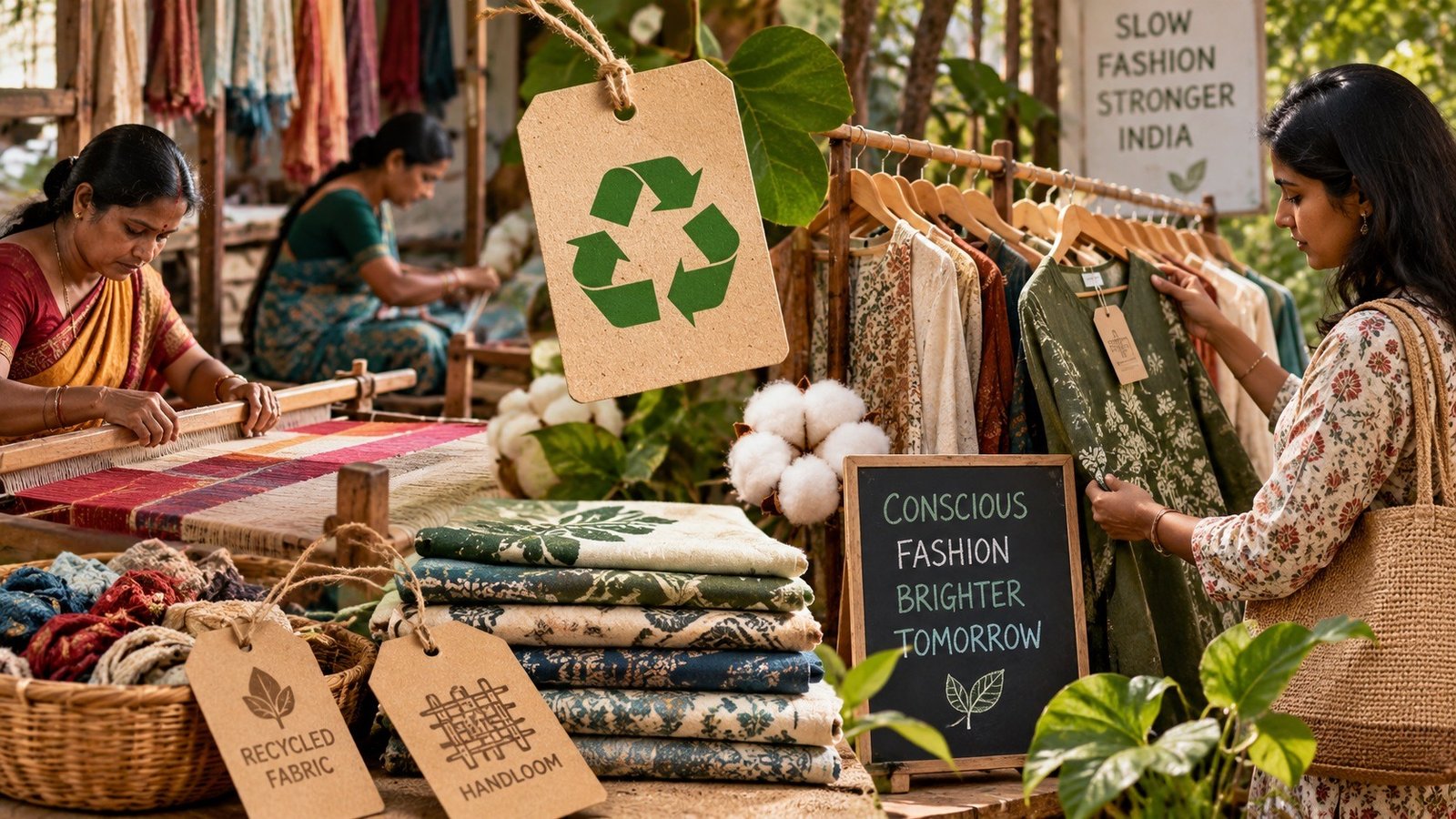
But the industry should resist turning sustainability into another seasonal aesthetic. A handloom label cannot answer every question about impact. A recycled-fabric tag cannot tell the whole story. And a campaign featuring artisans is not the same as transparent information about wages, working conditions or the supply chain.
The real test is whether a brand can explain its claims in plain language—and show evidence when asked. Regulators can set expectations, researchers can measure outcomes, and consumers can reward credible practice. None of these can do the job alone.
The future of sustainable Indian fashion will be shaped not just by what designers create, but by what brands disclose, what manufacturers improve and what customers choose to keep wearing.
Learning Point
Before buying “sustainable” fashion, ask three questions: What exactly makes it lower-impact? What evidence supports that claim? And will I use it for years? If a brand can answer clearly, the label becomes useful. If it cannot, the green wording may be doing more work than the garment.


World Beyond the News
Bees Communicate Where Food Is
Honeybees use movement patterns known as waggle dances to communicate information about food locations.
Street Food Reflects Local History
Many famous street foods developed from migration, trade, local ingredients and the everyday needs of working communities.
A Day on Venus Is Extremely Long
Venus rotates so slowly that one rotation relative to distant stars takes longer than its trip around the Sun.
Human Achievement Continues to Push Limits
Athletes, engineers, scientists and explorers regularly establish new benchmarks in speed, endurance, scale and precision.