When Algorithms Shape Your Wardrobe
Once upon a time, fashion inspiration arrived through glossy magazines, television, shop windows and perhaps a particularly well-dressed neighbour.
Today, it can arrive while you are scrolling through your phone at 11:47 p.m.
A recommendation engine notices what you searched for. A creator demonstrates a particular look. An algorithm connects that behaviour with products. A personalised feed presents another version of the same aesthetic. And, increasingly, technology tries to shorten the distance between “I like that” and “I bought that.”
The Indian fashion industry is entering an era in which technology is no longer simply the machinery behind e-commerce.
It is becoming part of fashion discovery itself.
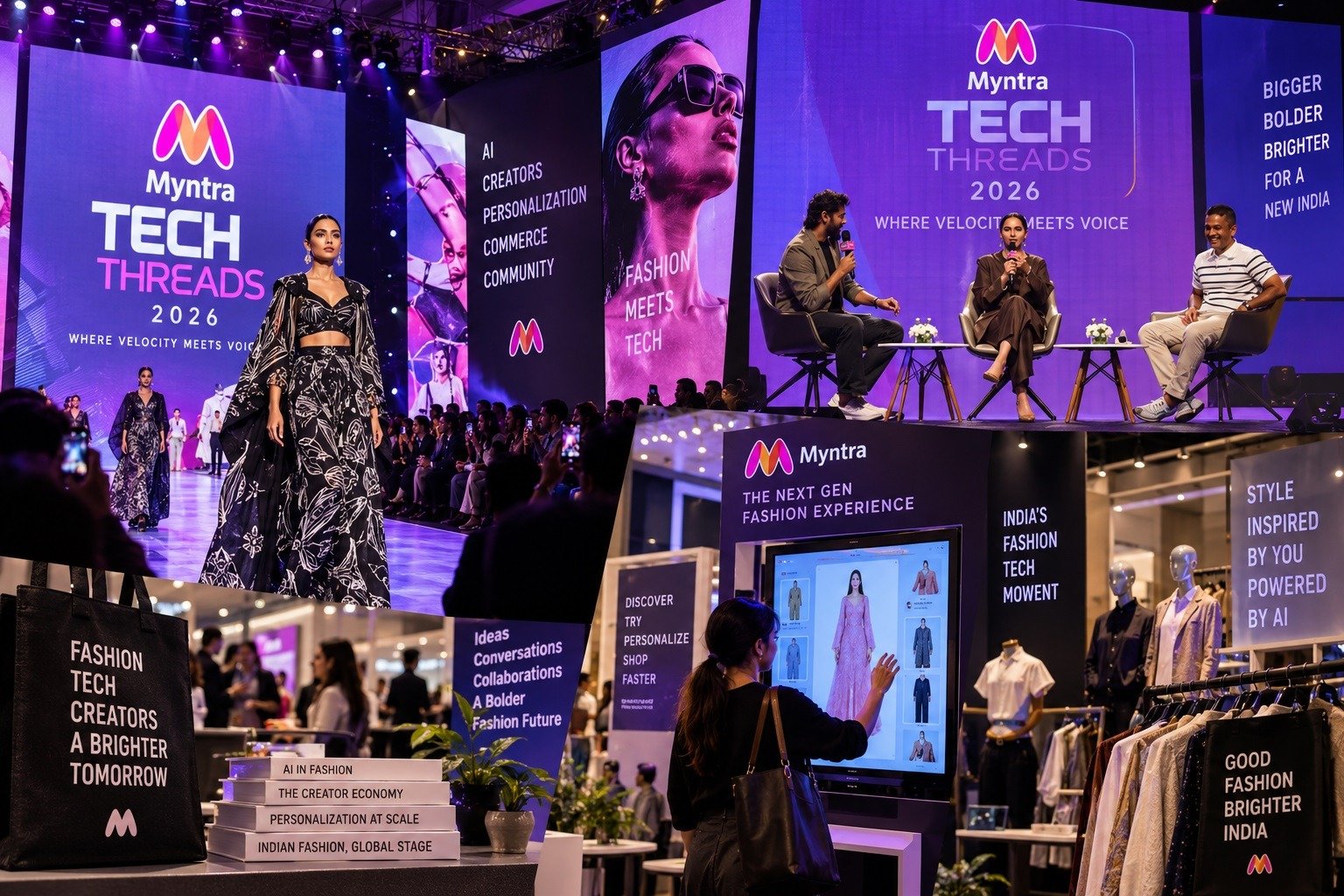
That was one of the central ideas behind Myntra Tech Threads 2026, held in Bengaluru on August 21 under the theme “Where Velocity Meets Voice.” The event brought fashion and lifestyle brands, technology, creators and cultural voices together to examine faster trend cycles, changing consumer behaviour and new approaches to brand building.
And beneath all the talk of AI, creators and speed sits a fascinating question:
Who discovers the trend first — the person, the creator or the algorithm?
Increasingly, the answer is: all three.
Fashion Has Become a Data Conversation
Fashion has always responded to society.
What people wear reflects music, cinema, sport, politics, geography, social movements and economics. Technology has not removed those influences. Instead, it has created a much faster feedback loop.
A consumer searches for a particular style.
Thousands of other consumers may be doing something similar.
Creators publish looks.
Platforms observe engagement.
Brands receive signals about what people are responding to.
Products can then be promoted, modified, produced or delivered faster.
At Tech Threads, the conversation around “velocity and voice” specifically examined how real-time consumer signals, creator engagement and technology-led supply chains are becoming important to modern brand building.
That is a significant change from the traditional fashion calendar.
Instead of waiting for a trend to travel from runway to magazine to retail store, the cycle can now happen through a phone screen in days — sometimes hours.
Fashion has discovered the refresh button.
Your Search Box Is Becoming a Stylist
One of the most visible changes is the transformation of online search.
Traditional e-commerce search expects something like:
“black oversized shirt.”
The newer model increasingly understands something closer to:
“I need something smart but relaxed for a dinner.”
Myntra’s technology ecosystem includes conversational discovery through Maya, along with AI styling assistance, precision sizing and concept-based recommendations. The company has previously developed tools such as MyFashionGPT and MyStylist to make fashion discovery more conversational and personalised.
That sounds like a small interface improvement.
It is actually a significant change in how people interact with fashion commerce.
The customer does not necessarily have to know the technical name of a garment.
They can describe an occasion, a mood or a desired look.
The technology then attempts to translate that human language into products.
The search box is slowly acquiring stylist ambitions.
From Catalogue to Culture
Perhaps the biggest shift is happening outside the traditional shopping interface.
Creators have become part of the discovery process.
A fashion creator wearing a particular combination of trousers, sneakers and jewellery can turn a collection of individual products into a style idea.
That idea can then travel through Instagram, YouTube and other social platforms before leading back to commerce.
Myntra launched its Ultimate Glam Clan Affiliate programme in 2026 with an ambition to enable one million creators to participate in India’s digital commerce ecosystem. The company said creator-led commerce contributed about 10% of its revenue, according to reporting in May.
This matters because creators do something an ordinary catalogue cannot.
They provide context.
A catalogue says:
Here is a jacket.
A creator says, in effect:
Here is how I would wear this jacket.
That second proposition is often much closer to how humans actually make fashion decisions.
Glamstream: When Inspiration Becomes Shopping
Tech Threads also highlighted Glamstream, Myntra’s inspiration-led experience that brings shoppers, influencers and culture together.
The idea reflects a broader change in online fashion: consumers increasingly discover products through content rather than deliberately entering a shopping journey.
A person may not open an app thinking:
“Today I shall purchase a pair of trousers.”
They may open it because they are bored.
Then they see an outfit.
Then a similar outfit.
Then another.
And suddenly boredom has become a shopping basket.
Glamstream and related social-commerce approaches attempt to connect that inspiration directly with discovery and purchasing.
The distinction between content and commerce is therefore becoming increasingly thin.
Speed Has Become a Fashion Feature
Technology is also changing what consumers expect after discovering something they want.
The fashion industry used to compete heavily on design, brand, price and distribution.
Now it increasingly competes on speed.
Myntra’s M-Now is part of this push toward faster fulfilment, while the company has also highlighted technology-enabled hyperlocal delivery.
That creates an interesting consumer expectation.
If a trend appears on your screen today, why should the product arrive next week?
The answer, increasingly, is: perhaps it shouldn’t.
This is one reason fashion is becoming connected to the same expectations that transformed food delivery and quick commerce.
Discovery is getting faster. Decision-making is getting faster. Delivery is getting faster.
The danger is obvious too.
The faster the cycle becomes, the easier it is for consumers to buy something they wanted for five minutes and may not want for five months.
AI Is Moving Behind the Curtain
Not all the technology is visible to shoppers.
A considerable part of the transformation is happening inside the businesses themselves.
Myntra has been expanding AI across search, styling, seller operations and supply-chain processes. The company has said AI is being used to personalise search, generate product content and improve operational efficiency. Business Standard reported in July that AI had helped reduce seller onboarding time substantially, while the company was also using AI in product videos, search and supply-chain simulation.
At Tech Threads, Myntra also showcased an AI-Powered Brand Stack, designed to shorten some design and brand-development processes, alongside its Mitra partner application.
This could change the economics of fashion for smaller brands.
A young Indian label does not necessarily need the infrastructure of a multinational company to experiment with new collections, understand customer signals or produce digital content at scale.
Technology can lower some of those barriers.
But it does not eliminate the need for good design.
An algorithm can identify demand.
It cannot automatically create taste.
The Indian Advantage: A Very Complicated Wardrobe
India presents an especially interesting test for fashion technology.
The country does not have one fashion market.
It has hundreds of overlapping ones.
A consumer in Mumbai may move between western wear, Indian occasion wear, streetwear, athleisure and regional influences within the same month.
A wedding in Jaipur has different fashion requirements from a college campus in Bengaluru.
A festive wardrobe in Chennai cannot simply be treated as a copy of one in Delhi.
And India’s enormous linguistic and cultural diversity makes the problem even more complicated.
This is where data can help brands understand demand at a level of detail that traditional national advertising could not easily provide.
But technology also has to learn something equally important:
India is not a spreadsheet.
Numbers can identify a pattern.
Culture explains why the pattern exists.
The Rise of the Micro-Trend
Traditional fashion worked through relatively large seasonal movements.
Digital fashion increasingly works through micro-trends.
Y2K aesthetics, streetwear, sport-inspired fashion, specific colours, silhouettes and creator-led looks can rise quickly and disappear just as quickly.
Tech Threads’ THE PULSE OF NOW runway explicitly explored this phenomenon, including themes such as Y2K styling, streetwear, sport-chic, contemporary South Asian design and modern festive wear.
The important point is not that Y2K has returned — apparently fashion has once again decided that the early 2000s were a good idea.
The important point is that digital platforms can accelerate the movement from cultural signal to commercial product.
But Algorithms Have Limits
There is a temptation to describe personalisation as though technology has finally solved fashion.
It has not.
Recommendation systems can reinforce existing preferences.
They can also make everyone see versions of the same thing.
If an algorithm learns that a consumer likes one aesthetic, it may keep showing increasingly similar products. Personalisation can therefore become a form of digital fashion tunnel vision.
There is also the question of sustainability.
Faster discovery and faster fulfilment can encourage more consumption. If trends become disposable, wardrobes can become disposable too.
That creates a genuine tension for the fashion industry:
Can technology make fashion more relevant without making fashion more wasteful?
The answer will depend on how brands use the technology.
Better demand forecasting can potentially reduce overproduction.
Better sizing can potentially reduce returns.
Smarter inventory management can potentially reduce unnecessary movement of products.
But faster trend cycles can push in the opposite direction.
Technology itself is neither sustainable nor unsustainable.
Its impact depends on the system it is optimising.
The New Fashion Brand Needs a New Skill Set
The Tech Threads discussions also point towards a changing definition of a fashion brand.
A successful brand increasingly needs to understand:
- design;
- consumer data;
- creators;
- social commerce;
- AI;
- supply chains;
- fulfilment;
- content;
- community;
- and cultural relevance.
That is a considerable list.
The old fashion question was:
“Does it look good?”
The new question is closer to:
“Does it look good, travel well through culture, get discovered digitally, fit correctly, arrive quickly and give consumers a reason to talk about it?”
The fashion designer has acquired quite a few colleagues.
Some of them write code.
What This Means for Indian Fashion
For Indian brands, this transformation could be particularly significant.
Technology gives emerging D2C labels access to consumers beyond their immediate geography. Myntra says its ecosystem includes more than 4,000 homegrown D2C brands, spanning fashion, beauty, footwear, accessories, kidswear, home and lifestyle and other categories.
That creates a potentially powerful combination:
Indian design + digital discovery + creator influence + national distribution.
A small label from one Indian city can now become visible to consumers hundreds or thousands of kilometres away without first building a chain of physical stores.
That is not simply an e-commerce development.
It is a change in how Indian fashion businesses can scale.
The Algorithm Can Suggest. The Human Still Chooses.
Perhaps the most important lesson from India’s fashion-tech transformation is that technology is changing the route to a fashion decision, not eliminating the decision itself.
Algorithms can recommend.
Creators can inspire.
Platforms can personalise.
Brands can respond to real-time signals.
Logistics can deliver faster.
But people still decide whether something feels like them.
That final step matters because fashion is not merely a transaction.
It is identity.
It is culture.
It is sometimes nostalgia, sometimes rebellion and occasionally just a desperate attempt to find something decent to wear to a wedding next Saturday.
Technology can understand patterns.
Human beings give those patterns meaning.
DOONITED Editorial Perspective
The most interesting development in Indian fashion is not that AI is becoming a stylist.
It is that the entire fashion value chain is becoming responsive.
Consumers generate signals. Creators interpret them. Algorithms process them. Brands respond. Supply chains accelerate. Platforms deliver the result — and the consumer generates another signal.
That creates a continuous loop rather than the old seasonal fashion cycle.
But India should be careful about confusing speed with progress.
The next generation of fashion technology should not merely help people buy more clothes, faster.
Its real achievement would be helping brands understand demand better, reduce waste, improve fit, support emerging designers and give consumers genuinely useful choices.
The smartest algorithm may ultimately be the one that knows when not to recommend another pair of trousers.
Meaningful Learning for Readers
Technology is quietly changing fashion before a consumer even reaches the checkout page.
The biggest transformation is taking place in discovery — what people see, who influences them, how products are recommended and how quickly an idea becomes commercially available.
For Indian consumers, this means the future wardrobe may be influenced by a mixture of personal taste, creators, culture and algorithms.
The important question is not whether technology will influence fashion.
It already does.
The more interesting question is what kind of fashion system we choose to build with it.
Sources
Myntra Tech Threads 2026 event material and current reporting from YourStory, Vogue India, Business Standard, Moneycontrol and Fortune India.


World Beyond the News
Why Elephants Stay Close to Their Herd
Elephants live in highly social family groups and use calls, touch and body movements to maintain strong bonds.
Most of the Deep Ocean Remains Difficult to Explore
Extreme pressure, darkness and distance make deep-ocean exploration one of Earth’s greatest scientific challenges.
Spacecraft Can Travel Without Traditional Roads
Spacecraft use carefully calculated trajectories and gravity assists to travel enormous distances through space.
Why Movie Trailers Are Released in Stages
Major films often use teaser trailers, full trailers and final promotional spots to build awareness over time.