Mumbai’s Dindoshi–Film City Flyover: A New Link, but Not Yet the Missing East–West Shortcut
Mumbai’s 1.3-km Dindoshi–Film City flyover is nearing its targeted October opening, with a mandatory load test and final safety clearances still to come. It could ease a difficult local stretch, but the larger promise of a 20–25-minute Goregaon–Mulund journey depends on a much bigger piece of infrastructure: the twin tunnels beneath Sanjay Gandhi National Park.
A flyover ready for traffic—but not quite ready to open
Mumbai’s infrastructure projects often arrive in pieces. A bridge is completed while its approach roads are being finished; a flyover is ready for testing while the wider corridor it belongs to remains under construction. The Dindoshi–Film City flyover is a case in point.
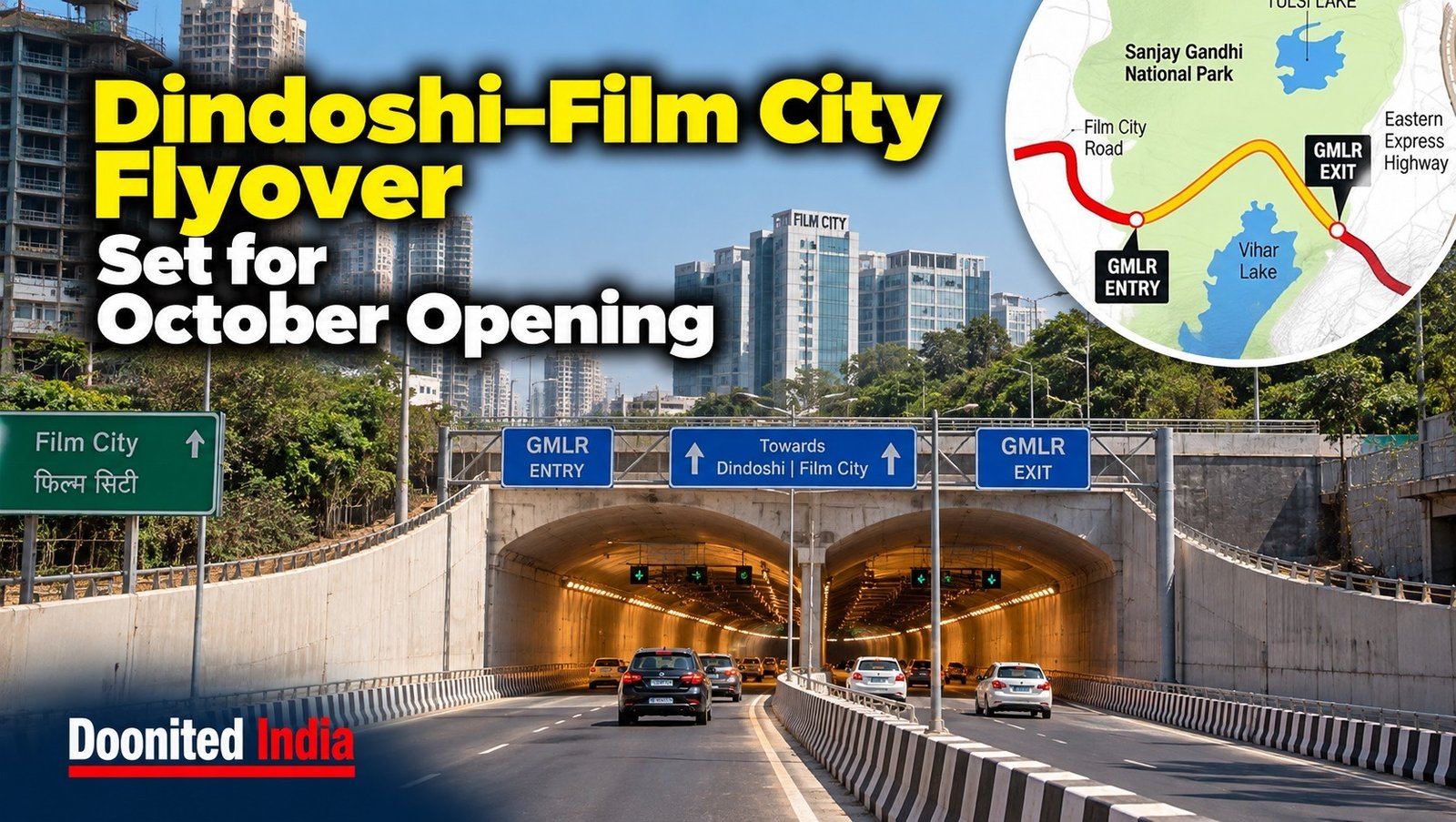
The Brihanmumbai Municipal Corporation (BMC) is targeting October 15, 2026, for opening the approximately 1.3-km elevated road connecting Dindoshi Court with Dadasaheb Phalke Chitranagari, better known as Film City. As of early October, the structure had not yet opened to public traffic. A load test was scheduled for the second week of the month, followed by the necessary technical clearances.
The main structural work is reported complete: 31 piers and 30 spans have been built, with girders installed, the deck slab cast and approach roads constructed. Remaining work includes road markings, signage, electrical installations and noise barriers.
The distinction between “construction substantially complete” and “open to traffic” is important. A flyover is not ready for motorists simply because its concrete and steel are in place. Testing, safety checks, road markings and traffic arrangements are part of making the structure fit for everyday use.
For commuters who regularly negotiate congestion around Goregaon East, Dindoshi and Film City, the wait may feel frustrating. But the load test is not an administrative hurdle to be hurried past. It is a necessary step before the public is invited onto the structure.
What the new flyover will actually change
The elevated road is a three-lane-per-direction connection running from the Dindoshi Court area, curving near Ratnagiri Junction Hotel and descending at Film City. It forms part of the larger Goregaon–Mulund Link Road (GMLR) project.
Its immediate value is local and practical. By providing a direct elevated connection between Dindoshi and Film City, it can improve movement along this stretch and reduce the need for traffic to negotiate some of the existing surface-level bottlenecks.
That could matter to people travelling to Film City, workers and production crews, and motorists moving through this part of the western suburbs. The benefits, however, will depend on how traffic feeds onto and off the flyover, how its junctions operate and whether congestion simply shifts to the next bottleneck.
This is a familiar challenge in urban road planning. An elevated road can remove a conflict at one junction, but it cannot by itself eliminate congestion across an entire corridor. The connections at either end matter almost as much as the structure in between.
The larger ambition: linking Goregaon and Mulund
The Dindoshi–Film City flyover is one component of a much more ambitious undertaking. The GMLR is planned as an approximately 12.2-km east–west corridor connecting Mumbai’s western and eastern suburbs, with links towards the Western Express Highway and Eastern Express Highway.
The project is intended to give motorists a more direct route between Goregaon and Mulund, reducing dependence on existing roads that can become heavily congested. The BMC has projected that the full corridor could cut the journey between the two suburbs from roughly 90 minutes to around 20 minutes, depending on the route and conditions.
That figure is a project-level aspiration, not a travel time that the new flyover alone can deliver. The flyover may improve one section of the journey, but the continuous east–west connection depends on the remaining road links, junctions, bridges and tunnels being completed and opened.
For commuters, this difference is more than a technicality. A new road segment can be useful before the entire project is finished, but the headline travel-time saving belongs to the completed network.
The tunnels beneath Sanjay Gandhi National Park are the critical link
The most complex part of the GMLR is the twin-tunnel section planned beneath Sanjay Gandhi National Park and the Aarey area. These tunnels are central to creating a direct connection between the western and eastern sides of the city without requiring traffic to follow the existing surface-road network.
Building major tunnels beneath a protected green landscape brings engineering and environmental responsibilities that do not arise in quite the same way on an ordinary urban flyover. The work involves specialised tunnelling, geological conditions, safety systems and coordination across a sensitive area.
The BMC’s 2026–27 budget material describes the twin-tunnel component as a major part of the project and gives an overall completion plan extending to 2028. The same material reported tunnel work at an earlier stage of progress than the flyover. That is a reminder that the different parts of GMLR are advancing on different timelines.
Until the tunnels and connecting sections are ready, the full corridor cannot function as the continuous Goregaon–Mulund route envisaged in the project’s travel-time projections.
Why a 20-minute promise needs careful reading
A projected journey time is useful for understanding what a project is designed to achieve. It is not a guarantee that every driver will complete the trip in that time.
Actual travel depends on the hour, traffic volumes, entry and exit points, road incidents, weather and the performance of connecting junctions. Even a fully operational corridor can experience congestion if demand grows or traffic merges at bottlenecks.
The 20–25-minute figure should therefore be understood as a target associated with the completed corridor and favourable operating conditions—not a promise that will automatically apply to every trip once one section opens.
There is also a wider urban-planning question. When a road makes driving faster, some journeys may shift to that route, and new traffic can emerge over time. That does not negate the value of a link road, but it does mean that road capacity alone is not a permanent cure for congestion.
The measure of success should include reliable journey times, safer junctions, effective traffic management and the impact on surrounding neighbourhoods—not just the fastest possible trip on a clear road.
The importance of opening the project in stages
Opening a completed section before the entire corridor is finished can provide benefits sooner. But it requires clear communication about what is operational, which routes remain incomplete and where motorists should expect diversions or bottlenecks.
For the Dindoshi–Film City flyover, the immediate priorities are straightforward: complete the remaining works, carry out the load test, obtain the required technical clearances and ensure that traffic arrangements are ready before opening.
The October 15 date remains a target, subject to those steps being completed. It should not be treated as a confirmed opening until the BMC announces that the flyover is cleared for public use.
For commuters, the practical advice is equally simple: check local traffic updates before changing a regular route, especially during the first days of operation. New infrastructure can alter traffic patterns around its approaches, and early adjustments may take time.
Mumbai needs the whole connection, not just the headline
The Dindoshi–Film City flyover is a tangible piece of progress. It can improve movement in its immediate area and bring one part of the Goregaon–Mulund Link Road closer to service.
But Mumbai’s larger east–west connectivity challenge will not be solved by a single elevated stretch. The full benefit depends on the tunnel, the connecting roads and the wider network working together.
That is the central lesson of large urban infrastructure: a road segment can be complete while the journey it was designed to transform remains unfinished.
The flyover’s opening will be worth watching—not as the end of the GMLR story, but as an early test of how well its individual pieces can deliver value while the city waits for the complete route.


World Beyond the News
Dolphins Use Individual Signature Whistles
Bottlenose dolphins develop distinctive whistles that function somewhat like individual acoustic identifiers.
The Pacific Is Earth’s Largest Ocean
The Pacific Ocean covers more area than any other ocean basin and stretches between Asia, Australia and the Americas.
Artificial Intelligence Learns Statistical Patterns
Modern machine-learning systems identify patterns in large datasets and use those patterns to generate predictions or outputs.
Why Some Stories Spread So Quickly
Emotion, novelty, visual appeal and easy sharing can make a story travel rapidly across social platforms.