Smart Homes Are Coming—But Do Indian Homeowners Actually Need Them?
Smart-home technology is becoming easier to install and more relevant to Indian households, but not every connected device is worth buying. For many homeowners, security, energy management and climate control offer a clearer return than expensive appliances or gadgets that simply add another app to the phone.
The Smart Home Has Finally Become Practical
For years, the “smart home” in India was largely a luxury concept: automated curtains, voice-controlled lights, elaborate home theatres and expensive integrated systems designed for premium apartments.
That picture is changing.
Connected lights, smart plugs, cameras, digital locks, AC controllers and voice assistants can now be installed without completely rewiring an existing home. At the same time, developers are incorporating smart-home features into new residential projects.
The shift is also being noticed by the real-estate industry. At the 2026 TOI Home & Decor Awards, CBRE India chairman and CEO Anshuman Magazine described technology and changing consumer aspirations as forces reshaping Indian real estate, including growing interest in AI-integrated smart homes.
But there is an important distinction between smart-home adoption and smart-home usefulness.
India may be buying more connected devices. That does not mean every household needs a connected version of everything.
The more useful question is:
Which smart technologies solve an actual Indian household problem?
The Five Smart-Home Categories That Matter
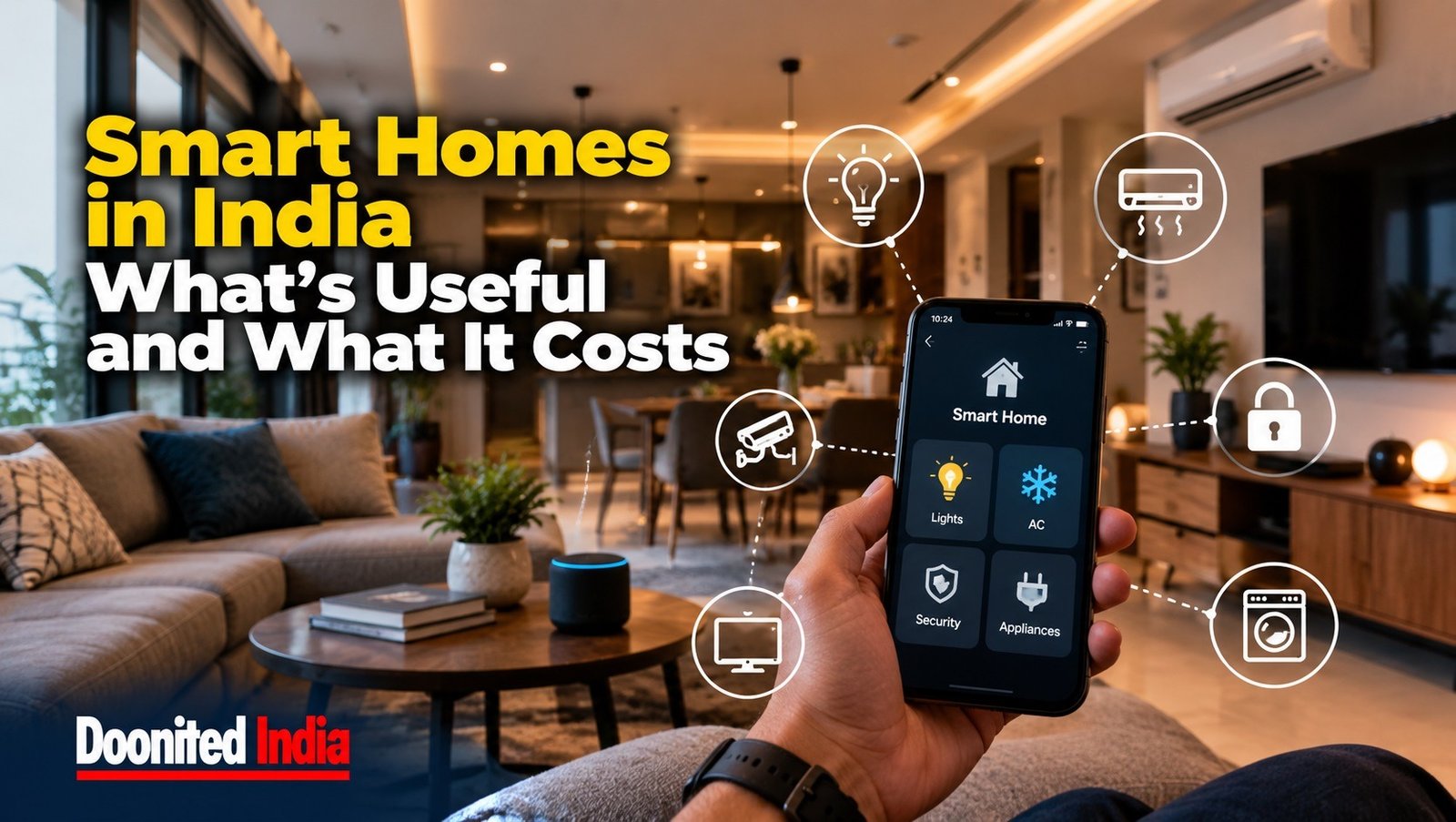
| Feature | Typical practical cost* | Maintenance | Main concern | Practical value |
|---|---|---|---|---|
| Smart lighting | ₹5,000–₹15,000 per room | Low | Wi-Fi/device compatibility | High |
| Security cameras/locks | ₹10,000–₹30,000+ | Medium | Privacy and cyber-security | Very high |
| AC/climate control | ₹15,000–₹40,000+ | Low–medium | Compatibility | High |
| Smart appliances | ₹25,000–₹1 lakh+ | Medium–high | Brand/service dependence | Moderate |
| Voice assistants | ₹3,000–₹10,000+ | Low | Microphone/privacy concerns | Moderate |
*These are indicative consumer-market ranges rather than official national price benchmarks. Actual prices vary considerably by brand, room size, device specification and installation requirements.
The table reveals something important.
The most useful smart-home products are not necessarily the most glamorous.
1. Smart Lighting: A Small Upgrade With a Clear Purpose
Smart lighting is probably the easiest place to begin.
A homeowner can install smart bulbs, switches or plugs and create schedules, remotely switch lights on or off, or control multiple lights from a phone or voice assistant.
The real benefit is convenience.
A resident returning home late can switch on lights remotely. Lights can automatically turn off at a particular time. Outdoor or entrance lighting can be scheduled without remembering to operate it manually.
There can also be energy benefits, but these should not be exaggerated.
A smart light does not magically consume less electricity simply because it is connected to Wi-Fi. The saving comes when automation prevents unnecessary operating hours or when smart controls are combined with efficient LED lighting.
That distinction matters.
Automation can reduce waste; connectivity itself is not energy efficiency.
For many Indian households, smart lighting is therefore a useful convenience upgrade rather than a revolutionary technology.
2. Security: Perhaps the Strongest Indian Use Case
Security technology has a much clearer practical purpose.
Smart cameras, video doorbells, digital locks and motion sensors can allow homeowners to monitor entrances and receive alerts while away from home.
This is particularly relevant to urban households where residents may spend significant periods away from the property.
Parents can check deliveries. Homeowners travelling abroad can monitor their property. Residents can receive alerts when movement is detected.
But security devices introduce a serious trade-off:
The device designed to protect your home can itself become a cybersecurity risk.
India’s Bureau of Indian Standards has been actively developing standards around IoT security and privacy. A BIS IoT security and privacy document specifically identifies risks involving IoT devices, networks, servers, web interfaces, mobile applications and data within an IoT ecosystem. Bureau of Indian Standards
That means a camera should not be selected only on the basis of resolution.
Buyers should ask:
- Where is the footage stored?
- Is it encrypted?
- Can the device receive security updates?
- What happens if the company stops supporting it?
- Is two-factor authentication available?
- Can unnecessary cloud access be disabled?
- Who can access the recordings?
A ₹5,000 camera with weak security can create a problem considerably more expensive than the camera itself.
3. Smart AC Control: Where India Has a Genuine Use Case
Climate control may be one of the strongest applications for Indian homes.
Air-conditioning can represent a substantial portion of household electricity consumption, particularly during hot weather. Smart controllers can allow users to schedule operation, adjust temperatures remotely and avoid leaving an AC running unnecessarily.
This is different from buying a refrigerator simply because it has an internet connection.
If smart scheduling prevents an air-conditioner from running for an unnecessary two hours each day, the feature has a measurable purpose.
For example, suppose a particular AC draws an average 1.2 kW while operating and smart scheduling eliminates two unnecessary operating hours per day.
The theoretical energy reduction would be:
1.2 kW × 2 hours = 2.4 kWh per day
Over 30 days:
2.4 × 30 = 72 kWh
If electricity costs ₹8 per kWh, the theoretical saving would be:
72 × ₹8 = ₹576 per month
That is ₹6,912 a year.
This is an illustration, not a guaranteed saving. Actual AC consumption changes with inverter behaviour, outdoor temperature, room conditions, thermostat settings and electricity tariffs.
But it demonstrates why climate automation can make more economic sense than a novelty gadget.
4. Smart Appliances: Convenient, But Not Essential
The refrigerator that sends a notification.
The washing machine that can be started remotely.
The oven that connects to an app.
The television that responds to voice commands.
These products can be useful. But usefulness and necessity are different things.
A conventional washing machine can still wash clothes perfectly well without an internet connection.
A refrigerator does not necessarily become substantially better at preserving food because it can send a notification to a smartphone.
Smart appliances make the strongest case when connectivity provides a specific operational benefit—for example, diagnostics, energy monitoring, scheduling or accessibility.
Otherwise, consumers may simply be paying for features they rarely use.
This is where the smart-home market faces its biggest credibility challenge.
The industry needs to demonstrate value rather than simply adding the word “smart” to products.
5. Voice Assistants: Useful Until the Internet Goes Down
Voice control is attractive because it makes technology accessible without requiring a phone or physical switch.
It can be particularly useful for older people or anyone with limited mobility.
But voice assistants also illustrate the limitations of connected homes.
Internet connectivity becomes part of the home’s infrastructure.
If the Wi-Fi fails, some functions may stop working. If the cloud service changes, a feature that worked when the device was purchased may behave differently later.
And then there is the microphone.
A voice assistant is designed to listen for a wake word. That inevitably raises questions about privacy, data processing and cloud storage.
Consumers should therefore understand the privacy policy and device controls before installing voice-enabled technology throughout the home.
The Bigger Problem: Too Many Apps
The future smart home has another surprisingly unglamorous problem.
Fragmentation.
One application controls the lights.
Another controls the camera.
A third operates the AC.
The washing machine has its own application.
The door lock has another.
And suddenly the supposedly intelligent home requires six passwords and a family WhatsApp message explaining which app controls the balcony lights.
This is precisely why interoperability matters.
NIQ’s 2026 research on India’s smart-home opportunity found an important tension: awareness of connected-home possibilities is growing, but adoption can be held back when systems are difficult to set up, fragmented, difficult to trust or unclear in everyday value. NIQ
That may be one of the defining challenges for the next phase of India’s smart-home market.
Consumers do not necessarily want more technology.
They want technology that works together.
New Homes vs Older Indian Homes
The smart-home opportunity is not restricted to new luxury apartments.
Older homes can often be upgraded gradually with plug-in devices, smart bulbs, smart plugs, compatible switches, cameras and AC controllers.
That makes retrofit technology particularly important for India’s enormous existing housing stock.
However, consumers should distinguish between genuinely simple retrofits and products requiring electrical modification.
Anything involving mains electrical wiring should be installed by a qualified professional rather than treated as a casual DIY project.
New construction has a different advantage: developers can integrate wiring, networking, access control and automation at the design stage.
That can produce a cleaner system.
But it can also create vendor lock-in.
A homeowner should be cautious if essential functions depend entirely on one developer, proprietary platform or subscription.
A smart home should remain useful even if the original technology supplier changes.
Tier-2 Cities May Not Be Left Behind
It would also be wrong to assume that smart homes belong exclusively to Mumbai, Delhi, Bengaluru or Hyderabad.
The availability of plug-and-play devices lowers the entry barrier for households in smaller cities and older buildings.
The technology does not require a luxury apartment.
A person can start with a ₹1,000–₹2,000 smart plug or bulb rather than spending several lakh rupees on whole-home automation.
That creates a more interesting future for the sector.
Smart-home adoption may grow not through one spectacular leap into fully automated houses, but through small upgrades accumulated over time.
One camera.
Two smart lights.
An AC controller.
A digital lock.
Perhaps a smart energy monitor later.
The “smart home” could therefore emerge gradually from the ordinary Indian home rather than replacing it overnight.
So, Do Indian Homeowners Actually Need Smart Homes?
For most households, the answer is:
Some smart technology — yes. A fully automated home — not necessarily.
If the objective is practical value, the priority order is relatively straightforward.
First: security.
Second: climate and energy management.
Third: lighting and basic automation.
Fourth: accessibility and convenience.
Only after that: connected appliances and lifestyle gadgets.
And there is another rule worth remembering:
Buy the problem you are solving, not the technology being advertised.
If electricity bills are high, investigate energy monitoring and AC automation.
If security is the concern, invest in a properly secured camera or smart lock.
If an elderly family member needs easier control of lights and appliances, voice or automated controls may provide genuine value.
If none of these problems exist, buying a connected toaster because it can send a notification is probably not a technological breakthrough worth celebrating.
The Smartest Home May Be the Simplest One
India’s smart-home market is entering a more practical phase.
The industry is moving from demonstrations of what technology can do towards a harder question: what should technology actually do inside an ordinary home?
That shift is healthy.
BIS has recognised the growing importance of IoT standardisation, security and privacy, while current consumer research indicates that ease of use, trust, interoperability and visible value will influence whether connected living scales beyond early adopters. Bureau of Indian Standards
The future Indian smart home is therefore unlikely to be the science-fiction house in which every curtain, kettle and light bulb has artificial intelligence.
It may be something much less dramatic.
A home where the AC switches off when nobody is there.
The entrance alerts you when a delivery arrives.
The lights turn off automatically.
The elderly parent can call for help without reaching for a phone.
And the electricity bill is slightly lower because the house wastes less energy.
That may not sound futuristic.
But if technology quietly makes everyday Indian life safer, cheaper and easier, perhaps that is exactly what a smart home should be.


World Beyond the News
Why Elephants Stay Close to Their Herd
Elephants live in highly social family groups and use calls, touch and body movements to maintain strong bonds.
Most of the Deep Ocean Remains Difficult to Explore
Extreme pressure, darkness and distance make deep-ocean exploration one of Earth’s greatest scientific challenges.
Spacecraft Can Travel Without Traditional Roads
Spacecraft use carefully calculated trajectories and gravity assists to travel enormous distances through space.
Why Movie Trailers Are Released in Stages
Major films often use teaser trailers, full trailers and final promotional spots to build awareness over time.