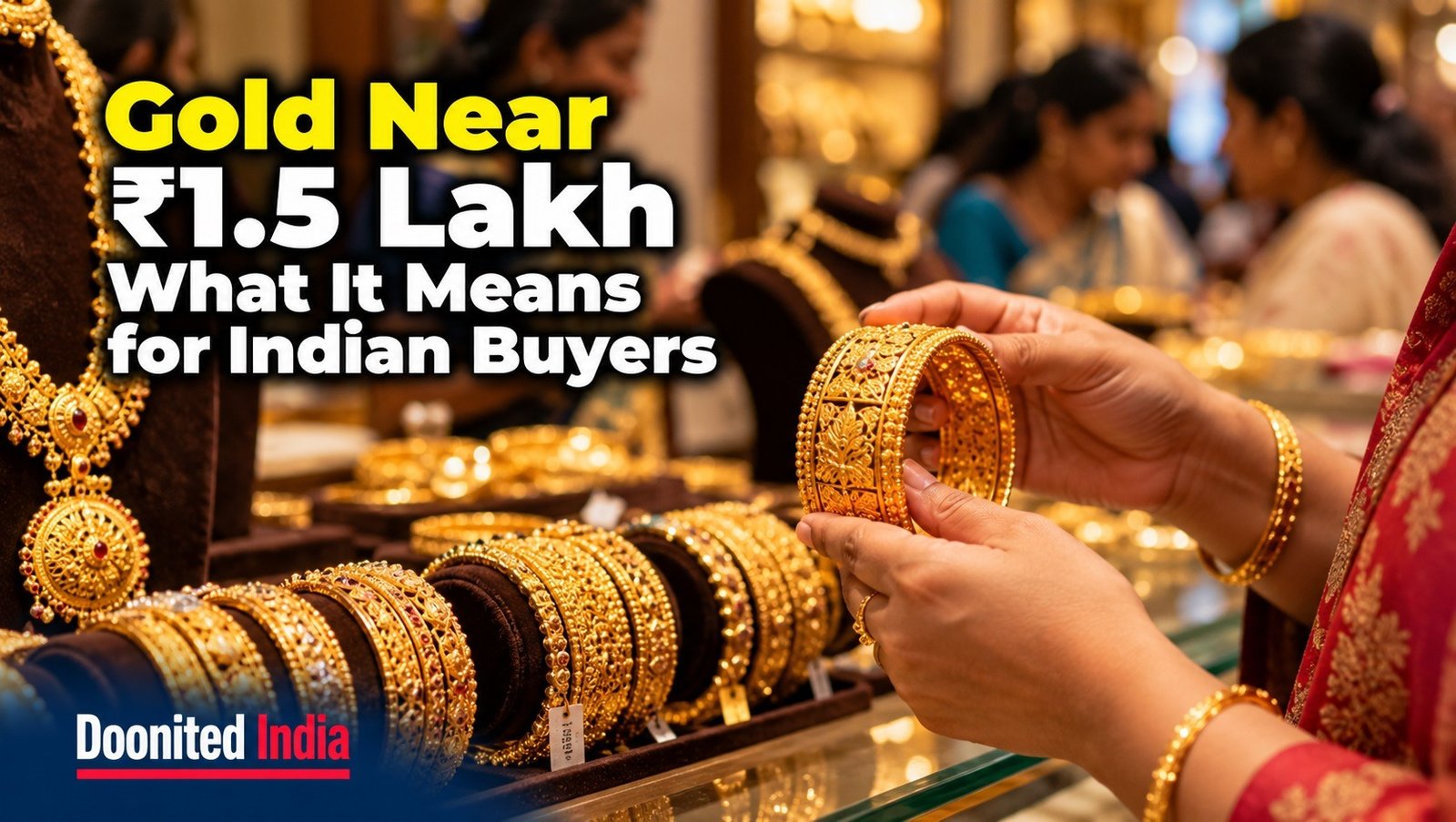
At ₹1.5 Lakh for 10 Grams, India’s Gold Market Is Learning to Sell Less Gold
For generations, buying gold in India has involved a deceptively simple calculation: How many grams can the family afford?
At around ₹1.5 lakh for 10 grams, that calculation is becoming considerably harder.
The price shock is visible in jewellery stores, wedding budgets and investment portfolios. But India’s response is not simply to stop buying.
Instead, the market is adapting.
Consumers are buying lighter pieces. Old jewellery is being exchanged rather than left in lockers. Lower-carat and studded jewellery is gaining ground in some organised retail channels. Investors are looking more closely at gold-backed financial products. And silver, once treated as the considerably less glamorous cousin of gold, is receiving renewed attention from price-conscious buyers.
The interesting story is therefore not that Indians have suddenly lost their appetite for gold.
It is that India is learning to buy gold differently.
₹1.5 lakh changes the meaning of a gram
The ₹1.5 lakh figure needs some context.
Gold prices move continuously, and the exact retail price varies by city, purity, taxes, making charges and the type of product being purchased. On October 3, reported domestic 24-carat rates were around ₹1.50 lakh per 10 grams, while 22-carat rates were lower. On October 5, domestic prices again moved around the ₹1.5 lakh level, with market prices fluctuating during the day.
That means a customer buying jewellery is not simply paying the headline bullion price.
There may also be making charges, taxes and other costs.
For a family purchasing wedding jewellery, therefore, the difference between 30 grams and 50 grams is no longer a minor adjustment.
It can represent several lakh rupees.
The result is an important psychological shift.
Gold jewellery is increasingly being judged not only by design and tradition but by weight efficiency.
Can the necklace look substantial without being extremely heavy?
Can a traditional design be produced with less metal?
Can a family exchange older jewellery and finance part of a new purchase?
The answer to all three is increasingly yes.
The lightweight revolution is not a marketing invention
There is hard evidence behind the shift.
The World Gold Council reported that Indian jewellery demand fell 15% year-on-year to 75 tonnes in Q2 2026, while first-half demand was down 17% to 141 tonnes.
Yet the value of jewellery demand rose sharply.
That apparent contradiction tells us something important.
Indians were buying fewer tonnes of gold, but spending more money.
The World Gold Council says high prices accelerated consumer movement towards lighter-weight, lower-carat and studded jewellery. It also reported that exchange schemes became an important source of demand support, with retailers reporting increases in exchange volumes and some saying exchanged purchases accounted for a substantial share of sales.
This is perhaps the clearest sign that India’s gold economy is adapting rather than collapsing.
The market is effectively trying to preserve the emotional and cultural value of jewellery while reducing the quantity of metal required to deliver it.
That is a very Indian form of inflation adjustment.
Old gold has become new purchasing power
One of the most consequential changes may be happening inside family cupboards.
Gold jewellery that once sat unused is increasingly becoming part of the transaction.
The World Gold Council’s India research found that old-gold exchanges represented roughly 40%–60% of transactions across retailers in Q1 2026, while Q2 research also showed exchange schemes supporting jewellery demand.
This is more than a convenient retail promotion.
Gold jewellery has always occupied an unusual position in Indian household economics. It is simultaneously ornament, cultural inheritance and a form of household wealth.
At very high prices, those characteristics begin to interact differently.
A family may not want to spend several lakh rupees buying an entirely new jewellery set.
But it may be willing to bring old ornaments to a jeweller, have the gold valued and convert part of that accumulated wealth into something new.
The locker becomes a source of purchasing power.
That is a significant change in consumer behaviour.
Silver is getting a new invitation to the wedding
The rise of silver is another part of the story.
At current prices, the same nominal budget buys dramatically more silver by weight than gold. That simple arithmetic is encouraging some price-sensitive consumers to look at silver jewellery, artefacts and investment products differently.
But silver should not be presented as a straightforward replacement for gold.
Gold carries a distinctive role in Indian weddings, family wealth and traditional jewellery. A bride replacing a conventional gold necklace with silver is not merely making a financial substitution; she is making a cultural decision.
The more likely development is segmentation.
Gold remains the premium store of wealth and traditional wedding purchase.
Silver can occupy more of the everyday, fashion, gifting and decorative space.
The two metals may increasingly serve different occasions rather than directly competing for the same customer.
And predictions that silver must rise to a particular future price should be treated as market forecasts—not facts.
Jewellery companies are having to become weight engineers
For jewellers, the challenge is straightforward but difficult.
High gold prices raise the value of inventory.
They also make that inventory harder for consumers to buy.
A retailer cannot simply keep increasing prices indefinitely and expect the same sales volume.
Design therefore becomes an economic tool.
Hollow construction, thinner profiles, smaller components, lower-carat options and more use of stones can allow retailers to offer pieces that maintain visual appeal without requiring the same quantity of gold.
The World Gold Council has already identified increased traction for lighter, lower-carat and studded jewellery, particularly among organised retailers.
This could accelerate a longer-term transformation in Indian jewellery.
The old question was:
“How much gold is in this piece?”
The new question increasingly becomes:
“How much design can I get for this amount of gold?”
That is a very different retail proposition.
But high prices have a limit
There is a danger in assuming that India’s cultural attachment to gold makes demand almost immune to price.
It does not.
The World Gold Council’s data show precisely the opposite.
Volumes have fallen.
Affordability is becoming a constraint.
Rural incomes, monsoon performance, gold prices and the wider economic environment can all influence jewellery demand. The World Gold Council expects wedding and festive buying to provide support, but also says demand will remain sensitive to price movements.
This matters because jewellery is not the same as investment demand.
A household may postpone a decorative purchase.
A wedding may require a certain amount of jewellery regardless of price.
An investor may instead buy an ETF.
The market therefore becomes increasingly segmented.
Investors are moving closer to financial gold
High prices also change the appeal of physical ownership.
Bars and coins involve storage, security and transaction considerations. Jewellery includes making charges that generally do not come back to the customer when the item is sold.
Financial gold products can provide a different route.
SEBI specifically recognises regulated gold products including Gold ETFs, exchange-traded commodity derivatives and Electronic Gold Receipts, accessed through regulated intermediaries.
There is, however, an important warning for consumers attracted by the phrase “digital gold”.
SEBI issued a public caution in November 2025 stating that many digital-gold products offered by online platforms are outside SEBI’s regulatory framework and do not carry the investor-protection mechanisms applicable to SEBI-regulated securities-market products.
For consumers, the lesson is simple:
“Digital” does not automatically mean “regulated”.
Gold investors should know exactly what they are buying and which regulator, if any, oversees the product.
Gold loans get more interesting when gold gets expensive
There is another part of India’s gold economy that becomes more important when the metal appreciates sharply: credit.
Gold loans allow households and businesses to borrow against eligible gold collateral without necessarily selling the underlying asset.
Higher gold prices can increase the monetary value of eligible collateral, although lenders still apply regulatory and internal loan-to-value requirements and borrowers remain exposed to repayment obligations and potential collateral loss.
The regulatory framework has also evolved.
The RBI issued its Lending Against Gold and Silver Collateral Directions, 2025, establishing a framework covering lending against eligible gold and silver collateral.
That is worth distinguishing from the more sweeping claim that gold-loan companies are simply replacing gold collateral with silver.
The regulation permits lending against specified gold and silver collateral under defined conditions; it does not mean every lender is suddenly accepting silver in the same way as gold.
For borrowers, the important point is that a precious metal can increasingly function not just as jewellery or investment but as collateral.
Purity matters more when every gram costs more
High prices also increase the importance of knowing exactly what is being purchased.
BIS permits hallmarking across several gold fineness grades, including 14K, 18K, 20K, 22K, 23K and 24KS, and the HUID system gives hallmarked jewellery a unique identification number that consumers can verify through the BIS Care app.
That makes an old-fashioned piece of advice newly important:
Know the purity. Know the weight. Know the charges.
At ₹1.5 lakh per 10 grams, even small differences matter.
Consumers should not compare two jewellery pieces simply by their sticker price. Gold content, purity, making charges, stone deductions, taxes and exchange terms can materially change the economics.
India’s gold relationship is not disappearing. It is becoming more efficient.
The fascinating thing about India’s gold market is that extremely high prices have not erased demand.
They have forced adaptation.
Jewellers are designing around weight.
Consumers are recycling old holdings.
Families are rethinking wedding purchases.
Investors have more incentive to distinguish jewellery from financial gold.
Silver is finding additional room in the household budget.
And regulators are placing greater emphasis on transparency, purity and the risks surrounding unregulated products.
This is not necessarily a temporary reaction to one price milestone.
It could represent a more permanent evolution in the way Indians think about precious metals.
The cultural equation remains powerful: gold is still associated with weddings, family wealth, festivals and financial security.
But the economic equation is changing.
The future Indian gold buyer may not ask, “How much gold can I buy?”
They may increasingly ask:
“What is the smartest way to use my gold budget?”
That is a much more consequential question.
DOONITED Editorial Perspective: India’s gold market is demonstrating an unusual form of resilience: not by pretending high prices do not matter, but by redesigning the transaction around them. The danger is that headlines about ₹1.5 lakh gold can encourage consumers to chase an asset simply because it has risen dramatically. The better lesson is the opposite. Whether someone is buying jewellery, exchanging old gold, taking a gold-backed loan or investing through a regulated product, the higher the price of the metal, the more important it becomes to understand what exactly is being bought—and what is being paid for it.


World Beyond the News
Octopuses Can Change Their Appearance
Octopuses can rapidly alter their skin colour and texture to communicate, camouflage themselves and respond to danger.
Some Cities Exist Across Two Continents
A small number of cities are geographically associated with two continents, creating unusual cultural and geographic identities.
Earth’s Climate Is Measured in Many Ways
Scientists track temperature, atmospheric gases, sea level, ice cover and other indicators rather than relying on a single climate number.
Streaming Changed How Audiences Discover Shows
Recommendation systems and global streaming releases allow audiences to discover programmes far beyond their original markets.