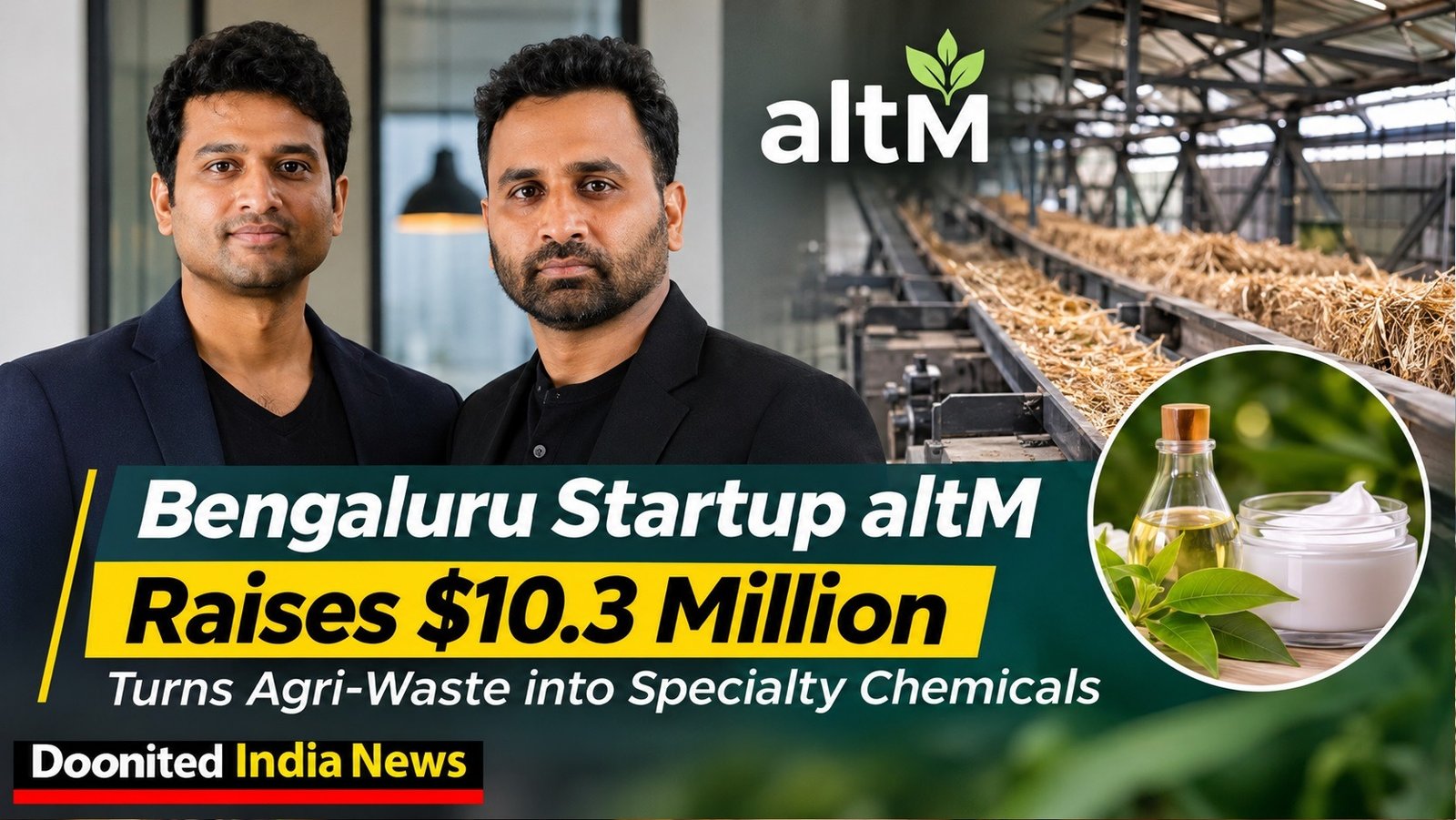
Bengaluru Startup altM Turns Agricultural Waste into Industrial Materials, Raises $10.3 Million
From sugarcane bagasse and rice straw to specialty chemicals for cosmetics and personal care, altM is attempting to build a new industrial supply chain from India’s agricultural residues. Its latest funding marks an important step—but the bigger test will be commercial-scale production.
India’s agricultural fields produce more than food. They also generate enormous quantities of leftover biomass—sugarcane bagasse, rice straw and other plant residues that can become an environmental and economic challenge when poorly managed. What if some of that material could become the raw ingredient for the next generation of industrial products?
That is the proposition behind altM, a Bengaluru-based specialty chemicals and advanced materials startup. Founded in 2022, the company is developing technology to convert agricultural residue into bio-based chemicals and materials that could replace selected fossil-derived industrial inputs.
On November 5, 2026, altM announced that it had raised $10.3 million in Series A funding, led by Rainmatter, the investment initiative associated with Zerodha, and Mela Ventures. Existing investors Omnivore, Theia Ventures, Aureolis Ventures and Spectrum Impact also participated, alongside VC Grid and strategic angel investors. The capital is intended to expand manufacturing, research and development, customer qualification and commercial operations.
From crop residue to industrial ingredients
The technology challenge is more complex than simply turning agricultural waste into fuel. Plant biomass contains several valuable components, principally cellulose, hemicellulose and lignin. Each has different chemical properties and potential industrial applications.
altM’s approach is based on processing these fractions to develop multiple products from a single feedstock. Its proprietary altMorph platform is described as a biorefinery system that uses biomass pretreatment, thermochemical deconstruction and catalytic upgrading to produce bio-based materials.
The concept resembles the logic of a petroleum refinery: rather than relying on one output, it seeks to extract value from different components of the original raw material.
For India, the idea has particular relevance. Agricultural residues are generated across major farming regions, and finding higher-value uses for them could create additional economic opportunities beyond conventional disposal or low-value applications. However, the commercial and environmental benefits will depend on the cost of collection, transport, processing and the availability of reliable feedstock.
Why cosmetics are an early market
altM’s first products moving towards commercialisation are aimed at personal care and cosmetics.
These include a lignin-derived SPF booster for suncare formulations, a cellulose-based rheology modifier used to influence the texture and flow of products, and bio-derived ferulic acid, an ingredient with applications in cosmetic formulations.
These are not finished consumer products carrying the altM brand. They are industrial ingredients intended for use by manufacturers. Their adoption will depend on performance, consistency, regulatory requirements, customer testing and competitive pricing.
The company’s longer-term ambitions extend to packaging, textiles, construction, pharmaceuticals and other industrial applications.
The difficult journey from laboratory to factory
The startup’s progress offers a glimpse into the engineering challenge behind industrial biotechnology. According to company and investor disclosures, altM has expanded its Bengaluru laboratory footprint nearly fivefold, commissioned a demonstration manufacturing facility and advanced six molecules to demonstration scale. Three have been selected for pilot production.
A February 2026 announcement also marked the launch of its integrated biorefinery pilot plant in Bengaluru.
These are meaningful development milestones, but they should not be confused with established commercial-scale manufacturing. A process that works in a laboratory or pilot facility must still demonstrate that it can produce consistent material at larger volumes, meet customer specifications and compete economically with existing petrochemical alternatives.
That is why the new funding matters. It is intended to help altM move through the difficult transition from technical demonstration to dependable industrial supply.
Founders with manufacturing experience
altM was founded by Apoorv Garg and Yugal Raj Jain, former Tesla manufacturing leaders, in 2022. Dr Harshad Velankar, an industrial bioprocessing scientist, is part of the leadership team as chief scientific officer. The combination brings together manufacturing experience and specialist knowledge of biomass processing.
The investors backing the company are betting that agricultural residues can become a commercially useful source of industrial carbon. Rainmatter and Mela Ventures have joined earlier backers in supporting the next phase of development.
The investment also reflects a wider shift in climate technology: attention is moving beyond renewable electricity and electric mobility towards the materials used in everyday manufacturing. Chemicals, packaging, textiles and personal care products all depend on industrial inputs whose production can carry a substantial fossil-carbon footprint.
The opportunity—and the questions India must ask
The promise of agricultural-residue-based materials is considerable, but the environmental case must be assessed across the entire supply chain. Crop residues also have existing uses, including animal feed, soil incorporation and other local applications. Removing too much biomass from fields can affect soil organic matter and nutrient cycles.
A credible assessment therefore needs to establish where the feedstock comes from, whether farmers receive fair value, how much energy and water the processing requires, and whether the finished material delivers a measurable lifecycle emissions advantage over the conventional alternative.
There is also a commercial test. Industrial customers do not switch ingredients simply because a substitute is described as sustainable. They need dependable quality, competitive pricing, regulatory compliance and uninterrupted supply.
For altM, the $10.3 million Series A is therefore not the finish line. It is an opportunity to demonstrate that an Indian deep-tech company can turn agricultural residues into reliable industrial materials at a scale that customers will adopt.
If it succeeds, the significance could extend beyond one startup. India’s farm economy may become an important source of advanced materials—provided innovation creates value for farmers as well as manufacturers. The future of this sector will be measured not by how much waste a company says it can transform, but by what it can produce consistently, profitably and with a demonstrable environmental benefit.


World Beyond the News
Birds Can Navigate Using Earth’s Magnetic Field
Several bird species can sense Earth’s magnetic field, helping them navigate during long-distance migration.
Fermentation Is a Global Food Tradition
People across continents have used fermentation for centuries to preserve food and create distinctive flavours.
Modern Batteries Store Energy Chemically
Rechargeable batteries repeatedly move ions between electrodes, allowing electrical energy to be stored and released.
Why Songs Become Global Hits
Streaming platforms, short-form video, playlists and international collaborations can rapidly carry music across borders.