India’s Monsoon Deficit Is More Than a Rainfall Story: How Water Stress Could Reshape Food Prices in 2027
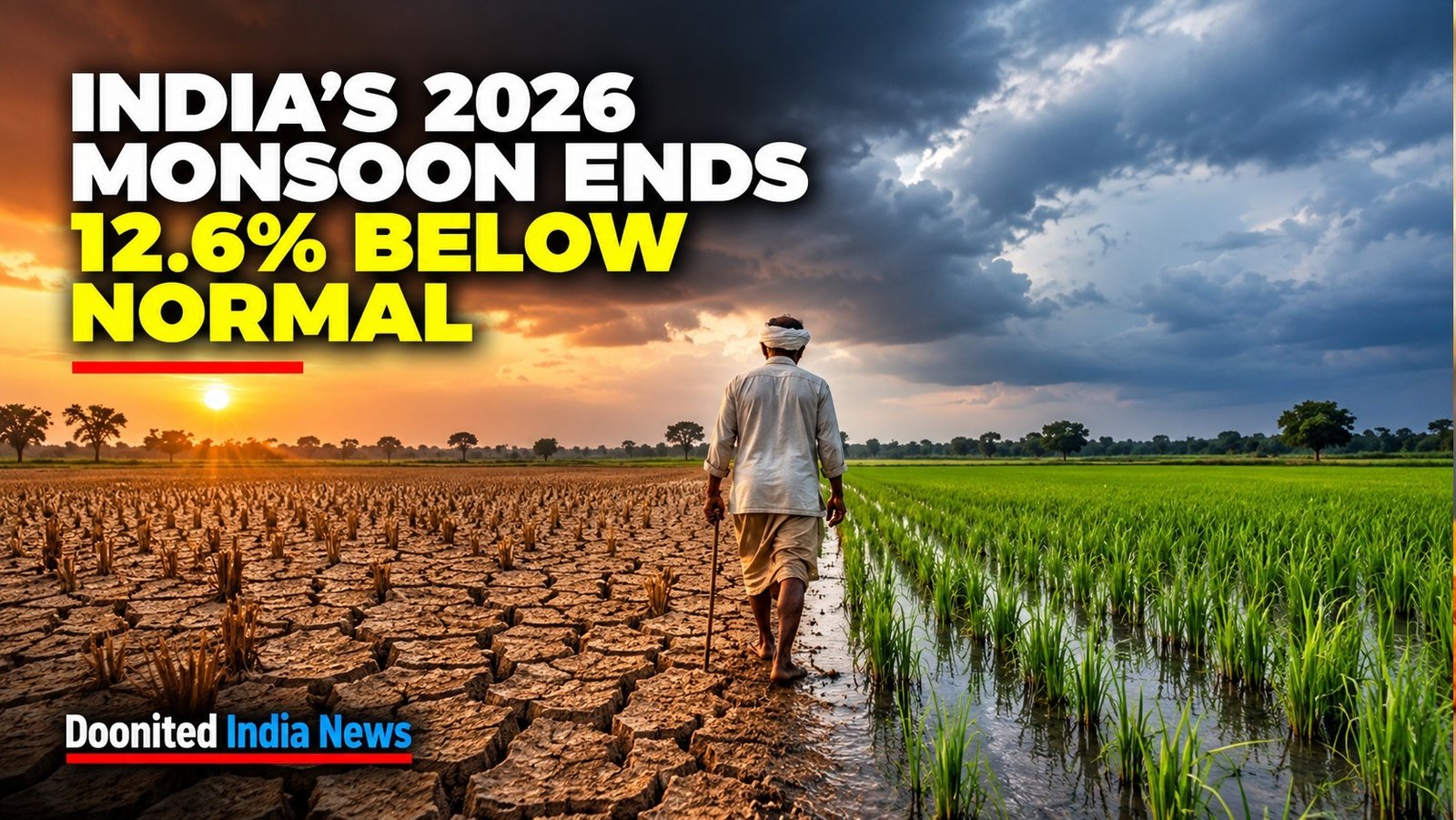
India’s 2026 southwest monsoon ended with rainfall 12.6% below normal, but the consequences are far from uniform. Low reservoir storage in southern India, pressure on sugarcane and other rain-sensitive crops, and rising food inflation have brought the next agricultural season into focus. The challenge now is to protect farm incomes and household budgets without mistaking a serious risk for a guaranteed nationwide crop failure.
A weak monsoon does not affect every Indian farm in the same way. For a farmer relying on rain to grow pulses in Karnataka, a long dry spell at the wrong stage of crop development can matter more than the season’s national rainfall total. For a sugar mill in Maharashtra, the concern may be how much cane reaches the factory and how much sugar it contains. For a household, the first warning may arrive not from a weather bulletin, but from the price of dal, cooking oil or sugar.
That is the real significance of India’s 2026 monsoon deficit. The season ended with 759.4 millimetres of rainfall, 12.6% below the long-period average, according to reporting based on India Meteorological Department (IMD) data. The national figure is serious, but it does not describe the whole story: rainfall distribution, the timing of dry spells, irrigation access and reservoir conditions determine where the damage is likely to be greatest.
The next test is whether uneven rainfall translates into lasting pressure on agricultural production, rural incomes and food prices through the winter cropping season and into 2027.
A national average can hide a regional water problem
India depends heavily on the southwest monsoon, which supplies a large share of its annual rainfall and replenishes reservoirs used for drinking water, irrigation and electricity generation. Yet rainfall is not stored or consumed evenly across the country.
Central Water Commission (CWC) data reported by The Indian Express showed that the 178 major reservoirs it monitored held around 70% of their total storage capacity in late September 2026. That was below the ten-year average of 76.62% and the 79% recorded at the same point in 2025.
The regional picture was more concerning. Reservoirs across southern India were reported at about 50% of capacity, compared with 87.25% a year earlier. By contrast, reservoirs in the western region covering Gujarat, Maharashtra and Goa held about 84.61% of capacity. The differences matter: a national storage figure can look manageable while particular river basins face tighter limits on irrigation and other water needs.
The figures also require care in interpretation. Reservoirs at 70% of capacity are not the same as reservoirs holding 28% of capacity, and neither figure automatically establishes how much water is available to each farmer. Storage varies by basin, reservoir operation, competing demand and the condition of local irrigation networks.
For the coming months, the crucial question is not simply how much water remains in India’s dams. It is where that water is, who can access it, and how carefully it is allocated.
El Niño is a warning signal, not a complete explanation
El Niño, a recurring warming of the central and eastern equatorial Pacific Ocean, can weaken the Indian summer monsoon. But its effects are not identical in every year or region. Other atmospheric conditions and local weather systems also influence rainfall.
In a July 2026 statement to Parliament, the government said El Niño conditions had developed and strengthened from weak to moderate during the monsoon. It also cautioned that the eventual intensity and Indian impacts depended on the evolution of wider ocean–atmosphere conditions. By late summer, the national rainfall deficit had widened, with prolonged dry spells adding to the pressure in several areas.
That distinction is important for public policy. A seasonal rainfall deficit is evidence of meteorological stress; it is not, by itself, proof that every state or crop has suffered a production collapse. Nor does it establish the final scale of losses before crop assessments and harvest data are available.
The risk is better understood as a chain of possible effects: inadequate soil moisture can reduce crop development; lower output can tighten local supplies; and tighter supplies may raise prices if stocks, imports or other sources cannot compensate. Each link depends on conditions that policymakers and markets will need to monitor.
Which crops are most exposed?
The effects of rainfall shortfalls differ by crop, soil, sowing date and irrigation access. Three areas deserve particular attention.
Sugarcane: Maharashtra and Karnataka are important sugar-producing states, and cane needs substantial water over a long growing period. A deficit can affect cane growth, sucrose content and the amount of harvestable crop. In an October 8 report, Reuters said the US Department of Agriculture’s Foreign Agricultural Service had cut its forecast for India’s 2026–27 sugar production to 29.5 million tonnes from 33.6 million tonnes. The agency attributed the revision to rainfall shortages and water stress.
That is a forecast, not a final harvest result. Even so, it illustrates how weather risks can affect a commodity with implications for food manufacturers, consumers and international sugar markets.
Pulses: Tur (pigeon pea), urad and other pulses are especially sensitive to moisture conditions at important stages of growth. India also imports a portion of its pulse requirements, so domestic crop performance can influence exposure to international prices and supply availability.
There is, however, an important counterweight to the worst-case scenario. The Financial Express reported on October 13 that government pulse buffer stocks had reached a record 4.5 million tonnes, above the stated norm of 3.5 million tonnes. The government said it could release stocks in a calibrated manner to manage prices. This reserve provides a potential cushion, although it cannot eliminate the consequences of poor yields, uneven distribution or persistent price pressures.
Oilseeds and coarse cereals: Soybean, groundnut, maize, millets and sorghum are grown across varied farming systems. In rainfed areas, dry spells during flowering, pod formation or grain development can affect yields. Lower oilseed production could increase dependence on imported edible oils, while reduced maize supplies could raise costs for poultry feed and other uses. These outcomes remain risks to assess—not automatic consequences of the national rainfall figure.
Rice production also deserves attention, especially in regions where rainfall shortages affected planting or transplantation. But estimates of acreage and production should be tied to official crop data rather than inferred from the monsoon deficit alone.
Food inflation is already a concern—but the monsoon is not the only driver
India’s food-price outlook is particularly sensitive because weather shocks can coincide with higher energy, transport and input costs.
Reuters reported on October 12 that India’s retail inflation rose to 5.54% in September 2026, while food inflation and higher energy prices contributed to the increase. A separate report in The Financial Express put September food inflation at 7.74%, up from 5.97% in August.
These figures show that price pressure is not merely hypothetical. They do not, however, mean that every increase can be attributed to El Niño. Prices also respond to seasonal supply patterns, previous harvests, storage and distribution costs, import prices and government policy. Some foods may become more expensive while others remain stable or fall.
For consumers, the impact can be disproportionate. Lower-income households spend a relatively large share of their budgets on food, leaving less room to absorb increases in essential items. Farmers can also be squeezed: a poor harvest may reduce the quantity they can sell even as the cost of irrigation, diesel, fertiliser or feed rises.
The international dimension matters too. India is a major producer and exporter of several agricultural commodities. Lower domestic sugar or rice availability could affect export volumes and global prices, depending on the final harvest, stock levels and trade policy. For edible oils and pulses, import dependence can expose Indian buyers to movements in global markets and currency costs.
The rabi season will test India’s water management
The monsoon’s end does not end the agricultural risk. The rabi season—winter crops such as wheat, mustard and gram—depends on a combination of stored soil moisture, irrigation, temperatures and the timing of winter rainfall.
Low reservoir levels can restrict canal releases in some areas. Farmers may respond by changing crops, reducing planted area, investing in groundwater pumping or leaving land fallow. Each response carries a different cost, and groundwater pumping can transfer today’s water shortage into a longer-term problem if extraction outpaces recharge.
A practical response must therefore be local rather than uniform. Authorities need timely district-level crop and soil-moisture assessments, clear irrigation schedules, access to suitable seeds, functioning crop-insurance processes and reliable advisories on water-efficient practices. Where water is scarce, encouraging farmers to plant water-intensive crops without accounting for local supply can deepen the problem.
Government buffer stocks and trade measures can help moderate food prices, but they cannot replace farm-level adaptation or sound water governance. Equally, blanket warnings that discourage all winter cultivation could damage farm incomes where water remains available. Decisions should reflect local reservoir conditions, crop economics and credible forecasts.
DOONITED View: Manage the water where the risk is
India should treat the 2026 monsoon shortfall as a test of its ability to manage agricultural risk—not as proof that a nationwide food crisis is inevitable.
The immediate priority is to identify vulnerable districts and river basins, publish transparent water-allocation plans and update crop assessments as evidence emerges. The next is to use existing tools effectively: public buffer stocks, crop insurance, agricultural extension services and carefully targeted import or market measures. These interventions need clear criteria and timely implementation, not just announcements after prices have already risen.
Over the longer term, rainwater harvesting, restoration of local water bodies, improved irrigation efficiency and crop choices suited to local water availability can reduce vulnerability. But efficiency gains must be measured in actual water saved, not simply in the number of irrigation systems installed. Water saved on one field can be offset if the same resource is used to expand water-intensive cultivation elsewhere.
The lesson is straightforward: rainfall is a national statistic, but water insecurity is experienced locally. India’s ability to limit the damage will depend on whether forecasts are translated into district-level decisions before farmers and consumers bear the full cost.
Learning point
A deficient monsoon does not automatically mean a deficient harvest. Crop outcomes depend on rainfall timing, soil moisture, irrigation, reservoir storage, farm decisions and the availability of food stocks. Watching these indicators together offers a more useful picture than relying on a single national rainfall number.


World Beyond the News
Why Elephants Stay Close to Their Herd
Elephants live in highly social family groups and use calls, touch and body movements to maintain strong bonds.
Most of the Deep Ocean Remains Difficult to Explore
Extreme pressure, darkness and distance make deep-ocean exploration one of Earth’s greatest scientific challenges.
Spacecraft Can Travel Without Traditional Roads
Spacecraft use carefully calculated trajectories and gravity assists to travel enormous distances through space.
Why Movie Trailers Are Released in Stages
Major films often use teaser trailers, full trailers and final promotional spots to build awareness over time.