Tata’s Boardroom Battle: Why a Governance Dispute Wiped Billions From the Group’s Market Value
For decades, the Tata name has been associated with something corporate India values almost as much as profits: institutional trust.
On September 18, however, investors delivered a different message.
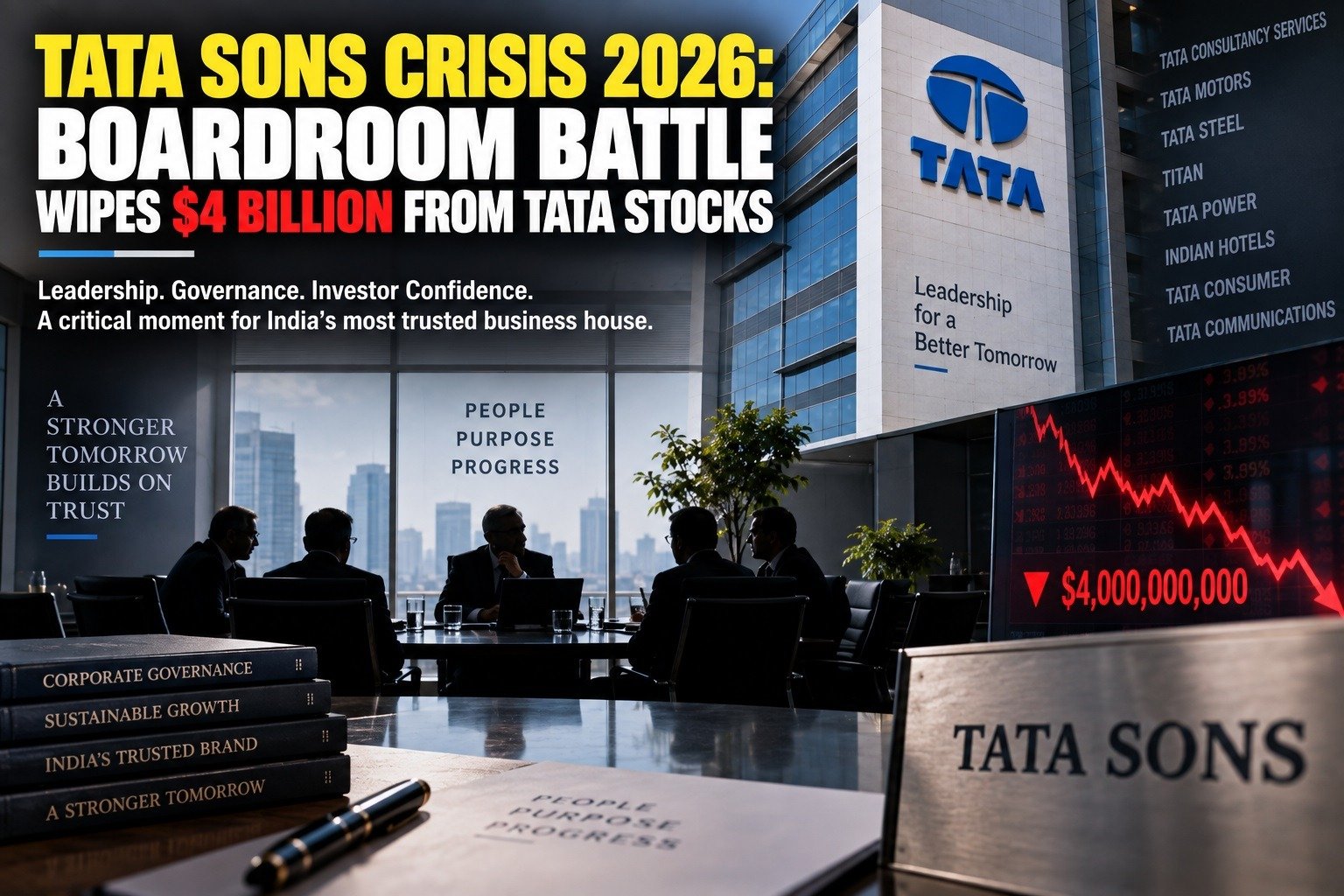
Shares of several Tata Group companies came under pressure after a dramatic boardroom dispute at Tata Sons, the group’s principal holding company and promoter. Tata Group companies collectively lost approximately $4 billion in market value during Friday’s trading, according to Reuters, as investors reacted to uncertainty surrounding governance, leadership and the future structure of Tata Sons.
The immediate trigger was extraordinary.
The Tata Sons board backed N. Chandrasekaran for another five-year term as executive chairman, despite his earlier decision to step down when his current term ends in February 2027. At the same time, the board moved towards complying with regulatory requirements that could lead to a listing of Tata Sons.
Both decisions were opposed by Tata Trusts, which holds about 66% of Tata Sons.
And that is where a corporate disagreement became a market story.
What actually happened inside Tata Sons?
The sequence matters.
On August 12, Chandrasekaran had informed the board that he would not seek another term. Tata Trusts accepted that decision and a succession process began.
Then came the September 17 board meeting.
The board asked Chandrasekaran to reconsider. He agreed. The board subsequently voted 4–1 in favour of reappointing him for another five years. Noel Tata, chairman of Tata Trusts and a Trust-nominated director, voted against the resolution.
Tata Trusts subsequently challenged the validity of the decision, arguing that Chandrasekaran’s earlier decision to step down had already been accepted and that the succession process had begun.
Tata Sons, meanwhile, has proceeded on a different interpretation of its governing documents and has obtained legal advice supporting its position. The legal validity of the reappointment is therefore contested, not settled.
That distinction is important.
This is not simply “the board versus one shareholder.” It is a dispute over how control is supposed to work inside Tata Sons.
The unusual Tata ownership structure
Here lies the heart of the matter.
Tata Trusts owns approximately 66% of Tata Sons. Tata itself describes Tata Sons as the principal investment holding company and promoter of Tata companies, while the Trusts’ shareholding supports philanthropic activities in areas including education, healthcare, livelihoods, and culture.
But majority ownership does not mean that every corporate decision can be reduced to a simple arithmetic exercise.
Tata Sons has special provisions in its Articles of Association governing important matters and the role of Trust-nominated directors. The current dispute revolves partly around how those provisions interact with majority shareholder rights, board authority and company law.
In other words:
66% ownership does not automatically answer every governance question.
That is why the dispute is potentially much more consequential than a disagreement over one chairman.
Then there is the Tata Sons listing question
The leadership dispute is running alongside another major issue: whether Tata Sons should become a publicly listed company.
The Reserve Bank of India had classified Tata Sons under its enhanced regulatory framework for large non-banking financial companies. Tata Sons had sought to surrender its Core Investment Company registration, but the RBI rejected that application on September 11.
The Tata Sons board has now decided to initiate steps towards complying with the applicable RBI requirements, potentially putting a listing back at the centre of the group’s future.
Tata Trusts opposes that direction and has argued that alternatives should be explored to allow Tata Sons to remain privately held.
This is not a trivial disagreement.
A listed Tata Sons would mean greater public disclosure, market scrutiny and shareholder expectations at the very top of the Tata structure.
It could also change how investors view the relationship between Tata Sons and its operating companies.
Why did the stock market react so sharply?
Because investors dislike uncertainty.
On September 18, Tata Consultancy Services fell sharply, while Tata Chemicals recorded an even steeper decline. Reuters reported TCS down 3.88% and Tata Chemicals down 11.04% during the session, while some other Tata companies, including Tata Power and Tata Capital, moved differently.
That last detail is revealing.
The market did not treat every Tata company identically.
Each listed Tata company has its own board, management, financial performance and industry exposure. Tata itself says its operating companies function independently under their respective boards.
Therefore, the $4-billion headline should not be interpreted as $4 billion of operating losses suddenly appearing inside Tata businesses.
It was primarily a change in market valuation driven by investor sentiment and uncertainty.
Markets, after all, are perfectly capable of panicking before the accountants have finished their tea.
The bigger concern: governance risk
The real question for investors is not simply whether Chandrasekaran stays.
It is whether Tata Sons can maintain a clear and credible mechanism for resolving disagreements between its board and controlling shareholder.
That matters because Tata is no longer merely an Indian industrial house.
The group operates across more than 100 countries and six continents. Tata companies collectively reported more than $180 billion in revenue in 2024–25 and employ more than one million people, according to Tata’s own corporate information.
Its businesses range from software and steel to automobiles, aviation, power, hotels, consumer products, electronics and emerging technology.
A governance dispute at the holding-company level therefore has potential consequences far beyond a Mumbai boardroom.
It can affect how lenders, investors, employees, joint-venture partners and global business partners perceive decision-making at the group level.
This is not simply another Cyrus Mistry episode
The comparison with the 2016 Tata Sons leadership crisis is inevitable.
But the two episodes should not be treated as identical.
The earlier conflict involved Cyrus Mistry’s removal and eventually travelled through India’s corporate-law tribunals and the Supreme Court. The present dispute has a different sequence: Chandrasekaran announced his intention to leave, a succession process began, the board subsequently reversed direction and Tata Trusts challenged that decision while simultaneously opposing the listing proposal.
History provides context.
It does not provide the verdict.
What happens next?
The immediate battle is likely to move beyond the boardroom.
The Chandrasekaran reappointment and his directorship will face the shareholder process. Tata Trusts may continue challenging the board’s interpretation of the Articles. The proposed Tata Sons listing will also require regulatory and corporate steps.
There is also the possibility of legal proceedings over specific governance questions.
At the same time, the Tata Group still has businesses to run.
That may sound obvious, but it is precisely the point.
Air India needs execution. Tata’s electronics and semiconductor ambitions require enormous capital and patience. Tata Consultancy Services operates in a rapidly changing global technology market. Jaguar Land Rover faces its own international challenges. The group cannot pause its operating businesses while its holding-company architecture is debated.
DOONITED Editorial Perspective: The real asset under examination is trust
The most interesting part of the Tata crisis is that the immediate financial damage is measurable, but the more important asset is not.
It is institutional credibility.
Tata’s unique model has historically attempted to combine commercial enterprise with a wider social and philanthropic purpose. Tata says 66% of Tata Sons is held by philanthropic trusts, with dividends supporting charitable work.
That structure gives Tata a distinctive identity.
But distinctive governance structures also need exceptionally clear rules.
The present dispute demonstrates a basic corporate lesson: governance systems are not truly tested when everyone agrees. They are tested when powerful stakeholders disagree.
The Tata Group now has an opportunity to demonstrate that its governance framework can withstand exactly that kind of disagreement without allowing uncertainty to become a permanent feature of the institution.
For investors, the lesson is equally important.
A famous name is not a substitute for governance clarity. A large market capitalisation is not protection against institutional uncertainty. And a trusted corporate legacy still has to be maintained one decision at a time.
The $4-billion market-value loss is therefore the headline.
The deeper story is about something harder to price:
Who has the final say at Tata Sons — and can the institution make that answer clear without damaging the trust on which the Tata name was built?
That question will matter far beyond September 18, 2026.
Reader Insight
The Tata episode offers a useful lesson for every large company, family business and investor: ownership, management and governance are three different things. A company can have a powerful shareholder and an experienced board and still face uncertainty if the rules governing their relationship are not sufficiently clear.
In modern business, reputation may take generations to build.
A governance dispute can test it in a single afternoon.


World Beyond the News
Why Elephants Stay Close to Their Herd
Elephants live in highly social family groups and use calls, touch and body movements to maintain strong bonds.
Most of the Deep Ocean Remains Difficult to Explore
Extreme pressure, darkness and distance make deep-ocean exploration one of Earth’s greatest scientific challenges.
Spacecraft Can Travel Without Traditional Roads
Spacecraft use carefully calculated trajectories and gravity assists to travel enormous distances through space.
Why Movie Trailers Are Released in Stages
Major films often use teaser trailers, full trailers and final promotional spots to build awareness over time.