When a rural product meets an urban customer
A bamboo bag from Assam can look very different once it is placed beneath the lights of a Gurugram marketplace.
The material may have come from a familiar rural resource. The technique may have been inherited. But the customer standing in front of the stall may be a corporate employee, a young urban household or a buyer looking for something distinctive for a modern home.
That meeting is the real significance of the SARAS Aajeevika Mela.
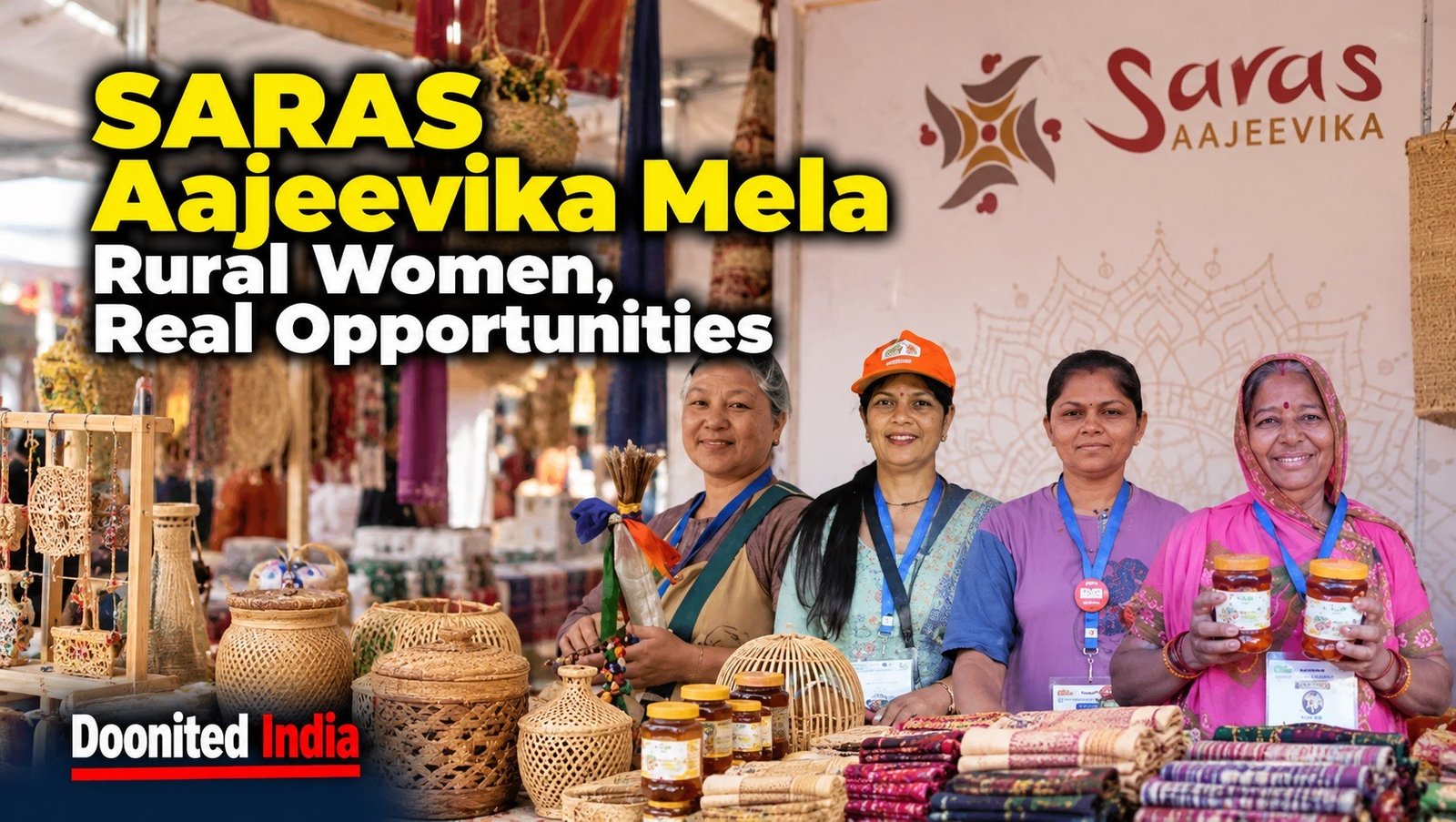
The Ministry of Rural Development has scheduled the next national-level SARAS Aajeevika Mela at Leisure Valley Park, Gurugram, from October 22 to November 6, 2026. The event is part of the Deendayal Antyodaya Yojana–National Rural Livelihoods Mission (DAY-NRLM), which uses Self-Help Groups (SHGs) as a platform for rural livelihoods and women-led enterprises.
The mela is officially designed to connect rural producers directly with urban consumers, improve market access and strengthen capabilities in areas such as packaging, branding, logistics and digital marketing.
That sounds like a fair.
Economically, it is something more interesting: a temporary laboratory for rural businesses.
The first lesson: make what people will buy
Traditional skill is valuable, but skill alone does not create a sustainable enterprise.
A craftswoman may know how to weave bamboo beautifully. A woman may possess a family recipe for papads. An SHG may know how to stitch garments. But the urban market asks additional questions.
Will somebody buy it?
At what price?
Can it be packaged?
Can it survive transportation?
Can the same quality be produced repeatedly?
And, perhaps most importantly, will the customer return?
The experience of Vishakha Didi from Assam illustrates this transition.
According to a September 2026 PIB backgrounder, Vishakha joined an SHG in 2014 and subsequently revitalised her father-in-law’s bamboo craft enterprise by introducing new designs and pursuing wider markets. Her participation in exhibitions, including the India International Trade Fair in Delhi in 2025, helped her achieve sales exceeding ₹2 lakh.
The interesting part is not simply the sales figure.
It is the redesign.
Traditional bamboo did not have to disappear for the product to become contemporary. The enterprise changed the form and market positioning of the craft while retaining the underlying material knowledge.
That is how heritage becomes commerce without becoming merely a museum object.
Suparna Didi: when a kitchen becomes a production unit
Food offers a different route into the same market.
Suparna Didi from West Bengal began with a small SHG in 2011, bringing together ten women to produce papads and regional food products from home kitchens. The enterprise subsequently expanded, with Suparna coordinating multiple SHGs in her gram panchayat.
At the 2026 Gurugram SARAS fair held earlier in the year, her group sold more than ₹50,000 worth of products in its first week, according to the Ministry’s account, with reported profit margins of 60–70% over production cost.
The model is particularly revealing.
There is no giant factory hidden behind the stall.
Women produce from their homes. Products are aggregated, packaged and marketed collectively.
That decentralised structure can turn scattered household production into a recognisable business while allowing women to remain within their local communities.
Suparna’s story also demonstrates why an exhibition sale should not be judged only by the amount of money taken at the counter.
The same PIB account says participation in exhibitions in Delhi, Noida, Punjab and Darjeeling has generated average earnings of around ₹1 lakh per event.
A fair can therefore function as customer acquisition.
The customer who buys a packet of papad today may become a repeat buyer tomorrow—provided the producer has the packaging, delivery system and contact channel to reach them again.
Sanjeevani Mahila SHG: from tailoring to employment
The Maharashtra story brings the transition into even sharper focus.
Members of the Sanjeevani Mahila SHG from Nagpur have developed cotton shirts and sarees through a rural production unit. What began as small-scale tailoring has grown into a structured enterprise employing more than 30 women, with support from the Maharashtra State Rural Livelihood Mission and local administration.
The group is reported to source cotton from local farms and undertake value addition through its production system.
The products have identifiable price points: the PIB account lists cotton shirts at approximately ₹600, with sarees ranging from ₹2,000 to ₹5,000. It also reports seasonal revenues of approximately ₹8–9 lakh from participation in exhibitions in major cities.
Here the transformation is no longer simply from artisan to seller.
It is from small producer to employer.
That is a much more consequential stage of rural entrepreneurship.
When an SHG creates regular work for additional women, the economic impact begins spreading beyond the original entrepreneur. Skills circulate. Household incomes change. Production becomes more organised. Machinery becomes worthwhile. Orders can be accepted at a larger scale.
A mela can help create the customer relationship that makes that expansion possible.
The fair is also a classroom
One of SARAS’s less visible functions may ultimately be among its most valuable.
The Ministry says its Knowledge and Learning Pavilion provides training in packaging, branding, business proposals and digital marketing, alongside sessions on logistics and transportation management. The programme also promotes awareness of the E-SARAS marketplace so that sales can potentially continue after the physical event ends.
This matters because rural enterprises face a problem that has little to do with craftsmanship.
They often know how to make the product.
They may not know how to build the business around it.
Packaging affects shelf life and perceived value. Branding affects recognition. Logistics determines whether a ₹300 product remains profitable after travelling 1,000 kilometres. Digital marketing determines whether the customer can find the producer again.
The difference between a craft and a business is often everything surrounding the craft.
The “Lakhpati Didi” idea—and its limits
SARAS is closely associated with the government’s Lakhpati Didi initiative, which seeks to help women SHG members achieve annual household income of at least ₹1 lakh through sustainable livelihood activities.
The concept is important because it changes the vocabulary of rural development.
A woman is not described only as a beneficiary receiving assistance.
She is potentially a producer, entrepreneur, employer, supplier and taxpayer.
But the distinction between an exhibition success and a sustainable business must remain clear.
A ₹2 lakh sales month—or a ₹9 lakh seasonal turnover—does not automatically equal household income or profit. Revenue still has to cover raw materials, wages, transport, packaging, stall-related expenses, equipment, finance costs and unsold inventory.
This is where public programmes should be judged carefully.
The real question is not simply how much was sold at SARAS.
It is how many businesses continue selling six months later.
The missing piece: what happens after the lights go out?
This is where the SARAS model faces its most important test.
An urban fair provides something that rural producers normally find difficult to obtain: concentrated access to thousands of potential customers.
But a 17-day marketplace cannot become a permanent business model by itself.
For the transition to last, producers need repeat orders, institutional buyers, reliable logistics, digital payment and ordering systems, appropriate working capital and access to markets beyond government exhibitions.
The government itself recognises this by emphasising E-SARAS, e-commerce linkages, packaging and logistics training.
The objective should therefore be to make the mela the beginning of a customer relationship, not its conclusion.
That distinction could determine whether the event creates temporary income or lasting enterprise.
Four women, four different business lessons
The stories documented around the 2026 SARAS programme reveal different routes from traditional skill to enterprise.
Vishakha Didi shows how product redesign can make inherited bamboo craft relevant to contemporary consumers.
Suparna Didi demonstrates how home-based food production can become a decentralised collective enterprise when women aggregate production and market together.
Sanjeevani Mahila SHG demonstrates the employment multiplier: a tailoring activity can evolve into organised production employing more than 30 women.
And Shobhita Didi from West Bengal illustrates another route: beginning with an SHG in 2006, she expanded her leadership across hundreds of SHGs while developing jute and wood-based products and connecting with urban markets.
These are not identical success stories.
That is precisely why they are useful.
There is no single formula for rural entrepreneurship.
Gurugram as the marketplace test
The location itself is revealing.
Leisure Valley Park sits in one of India’s most recognisable corporate urban environments. Gurugram is associated with technology companies, finance, multinational offices and high-income consumption.
SARAS temporarily inserts another economy into that landscape: one based on handwork, agricultural materials, home production, food traditions and collective enterprise.
The encounter works both ways.
Urban consumers discover products they may not otherwise encounter. Rural producers observe what urban customers actually pick up, ask about, reject or return to buy.
That feedback can be more valuable than a generic market survey.
A customer asking for a smaller bamboo basket is market intelligence.
Someone rejecting a food product because the packaging is inconvenient is market intelligence.
A buyer willing to pay more for a well-finished handloom garment is market intelligence.
The mela becomes a live focus group—only one where people actually buy the products.
The bigger opportunity for India
India’s rural economy does not need to choose between tradition and modern commerce.
The more promising model is to connect the two.
Bamboo can become contemporary design. Regional food can become a packaged product. Handloom can become everyday clothing. Agricultural residue can become art. A village tailoring unit can become an employer.
The challenge is to ensure that value addition happens close enough to the producer that rural communities capture a meaningful share of the final value.
That is where SHGs can be powerful.
They provide collective purchasing, production, training and market access that an individual rural producer may struggle to achieve alone.
But collective organisation must ultimately connect to actual demand.
No amount of branding can permanently rescue a product that consumers do not want.
And no amount of consumer enthusiasm can sustain a business that cannot deliver consistently.
The real success metric
When the SARAS Aajeevika Mela opens in Gurugram on October 22, the easiest success metric will be crowds.
The more meaningful ones will be harder to see.
How many first-time customers become repeat buyers?
How many exhibitors receive orders after returning home?
How many women increase production without taking on unsustainable debt?
How many enterprises create additional employment?
How many traditional products find new markets without losing the knowledge and identity behind them?
Those are the numbers that can turn a government-supported fair into a genuine rural-enterprise ecosystem.
For visitors, the message is simple: buying from an SHG stall is not merely shopping for something different. It can be a vote for a business model in which the producer is closer to the customer and more visible in the value chain.
For policymakers, the lesson is even more important.
The best SARAS mela would not be the one where every stall sells out.
It would be the one where many of those stalls no longer need the next mela to survive.


World Beyond the News
Octopuses Can Change Their Appearance
Octopuses can rapidly alter their skin colour and texture to communicate, camouflage themselves and respond to danger.
Some Cities Exist Across Two Continents
A small number of cities are geographically associated with two continents, creating unusual cultural and geographic identities.
Earth’s Climate Is Measured in Many Ways
Scientists track temperature, atmospheric gases, sea level, ice cover and other indicators rather than relying on a single climate number.
Streaming Changed How Audiences Discover Shows
Recommendation systems and global streaming releases allow audiences to discover programmes far beyond their original markets.