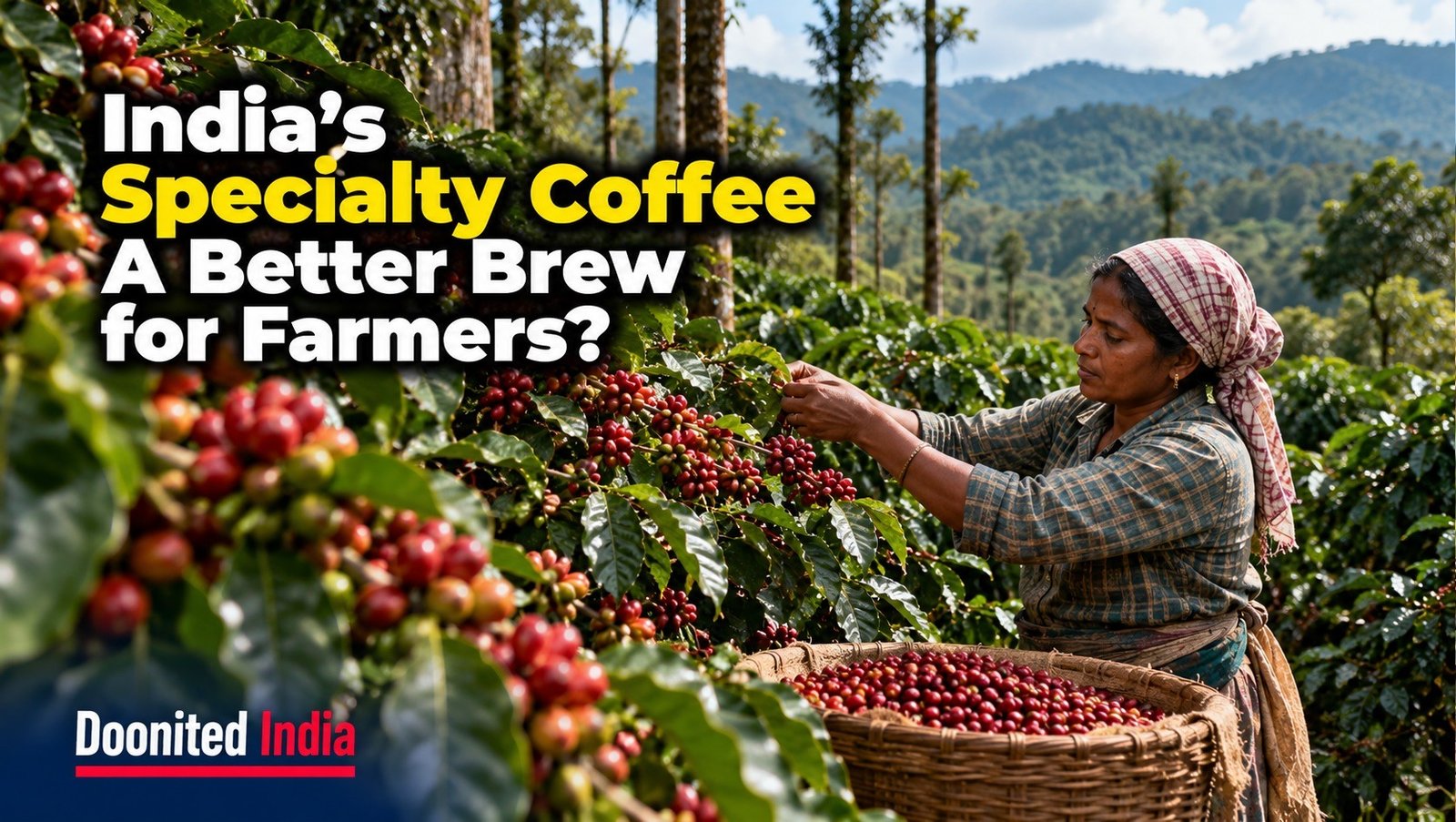
India’s Specialty Coffee Boom: Will the Farmer Finally Get a Better Share?
India’s coffee is moving from commodity shelves to specialty cafés and global premium markets. But the real test of the coffee revolution is not how much consumers pay for a cup—it is whether more of that value reaches the people who grow the beans.
For decades, Indian coffee was better known internationally as an export commodity than as a story consumers could follow back to a particular farm.
That is changing.
A bag of coffee can now carry the name of a region, estate, processing method or even a particular farmer group. Indian specialty roasters are talking about traceability and single-origin beans. Araku, Coorg, Chikmagalur and other Indian coffee regions increasingly appear on menus aimed at consumers who want to know not only what they are drinking, but where it came from.
The transformation looks impressive from the café counter.
But there is a more important question hiding behind the aroma: is India’s specialty-coffee revolution also becoming a farmer-income revolution?
The answer, so far, is promising—but far from universal.
India is producing more coffee, and the world is buying it
India’s Coffee Board estimates total coffee production at 3.73 lakh tonnes for 2025–26, comprising 1.11 lakh tonnes of Arabica and 2.62 lakh tonnes of Robusta. Its latest post-blossom estimate for 2026–27 rises to 4.04 lakh tonnes. Karnataka remains overwhelmingly important, followed by Kerala and Tamil Nadu.
Government figures also underline how export-oriented the sector remains. India exports roughly 70% of its coffee to markets around the world. Coffee exports during April–October of FY2025–26 were valued at $1.176 billion, about 12% higher than the corresponding period a year earlier.
There is therefore no shortage of evidence that Indian coffee has become a serious global agricultural export.
But production and exports tell only half the story.
The other half is who captures the value.
The coffee farmer is not a footnote
India’s coffee industry has an unusually broad smallholder base.
Coffee Board statistics list 442,753 coffee holdings for 2024–25. Of these, 439,891 were holdings below 10 hectares, compared with only 2,862 above 10 hectares. That means small holdings account for roughly 99.4% of the listed holdings.
This matters because specialty coffee can reward quality, but producing quality is not free.
Specialty coffee depends on careful harvesting and processing. The Coffee Board notes that specialty preparation involves selective harvesting of ripe berries, careful fermentation, washing where appropriate, slow drying and meticulous grading.
In other words, the farmer is being asked to do more than simply grow coffee.
A specialty lot may require better harvesting discipline, additional labour, careful processing, drying infrastructure, quality control and reliable separation from ordinary coffee.
The premium therefore has a cost attached to it.
That is one reason the popular narrative—specialty coffee means higher price, therefore farmers automatically become richer—is too simple.
The premium exists. Access to it is the real issue.
The Coffee Board itself describes specialty coffee as a segment that can attract better prices and premiums because of origin, cultivation, processing, quality and branding. India already has recognised specialty coffees including Monsooned Malabar AA, Mysore Nuggets Extra Bold and Robusta Kaapi Royale.
The problem is scale.
A farmer cannot simply announce that a crop is “specialty” and expect a premium.
The coffee has to meet quality requirements. It needs buyers who value that quality. And the farmer needs the capacity to preserve the quality between harvest and sale.
That creates a divide between producing specialty coffee and having access to the specialty market.
The Coffee Board’s own material on smallholder groups makes this point indirectly. It records past difficulties involving quality consistency and marketing capability, while noting that some producers have succeeded in obtaining premiums through better quality and marketing.
That is perhaps the least glamorous part of the specialty-coffee story.
The farmer needs not only a good bean, but also a route to the right buyer.
Araku offers a different model
One of India’s most interesting experiments comes from the Araku Valley in Andhra Pradesh.
The Araku model brings around 10,000 farmers into a cooperative structure, combining cultivation, processing and marketing. According to Araku’s own published model, farmers own their plots, receive agricultural support, sell cherries to the organisation and are paid on the day of harvest. The organisation says this integrated structure allows more value to be returned to farmers rather than being absorbed by multiple intermediaries.
Araku also says its cooperative guarantees farmers a price above the world-market level; its commercial material currently describes a purchase price 2.5 times the world price. That is a company claim rather than an independently audited national benchmark, so it should be treated as evidence of the model’s stated approach, not as proof that every Indian coffee farmer can obtain comparable returns.
Nevertheless, the underlying lesson is significant.
The route from farm to consumer matters.
If farmers sell only an undifferentiated commodity, they have limited control over the final value.
If farmers participate in aggregation, processing, branding or direct relationships with buyers, a greater share of the value chain can potentially remain closer to the producer.
That is not a coffee-specific lesson. It is a broader agricultural-business lesson.
Climate may decide how far the specialty story can go
There is another complication: coffee quality begins with agriculture, and agriculture is increasingly exposed to weather volatility.
The Coffee Board identifies soil erosion during the monsoon and post-monsoon moisture shortages as important plantation-management problems. Its research material also describes white stem borer as a serious pest of Arabica and notes increasing flare-ups associated with erratic rainfall and rising temperatures.
Arabica is particularly vulnerable.
Coffee Board guidance says Arabica requires more care than Robusta and is susceptible to white stem borer and leaf rust.
This creates an uncomfortable contradiction for the premium-coffee industry.
Consumers increasingly want delicate, distinctive coffees. But some of those coffees can also be among the more demanding crops to produce.
A farmer facing pest pressure, irregular rainfall, rising labour costs and higher processing requirements cannot be expected to absorb every risk simply because a café customer is willing to pay more.
India should not confuse a premium cup with a premium farming system
This is where India’s coffee conversation needs greater honesty.
A ₹300 or ₹400 specialty beverage does not mean the farmer received a proportionately higher price for the cherries.
Between plantation and cup sit harvesting, sorting, processing, curing, transportation, roasting, packaging, rent, equipment, staff, taxes, marketing and retail margins.
The final café price is therefore a very poor proxy for farm income.
What matters is the realised price at the farm gate and the farmer’s net return after additional production costs.
That distinction should become central to India’s specialty-coffee debate.
There are encouraging examples. There are cooperatives. There are direct sourcing models. There are increasingly sophisticated Indian roasters. There is stronger consumer interest in origin and quality. The Coffee Board itself is promoting value addition and specialty markets.
But none of these developments guarantees broad-based farmer prosperity.
The next coffee revolution should be measured at the farm
India’s coffee story has already moved well beyond the old image of a plantation crop quietly shipped overseas.
It is now part of a global conversation about specialty agriculture, traceability, regional identity, sustainability and premium consumption.
That is good news.
But the industry should resist the temptation to declare victory from the café menu.
The real measure of success should be much less photogenic: better and more predictable net returns for growers, stronger farmer organisations, improved access to processing infrastructure, transparent pricing, climate resilience and the ability of smallholders to participate in premium markets without taking on disproportionate risk.
There is an irony here.
The more sophisticated coffee becomes at the consumer end, the more important the farmer becomes at the beginning.
A barista can explain the altitude, variety, fermentation and tasting notes. A beautifully designed packet can tell the story of an estate. A café can turn provenance into a premium.
But none of that matters if the person who grew the coffee remains the least powerful participant in the chain.
India’s specialty-coffee revolution will be truly successful not when the world learns to pronounce Chikmagalur or Araku correctly, but when more farmers can say that the premium attached to those names has changed their economics too.
The future of Indian coffee may therefore depend on a simple question: can India move from selling better coffee to building better value chains for the people who grow it?


World Beyond the News
Why Elephants Stay Close to Their Herd
Elephants live in highly social family groups and use calls, touch and body movements to maintain strong bonds.
Most of the Deep Ocean Remains Difficult to Explore
Extreme pressure, darkness and distance make deep-ocean exploration one of Earth’s greatest scientific challenges.
Spacecraft Can Travel Without Traditional Roads
Spacecraft use carefully calculated trajectories and gravity assists to travel enormous distances through space.
Why Movie Trailers Are Released in Stages
Major films often use teaser trailers, full trailers and final promotional spots to build awareness over time.