India’s Gold Habit Is Changing: When Tradition Meets Record Prices
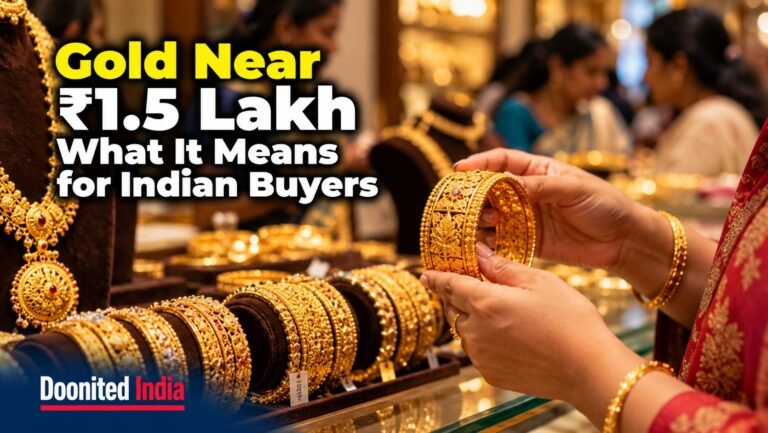
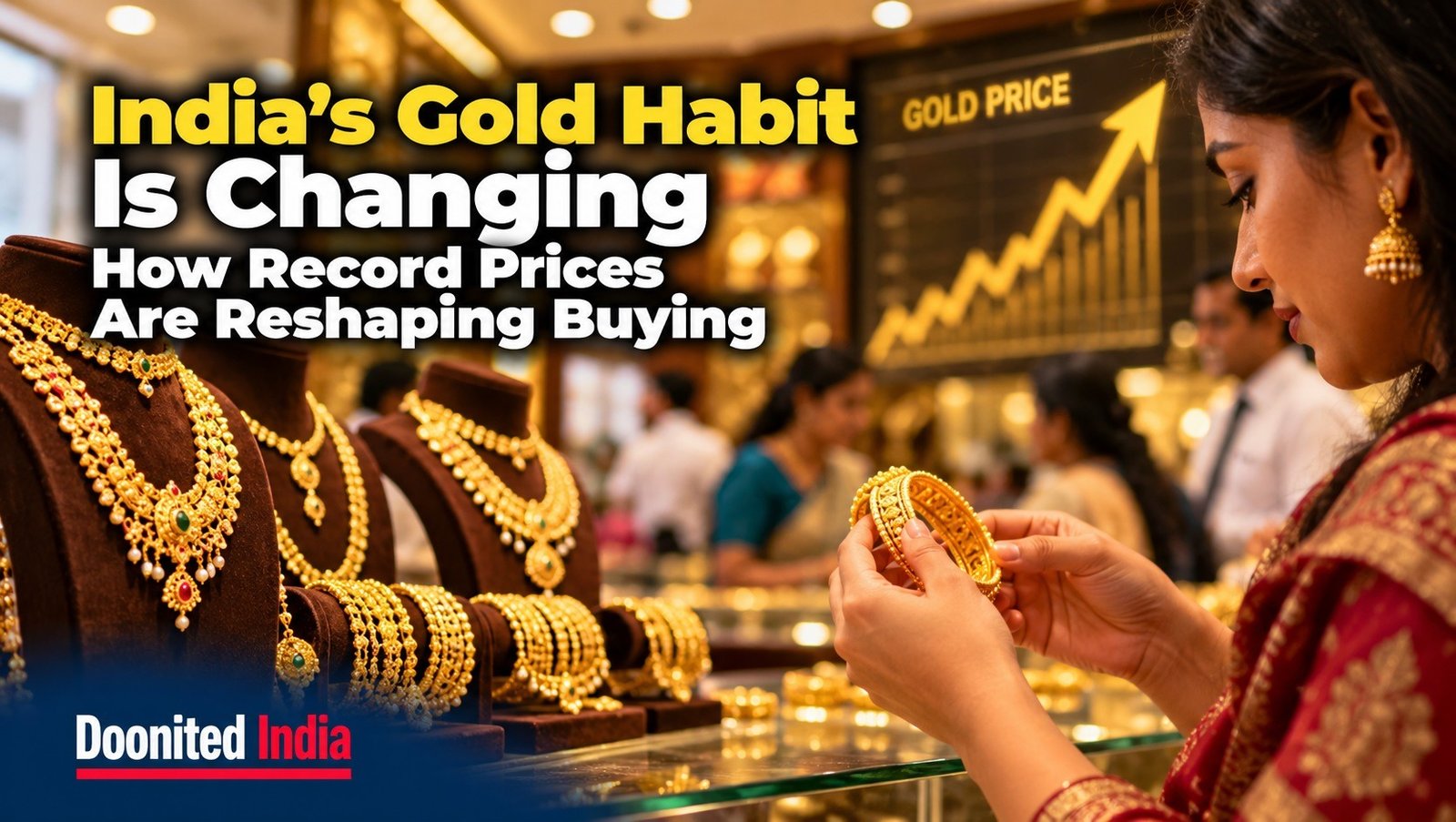
For generations, Indians have treated gold as jewellery, inheritance, emergency wealth and cultural memory. Now, with prices at historically high levels, the country is learning a new way to own the yellow metal: fewer grams, smarter exchanges and a sharper distinction between wearing gold and investing in it.
There is an old Indian financial instinct that needs no spreadsheet.
A family buys gold. A daughter receives it at marriage. A grandmother keeps jewellery carefully wrapped away. Years later, when money is needed, the same gold can be exchanged, pledged or sold.
Gold has never fitted neatly into the categories created by modern finance.
It is jewellery, but it is also savings. It is an ornament, but it can become collateral. It carries emotional value, yet it has a market price that is quoted every day.
That unusual combination is precisely why India’s relationship with gold is surviving the latest price shock.
But it is changing.
The latest data from the World Gold Council shows the scale of that adjustment. Indian gold demand in the second quarter of 2026 fell 6% year-on-year to 131 tonnes, while spending reached a record ₹1,979 billion for a second quarter, up 35% year-on-year. Jewellery demand fell 15% to 75 tonnes, yet jewellery spending increased 34% to ₹1,132 billion.
In other words, Indians bought less gold but spent considerably more money on it.
That may be the most revealing gold story in India today.
The gram is becoming less important than the rupee
When gold was relatively affordable, the conversation could be about grams.
At very high prices, consumers increasingly think in budgets.
A family may still decide that it wants a gold necklace for a wedding. But instead of asking how much gold the necklace contains, the first question increasingly becomes: What can we buy within ₹1 lakh, ₹2 lakh or ₹5 lakh?
That changes design.
The World Gold Council reported that India’s high gold prices accelerated demand for lighter-weight, lower-carat and studded jewellery during Q2 2026. Retailers also reported a 10%–20% rise in exchange volumes, with exchange transactions accounting for as much as 70% of sales at some outlets.
This is not necessarily a rejection of gold.
It is a form of adaptation.
Instead of abandoning the tradition, consumers are reducing the quantity required to participate in it.
That may explain why the Indian gold market can experience falling physical volumes while the value of consumer spending continues to rise.
The wedding has not disappeared—but the jewellery is changing
Gold’s cultural role is particularly difficult to separate from weddings.
Across India, jewellery can represent family wealth, social identity, gifting and continuity between generations. But expensive gold creates a tension between tradition and affordability.
The solution emerging in the market is not necessarily to abandon the wedding purchase.
It is to redesign it.
Lighter necklaces. Smaller earrings. Lower-carat products. Studded designs. More versatile pieces that can be worn beyond the wedding itself.
The World Gold Council’s Q1 2026 research found that mass-market consumers were increasingly moving toward lighter-weight, lower-carat and studded jewellery, while higher-income buyers remained more capable of purchasing heavier pieces.
That distinction is important.
High gold prices do not affect every Indian household equally.
For affluent buyers, a rising gold price can increase the value of existing holdings without dramatically changing purchasing behaviour.
For middle-income and price-sensitive households, the same price rise can turn a traditional purchase into a budgeting exercise.
India’s gold market is therefore becoming more economically segmented.
Old gold is becoming new purchasing power
One of the most interesting developments is happening inside family cupboards.
Old jewellery is being brought back into the market.
The World Gold Council reported that old-for-new exchanges became an increasingly important source of demand during 2026. In Q1, exchange activity represented around 40%–60% of transactions across retailers, according to industry data cited by the Council. In Q2, retailers reported further increases in exchange volumes.
This changes the economics of a high-price market.
A customer does not necessarily have to find all the money for a new piece.
An old necklace can become part of the financing mechanism.
The family is effectively recycling an existing store of wealth rather than abandoning gold altogether.
There is also a wider economic implication.
Recycling old gold provides additional supply to the domestic market. The World Gold Council estimated that recycled gold accounted for 16% of India’s gold supply in Q2 2026, helping compensate for weaker imports.
The old jewellery box is therefore not merely sentimental storage.
In a high-price environment, it can become part of the market’s supply chain.
Gold is also a financial emergency valve
The Indian relationship with gold goes beyond buying and selling.
Gold can also be pledged.
The World Gold Council reported that retail bank loans backed by gold jewellery reached ₹4.3 trillion at the end of February 2026, up 124% year-on-year.
The figure demonstrates why calling gold merely a “luxury purchase” misses something fundamental about India.
A gold ornament may sit unused for years. But it can potentially be converted into borrowing capacity when a household needs liquidity.
The Reserve Bank of India has long maintained prudential rules around lending against gold jewellery, including valuation and loan-to-value requirements. RBI has also warned lenders about irregular practices in gold-loan operations and emphasised proper assaying, ownership verification, custody and related controls.
That financial functionality helps explain gold’s resilience.
A share certificate does not attend a wedding.
A bank deposit does not carry the same cultural symbolism.
And a gold necklace can, under the right circumstances, become collateral.
Gold occupies an unusual space because all three possibilities can coexist.
But jewellery is not automatically an investment
This is where Indian consumers need to make a distinction.
Buying gold jewellery and investing in gold are not identical decisions.
Jewellery includes manufacturing costs, design premiums and other charges. The resale economics can therefore differ significantly from the headline gold price.
Someone buying jewellery primarily as an investment should understand that the value of the underlying metal is only part of the equation.
For investment purposes, consumers may instead consider products such as bars, coins or regulated financial products linked to gold, depending on their objectives and applicable rules.
The World Gold Council’s 2026 data shows that Indian investment demand remains significant. Q2 investment demand was 54 tonnes, and first-half bar-and-coin demand reached 63 tonnes; gold ETF holdings also rose substantially during the first half.
The market is therefore developing two increasingly distinct gold cultures:
Gold that people wear.
And gold that people own for financial exposure.
They overlap, but they should not be confused.
The rise of “smarter gold”
High prices are also forcing consumers to become more analytical.
The WGC–Kantar consumer research conducted across 12 Indian metro and Tier-I cities found that consumers were increasingly comparing prices, exchange offers, discounts and payment options. The survey also found stronger purchase intent for investment gold than jewellery and increasing interest in lighter, lower-carat pieces and smaller, less frequent purchases.
That is a subtle but important cultural change.
For generations, gold buying could be driven heavily by tradition.
Now tradition is increasingly negotiating with spreadsheets.
The Indian buyer is asking:
- How many grams am I getting?
- What purity is it?
- How much is the making charge?
- What will I receive if I exchange it?
- Is this jewellery or an investment?
- Can I afford to wait?
- Would another form of gold exposure make more sense?
Gold has not become less emotional.
It has become more financially scrutinised.
Trust now needs a six-digit number
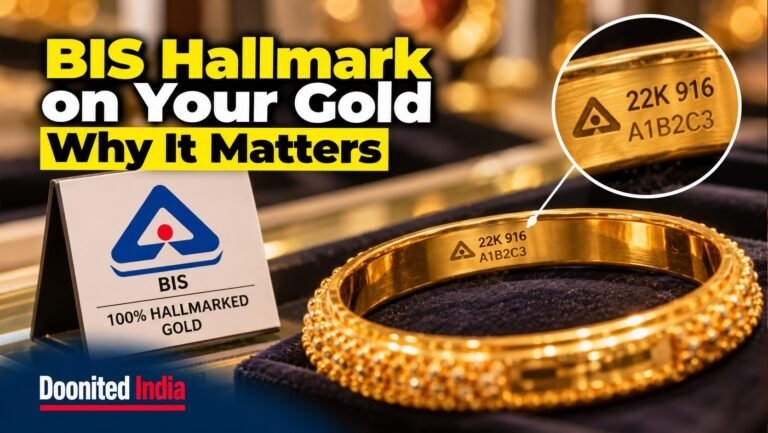
Modern gold buying also comes with a practical consumer-protection tool that previous generations did not have: HUID, or Hallmark Unique Identification.
BIS states that hallmarked gold jewellery carries the BIS logo, purity/fineness information and a unique six-digit alphanumeric HUID. Consumers can use the BIS Care App’s “Verify HUID” function to check the hallmarked item’s authenticity information.
BIS also advises consumers to obtain an authentic bill containing details such as the article description, net precious-metal weight, purity and fineness.
For an asset whose value depends heavily on purity and weight, this is more than administrative detail.
It is the modern version of trust.
The family may still trust its jeweller.
But now the buyer has a verification mechanism too.
The strange economics of record prices
There is a paradox at the heart of India’s gold market.
Rising prices can make gold less affordable while simultaneously making households more conscious of the value of the gold they already own.
That creates a feedback loop.
High prices discourage some new purchases.
But high prices can encourage exchanges.
They can make old jewellery more valuable.
They can increase interest in investment products.
And they can increase the financial value of gold already held by households.
This helps explain why gold demand cannot be understood simply by counting tonnes.
In Q2 2026, India’s gold demand was down 6% in volume terms, but spending was at a quarterly record. H1 jewellery demand was 141 tonnes, down 17% year-on-year, while jewellery demand value rose 26% to US$21 billion.
The Indian consumer is effectively adapting to the price by changing what “buying gold” means.
Gold’s future may be lighter—but not smaller
The future of Indian gold consumption may not be a story of abandoning tradition.
It may be a story of compressing tradition into fewer grams.
A bride does not necessarily need a heavier necklace to inherit the symbolism of gold.
A family does not necessarily need to purchase the same quantity every year.
An investor does not necessarily need to buy jewellery to own gold exposure.
And an emergency does not necessarily require selling a family’s entire gold holding if responsible secured borrowing is available.
The market is therefore becoming more flexible.
That flexibility could ultimately make gold more resilient.
The DOONITED view
India’s attachment to gold is often explained as emotion versus modern finance.
That is too simplistic.
Gold survived precisely because Indian households have never treated it as only one thing.
It can be culture and collateral. Jewellery and savings. A wedding gift and an emergency reserve. A family heirloom and a financial asset.
What is changing in 2026 is not that Indians have stopped trusting gold.
They are becoming more selective about how they trust it.
The record-price environment is forcing consumers to distinguish between owning gold and wearing gold, between emotional value and investment value, and between tradition and affordability.
That may be healthy.
Because the strongest traditions are not necessarily the ones that refuse to change.
They are the ones capable of changing without losing their meaning.
And India’s gold tradition appears to be doing exactly that—one lighter necklace, one old-for-new exchange and one carefully checked HUID at a time.


World Beyond the News
Bees Communicate Where Food Is
Honeybees use movement patterns known as waggle dances to communicate information about food locations.
Street Food Reflects Local History
Many famous street foods developed from migration, trade, local ingredients and the everyday needs of working communities.
A Day on Venus Is Extremely Long
Venus rotates so slowly that one rotation relative to distant stars takes longer than its trip around the Sun.
Human Achievement Continues to Push Limits
Athletes, engineers, scientists and explorers regularly establish new benchmarks in speed, endurance, scale and precision.