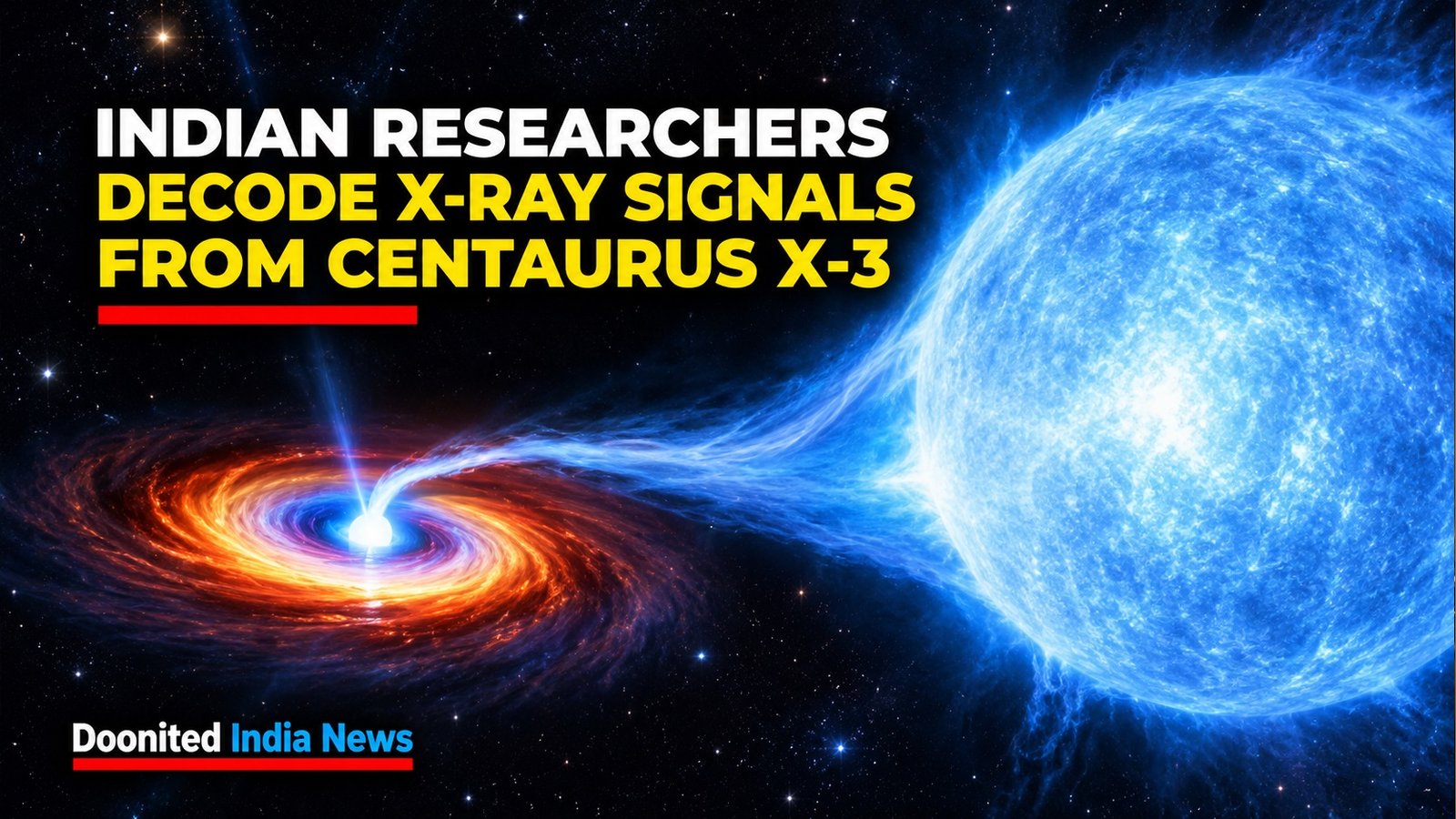
Indian Researchers Decode Hidden Cosmic Structure Around a Famous Neutron Star
A team led by Kinjal Roy at Bengaluru’s Raman Research Institute has traced changing X-ray signals from Centaurus X-3 to a rotating stream of matter feeding a neutron star. The findings offer new insight into how extreme stellar systems gather material and why astronomers may need to refine their models of this distant binary.
A cosmic mystery written in X-rays
Some of the most important discoveries in astronomy begin with something scientists cannot see directly.
Around 24,000 light-years from Earth, in the constellation Centaurus, a powerful stellar system has been revealing clues about the extraordinary forces operating near a neutron star. Known as Centaurus X-3, it is one of the best-studied X-ray pulsars and among the earliest such objects discovered by astronomers.
In October 2026, researchers at Bengaluru’s Raman Research Institute (RRI) reported new evidence about how this system acquires the material that powers its intense X-ray emissions. Led by researcher Kinjal Roy, the team investigated variations in four X-ray emission lines and identified a rotating stream of matter as the likely source of the changes.
The interpretation points to a significant feature of the system: material is being channelled towards the neutron star through an accretion disk, a structure that is not generally expected in the same way across high-mass X-ray binaries.
The finding matters because astronomers must understand not only the radiation reaching their instruments but also the physical structures that produce, absorb and redirect it.
What makes Centaurus X-3 extraordinary?
Centaurus X-3 belongs to a class of objects called high-mass X-ray binaries, or HMXBs. These systems contain a compact object, such as a neutron star, orbiting a much more massive companion star.
The neutron star is the remnant of a massive star that has undergone a supernova explosion. Its matter is extraordinarily compressed, while its gravitational field can draw surrounding material towards it.
As that material falls towards the compact object, it releases gravitational energy. Some of this energy emerges as X-rays, making the system detectable across enormous distances.
Centaurus X-3 is particularly interesting because its neutron star is a pulsar. It rotates and emits radiation associated with its magnetic poles. As the radiation sweeps through space, an observer can detect repeating changes in intensity, much like a lighthouse producing a regular beam of light.
The comparison is useful, but the physics is more complicated. The observed signal also carries information about the material surrounding the neutron star.
In many high-mass X-ray binaries, the compact object captures gas from the powerful stellar wind of its companion. A stable accretion disk is not the default expectation for every system in this category. The way material is transferred depends on the binary’s physical configuration and the behaviour of the gas.
Centaurus X-3 provides an opportunity to examine that process in detail.
Reading the evidence hidden in the signal
The RRI team’s approach illustrates how modern astronomy can reconstruct distant environments without resolving their individual structures in an image.
The researchers analysed archival observations from the European Space Agency’s XMM-Newton X-ray space observatory. Their investigation used pulse-phase-resolved spectroscopy, a technique that compares an object’s X-ray spectrum at different stages of its rotational cycle.
Instead of treating the incoming radiation as one continuous signal, astronomers divide it according to the pulsar’s rotation and examine how individual spectral features change.
The team studied four secondary emission lines associated with iron. These lines provide information about material surrounding the compact object because iron atoms and ions can absorb and re-emit radiation at characteristic energies.
The crucial clue was the relationship between the emission lines and the pulsar’s rotation.
The researchers found that the variations were consistent with a structure moving in step with the pulsar. They identified an accretion stream as the likely source of the changing secondary emission.
This stream is not simply an unrelated cloud of gas. It is part of the process through which material travels from an accretion disk towards the neutron star.
The distinction is important: the evidence came from the behaviour of the radiation, rather than from a direct photograph of the disk.
Why the two X-ray signals matter
The system produces radiation through more than one process.
Primary emission originates close to the neutron star and is associated with radiation emerging from its magnetic-pole regions. As the star rotates, the observed intensity changes with the orientation of the emission and the observer’s line of sight.
Secondary emission occurs when surrounding material absorbs and re-emits radiation. The resulting spectral lines can reveal the composition, ionisation state and changing geometry of the gas.
In Centaurus X-3, the researchers found a pattern that helps distinguish these contributions.
As the rotating accretion stream moves across the observer’s line of sight, it can obscure part of the direct emission from the pulsar. At the same time, the stream’s own reprocessed emission can become more prominent.
The result is a changing relationship between the direct X-rays and the secondary emission lines.
This is where spectroscopy becomes a powerful investigative tool. A distant system that appears as a point of light can still reveal information about its internal structure through carefully measured changes in its spectrum.
The reasoning follows a chain of evidence: variations in the emission lines indicate a structure associated with the pulsar’s rotation; the accretion stream explains those variations; and the stream’s role in delivering matter supports the inference that an accretion disk feeds the neutron star.
Why an accretion disk changes the picture
An accretion disk is a rotating structure of gas and other material that moves towards a compact object under gravity. As the material loses energy and angular momentum, it can spiral inward.
The disk does not mean that matter falls directly onto the neutron star without further interaction. A neutron star’s strong magnetic field can channel material from the inner accretion flow towards its magnetic poles.
This creates a connection between the larger-scale disk and the smaller-scale processes responsible for the pulsar’s radiation.
For Centaurus X-3, recognising that connection has consequences for how scientists interpret the observed X-ray spectrum.
If models attribute too much of the measured radiation to the stellar wind or the neutron star alone, they may fail to account adequately for emission originating in the disk and the stream.
Roy’s team has therefore highlighted the need for future emission models of Centaurus X-3 to include the disk’s contribution.
The finding should not be read as a claim that astronomers have solved every question about the system. Rather, it identifies a physical component that must be considered when interpreting its radiation.
That is a meaningful advance in a field where several processes can produce overlapping observational signatures.
A wider lesson for high-energy astronomy
The implications extend beyond one binary system.
High-mass X-ray binaries help scientists investigate how matter behaves under intense gravitational and magnetic forces. They also provide laboratories for testing models of plasma, radiation transfer and the interaction between stellar winds and compact objects.
Understanding their accretion mechanisms is important because different ways of transferring matter can produce different patterns of brightness, spectral features and variability.
The Centaurus X-3 study also demonstrates the value of revisiting archival observations. Existing data can yield fresh results when researchers ask more specific questions or apply a more detailed analysis to signals that were previously treated differently.
This approach is particularly valuable in space astronomy, where access to observatories is competitive and each observation represents a substantial investment of scientific resources.
The lesson is not that one technique can replace every other form of observation. It is that spectroscopy, timing analysis and physical modelling work best when their evidence is considered together.
India’s contribution to a global scientific effort
The research highlights the role of Indian scientific institutions in international astrophysics.
The Raman Research Institute is an autonomous research institution under India’s Department of Science and Technology. Its work on Centaurus X-3 draws on observations made by a European space observatory and contributes to a global effort to understand compact stellar systems.
This combination of international observational infrastructure and research expertise is characteristic of modern astronomy. Discoveries often depend on scientists analysing data collected by instruments operated far from their own institutions.
For India, the value lies not merely in the announcement of a new result but in the research capability behind it: the ability to interpret complex measurements, test competing explanations and improve the models used by the wider scientific community.
The study also offers a useful reminder about scientific progress. Not every advance requires a new telescope or a spectacular image. Sometimes, the breakthrough comes from understanding what an existing signal has been trying to reveal.
The universe does not always reveal its structure directly
Centaurus X-3 is thousands of times farther away than the objects we routinely observe in the night sky, yet its changing X-ray spectrum carries clues about the flow of matter around its neutron star.
By tracing four emission lines through the pulsar’s rotational cycle, the RRI team identified evidence for a co-rotating accretion stream and an associated disk-fed accretion process.
The result gives astronomers a stronger basis for refining models of this particular system and contributes to the broader study of how compact objects gather matter.
There is a wider lesson in the discovery: scientific understanding does not depend exclusively on seeing an object clearly. It also depends on learning to interpret the signals it sends.
In the case of Centaurus X-3, those signals have opened another window onto the complex physics of one of the universe’s most extreme stellar environments.


World Beyond the News
Birds Can Navigate Using Earth’s Magnetic Field
Several bird species can sense Earth’s magnetic field, helping them navigate during long-distance migration.
Fermentation Is a Global Food Tradition
People across continents have used fermentation for centuries to preserve food and create distinctive flavours.
Modern Batteries Store Energy Chemically
Rechargeable batteries repeatedly move ions between electrodes, allowing electrical energy to be stored and released.
Why Songs Become Global Hits
Streaming platforms, short-form video, playlists and international collaborations can rapidly carry music across borders.