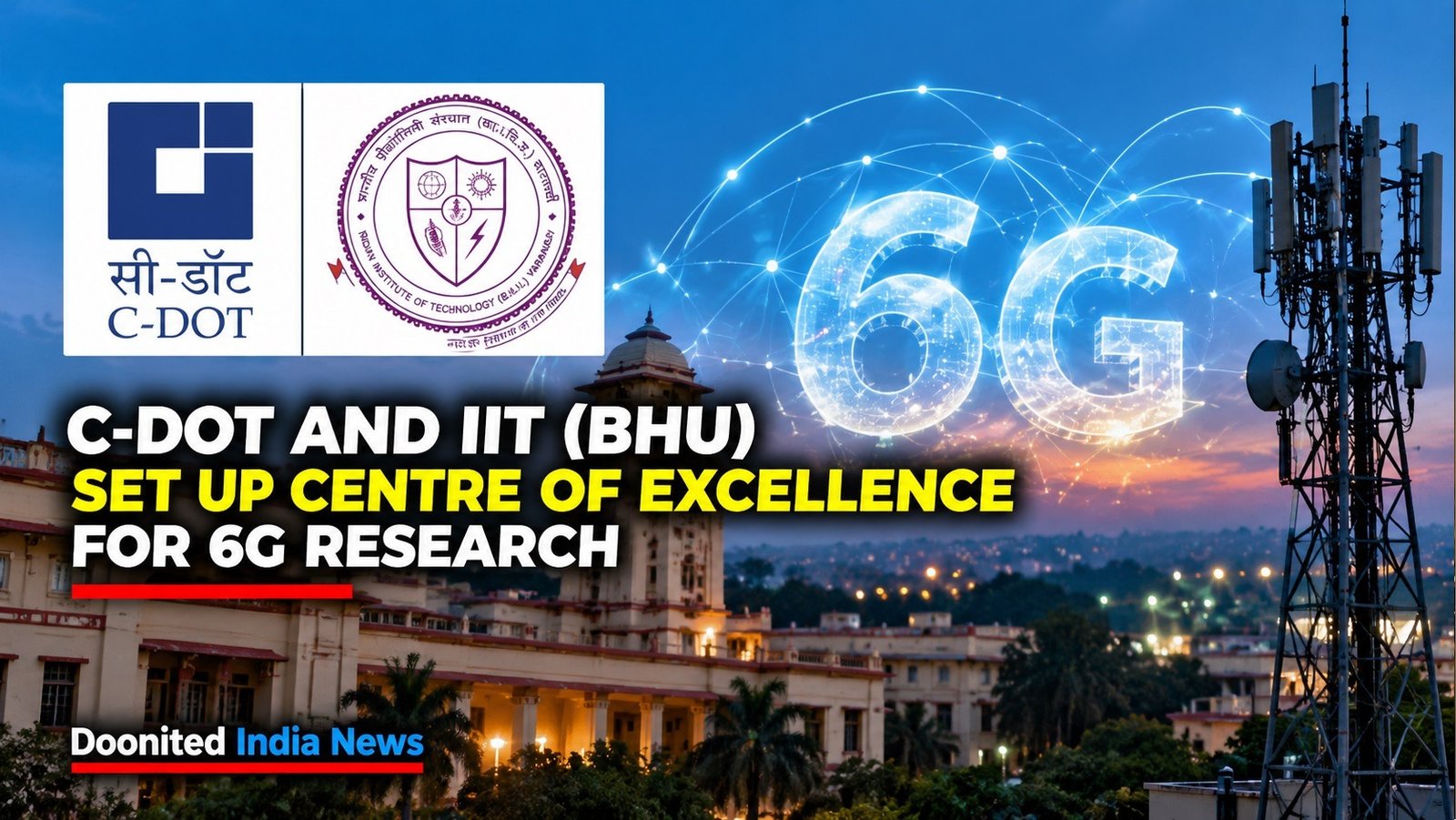
C-DOT and IIT (BHU) Open New Centre to Advance India’s 6G Research
A new Centre of Excellence at IIT (BHU), Varanasi, brings government telecommunications researchers and university experts together to investigate advanced wireless systems, artificial intelligence and communications security. The partnership strengthens India’s research ecosystem, but its long-term significance will depend on whether it produces tested technologies that can be deployed at scale. From Research to Reality: India’s Next Telecom Challenge Begins in Varanasi
India’s next telecommunications breakthrough may begin in a university laboratory rather than a mobile phone factory.
The Centre for Development of Telematics (C-DOT), the telecommunications research and development organisation under the Department of Telecommunications, has partnered with the Indian Institute of Technology (BHU), Varanasi, to establish its sixth Centre of Excellence. Announced on 23 October 2026, the initiative is designed to connect academic research with the engineering challenges facing India’s telecommunications industry.
The research programme covers 5G Advanced and 6G technologies, advanced wireless communications, artificial intelligence, quantum technologies and cybersecurity. Specific areas include very large-scale multiple-input multiple-output (MIMO) systems, integrated sensing and communication, AI-native communication networks, and quantum and post-quantum communication technologies.
The partnership is part of a broader effort to strengthen India’s ability to develop indigenous telecommunications technology.
Yet the most important question is not how many research centres India establishes. It is how effectively those centres turn scientific ideas into reliable, secure and commercially useful systems.
Why India needs its own telecom research capabilities
Telecommunications networks underpin much of modern economic life. Banking transactions, digital payments, logistics, emergency communications, industrial operations and public services all depend on reliable connectivity.
Countries that develop expertise in telecommunications design and engineering can contribute to international standards, create intellectual property and build domestic businesses around new technologies.
For India, indigenous research can also help address challenges specific to its conditions, including providing affordable connectivity across densely populated cities, remote rural communities and difficult terrain.
Technological self-reliance, however, should not be confused with technological isolation. Telecommunications equipment relies on international standards, specialist components and global supply chains. India’s objective should be to build capabilities that give its researchers and companies a meaningful role in developing and improving the systems the country uses.
C-DOT’s partnership with IIT (BHU) supports that objective by combining institutional telecommunications expertise with academic research.
What the new Centre of Excellence will investigate
According to the Department of Telecommunications’ official announcement, the centre will focus on several areas relevant to future communications infrastructure.
1. 5G Advanced and 6G
The next generation of telecommunications is expected to build on existing mobile networks while exploring new capabilities in performance, sensing, computing integration and energy efficiency.
Research into higher-frequency communications, advanced radio architectures and network design could contribute to these developments. But higher frequencies can also introduce greater propagation losses and coverage challenges.
A useful 6G system must therefore do more than achieve impressive speeds in a laboratory. It must operate reliably, manage interference, control energy consumption and remain economically viable.
The new centre provides a framework for research into these problems. Its establishment does not mean that a commercial 6G system has already been developed.
2. Very large-scale MIMO
MIMO technology uses multiple antennas to transmit and receive information. Very large-scale MIMO extends this approach through much larger antenna arrays, allowing networks to improve spectral efficiency and serve users more effectively under suitable conditions.
The engineering challenge is to achieve those benefits without creating excessive hardware complexity, energy consumption or operating costs.
Research in this area could contribute to more efficient future wireless networks, particularly as demand for data and connected devices increases.
3. Integrated sensing and communication
Integrated sensing and communication, or ISAC, investigates how wireless systems might combine data transmission with certain sensing functions.
Radio infrastructure could potentially help detect movement or changes in an environment while continuing to carry communications traffic.
Possible applications include industrial monitoring, transport systems and selected smart-infrastructure uses.
The technology also raises questions about privacy, interference, accuracy and reliability. Its value will depend on demonstrated performance and responsible implementation, not simply on the promise of combining two functions.
4. Artificial intelligence in communication networks
AI can help network operators predict traffic demand, identify faults and allocate resources more efficiently.
AI-native communication systems seek to incorporate intelligence into network design and operation rather than treating AI as a separate application.
Such systems could improve network management, but they must also remain secure and predictable. Automated decisions that affect critical communications infrastructure require robust testing, safeguards and human oversight where appropriate.
The centre’s focus on AI-driven communication research places these challenges within its wider programme.
5. Quantum and post-quantum security
Quantum communication and post-quantum cryptography address related but distinct challenges.
Quantum key distribution uses quantum properties to establish cryptographic keys under specific security assumptions. Post-quantum cryptography develops conventional cryptographic algorithms designed to withstand attacks from sufficiently capable quantum computers.
Neither approach is a universal security solution. Implementation quality, interoperability, cost and the security of the complete system remain important.
Research in these areas could help India prepare its telecommunications infrastructure for changing cybersecurity requirements.
Why the academic partnership matters
The collaboration connects C-DOT’s telecommunications research experience with IIT (BHU)’s faculty, laboratories and student researchers.
That relationship can be valuable because developing a new technology often requires more than a promising scientific result. Researchers must test assumptions, build prototypes, measure performance and understand how a system behaves under real operating conditions.
Academic institutions can investigate difficult technical questions, while an experienced telecommunications research organisation can help connect those investigations with practical engineering requirements.
The official announcement describes the centre as a platform for joint research, technology development and capacity building.
However, it does not establish that every proposed project, student deployment or hardware prototype described in secondary reports is already operational. Those developments should be assessed as the programme progresses.
Six centres are a network, not a measure of success
The IIT (BHU) initiative expands C-DOT’s network of Centres of Excellence to six. Previous collaborations include IIT Kanpur, IIT Gandhinagar, IIT Roorkee, IIT Hyderabad and the Indian Institute of Science, Bengaluru, through the Foundation for Science Innovation and Development.
The wider network is intended to encourage collaboration, knowledge exchange and specialised research talent.
Its effectiveness will depend on how well the centres work together and whether their projects complement one another rather than duplicate effort unnecessarily.
A useful next step would be to evaluate research outcomes across the network: validated prototypes, technical publications, patents where appropriate, contributions to standards, partnerships with industry and technologies that progress towards commercial use.
These indicators would offer a more meaningful picture of progress than counting institutional agreements alone.
What should India measure next?
The establishment of the centre is a concrete institutional development. Its eventual contribution to technological self-reliance remains a question for the future.
Several measures will help determine whether the initiative is delivering results.
First, research must produce evidence. Proposed systems should be tested against clear performance requirements, including reliability, energy efficiency, security and cost.
Second, promising prototypes need a path towards deployment. That requires industrial collaboration, interoperability testing, manufacturing capability and long-term technical support.
Third, students must gain opportunities to develop practical expertise. Training researchers who understand both fundamental science and real-world engineering could be one of the partnership’s most enduring benefits.
Finally, India should remain engaged with international research and standards. Indigenous capability is strengthened when domestic expertise can contribute to global technological development.
A promising start, with the real test still ahead
The new Centre of Excellence at IIT (BHU), Varanasi, expands India’s institutional capacity to investigate next-generation telecommunications technologies.
It creates a formal platform for collaboration between C-DOT researchers and university experts, with potential benefits for advanced wireless systems, AI-driven networks and communications security.
But the centre’s inauguration is the beginning of a research programme, not its conclusion.
The real measure of success will be whether the partnership produces technologies that perform reliably outside the laboratory, attract industry interest and contribute meaningfully to India’s telecommunications capabilities.
India’s 6G ambitions will ultimately depend on patient research, rigorous testing and the ability to turn promising ideas into dependable systems.
That is where the work in Varanasi will matter most.


World Beyond the News
Octopuses Can Change Their Appearance
Octopuses can rapidly alter their skin colour and texture to communicate, camouflage themselves and respond to danger.
Some Cities Exist Across Two Continents
A small number of cities are geographically associated with two continents, creating unusual cultural and geographic identities.
Earth’s Climate Is Measured in Many Ways
Scientists track temperature, atmospheric gases, sea level, ice cover and other indicators rather than relying on a single climate number.
Streaming Changed How Audiences Discover Shows
Recommendation systems and global streaming releases allow audiences to discover programmes far beyond their original markets.