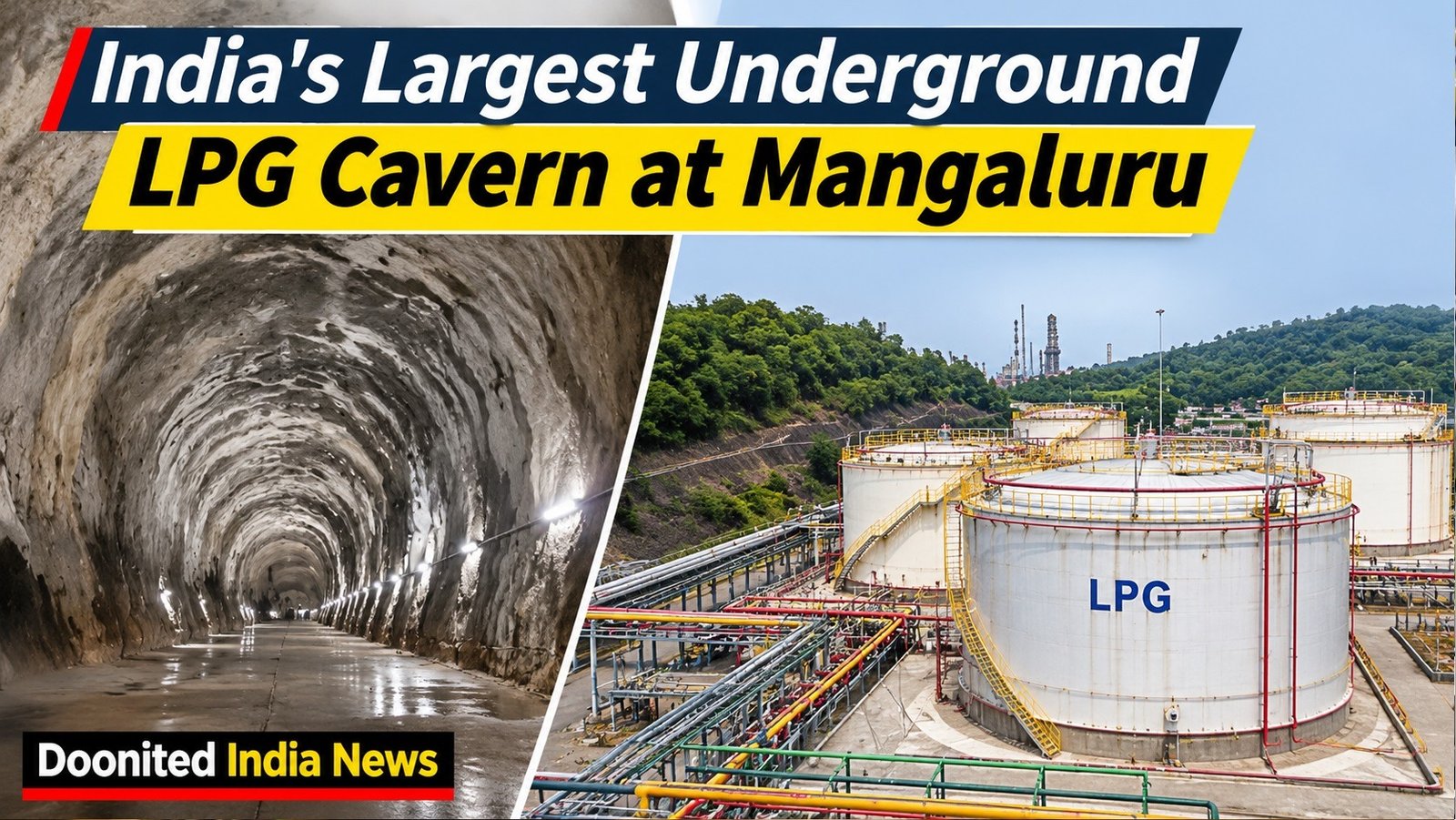
India’s Largest LPG Storage Cavern Opens in Mangaluru: A Major Step, but Not the End of Energy Vulnerability
The 80,000-tonne underground facility at Bala strengthens India’s ability to store imported cooking gas. Connected to New Mangalore Port, it adds an important buffer against supply disruptions—but its capacity must be understood against the country’s enormous daily LPG consumption.
By Pradeep Banerjee | Editor, DOONITED.in
A disruption thousands of kilometres away can affect the availability of cooking gas in Indian homes. That vulnerability became particularly visible during the West Asian supply crisis, when shipping routes and import flows came under pressure. India’s response cannot depend only on finding alternative cargoes. It also needs the ability to store fuel before a disruption occurs.
A major addition to that infrastructure is now in place at Bala in Mangaluru, Karnataka. On November 13, 2026, Prime Minister Narendra Modi dedicated India’s largest underground liquefied petroleum gas (LPG) storage cavern to the nation. Developed for Hindustan Petroleum Corporation Limited (HPCL), the facility has a capacity of 80,000 metric tonnes and represents an investment of more than ₹850 crore.
The project is significant not merely for its size, but for the strategic role it can play in India’s cooking-gas supply chain.
Inside the underground storage facility
Unlike conventional storage tanks visible above ground, the Mangaluru facility stores LPG in chambers excavated deep within solid rock. The cavern comprises two underground storage chambers, designed for the storage of propane and butane—the principal components of commercial LPG.
The project was built by Megha Engineering and Infrastructures Limited (MEIL) for HPCL, with Engineers India Limited (EIL) providing engineering and project-management services. The estimated project cost has been reported at approximately ₹850–854 crore.
One of the important engineering features is the use of a water-curtain system. Water is maintained around the rock cavern to help control pressure and prevent LPG from escaping through fractures in the surrounding rock. Such systems are critical to the safe operation of underground storage facilities.
The cavern is connected to New Mangalore Port through a pipeline network reported to be approximately 9.4 kilometres long. This link allows imported LPG arriving by ship to be transferred into storage and subsequently moved into the distribution system.
The facility’s construction was completed and it had undergone commissioning-related testing well before the November 2026 dedication. EIL reported successful delivery of the cavern in September 2025, while a Cavern Acceptance Test had been completed in June 2025. The November event therefore marked its formal dedication to the nation, rather than the first completion of construction.
Why Mangaluru matters to India’s energy security
India is one of the world’s largest LPG consumers. The fuel is essential to household cooking, particularly through the Pradhan Mantri Ujjwala Yojana and the wider domestic LPG distribution network.
The country’s dependence on imported LPG creates exposure to international prices, shipping costs and geopolitical risks. A parliamentary response in 2026 stated that approximately 60 per cent of India’s LPG consumption was met through imports, with around 90 per cent of those imports passing through the Strait of Hormuz. That concentration makes disruptions in West Asia a serious concern for Indian energy planners.
Mangaluru is strategically positioned because the cavern is linked directly to a major coastal import facility. Ships can bring LPG into the port, after which the gas can be transferred to underground storage. This creates a buffer between the arrival of imported cargoes and their movement into the domestic supply chain.
The Mangaluru cavern also joins the existing 60,000-tonne underground LPG storage facility at Visakhapatnam. Together, the two underground caverns provide approximately 1.4 lakh tonnes of storage capacity.
The scale: an important buffer, not a complete reserve
The 80,000-tonne capacity is substantial for a single facility, but it needs to be viewed in the context of national consumption.
India consumed approximately 33.2 million tonnes of LPG in 2025–26, according to figures cited in recent energy-sector analysis. Dividing that annual consumption by 365 days gives an average of roughly 91,000 tonnes per day.
That means the Mangaluru cavern’s full 80,000-tonne capacity is equivalent to approximately 21 hours of average national consumption:
Annual consumption: approximately 33.2 million tonnes
Average daily consumption: 33.2 million ÷ 365 = approximately 91,000 tonnes
Mangaluru cavern: 80,000 ÷ 91,000 = approximately 0.88 days
The combined 1.4-lakh-tonne capacity of the two underground caverns represents roughly 1.5 days of average national consumption. These are theoretical comparisons assuming the entire capacity is filled and available; actual usable inventory, operational requirements and distribution constraints affect the supply buffer.
This is the central distinction: India has strengthened its underground LPG storage, but it has not yet built a reserve capable of insulating the country from a prolonged import crisis.
A bigger policy challenge remains
Underground rock caverns offer advantages over large surface tanks, including efficient use of land and the ability to store significant quantities of pressurised LPG. However, such facilities require specialised geology, engineering, safety systems and substantial investment. They cannot be constructed quickly wherever additional storage is needed.
The next step must be a broader strategy that combines more storage with diversified import sources, stronger domestic LPG production, resilient port and pipeline infrastructure, and improved supply-chain planning. The March 2026 LPG disruption demonstrated how vulnerable the system can become when a major international shipping route is affected.
HPCL’s own 2025–26 annual report describes the commissioning of the Mangaluru cavern as an infrastructure milestone and records that the company’s total LPG storage capacity rose to 230.7 thousand tonnes after other capacity enhancements. This figure covers HPCL’s storage infrastructure, not just the two national underground caverns.
Hindustan Petroleum Corporation Ltd.
The Mangaluru project is therefore a meaningful addition to India’s energy infrastructure, particularly for a fuel used daily by millions of households. But its success should be judged by more than the size of the underground chambers. The real test is whether India can maintain reliable supplies during the next major international disruption.
The cavern gives India more room to prepare. It does not remove the need to reduce the risks that make such preparation necessary.


World Beyond the News
Octopuses Can Change Their Appearance
Octopuses can rapidly alter their skin colour and texture to communicate, camouflage themselves and respond to danger.
Some Cities Exist Across Two Continents
A small number of cities are geographically associated with two continents, creating unusual cultural and geographic identities.
Earth’s Climate Is Measured in Many Ways
Scientists track temperature, atmospheric gases, sea level, ice cover and other indicators rather than relying on a single climate number.
Streaming Changed How Audiences Discover Shows
Recommendation systems and global streaming releases allow audiences to discover programmes far beyond their original markets.