$5 Billion for India’s Semiconductor Future: Why Applied Materials Is Expanding Here
India’s semiconductor story has acquired another significant number.
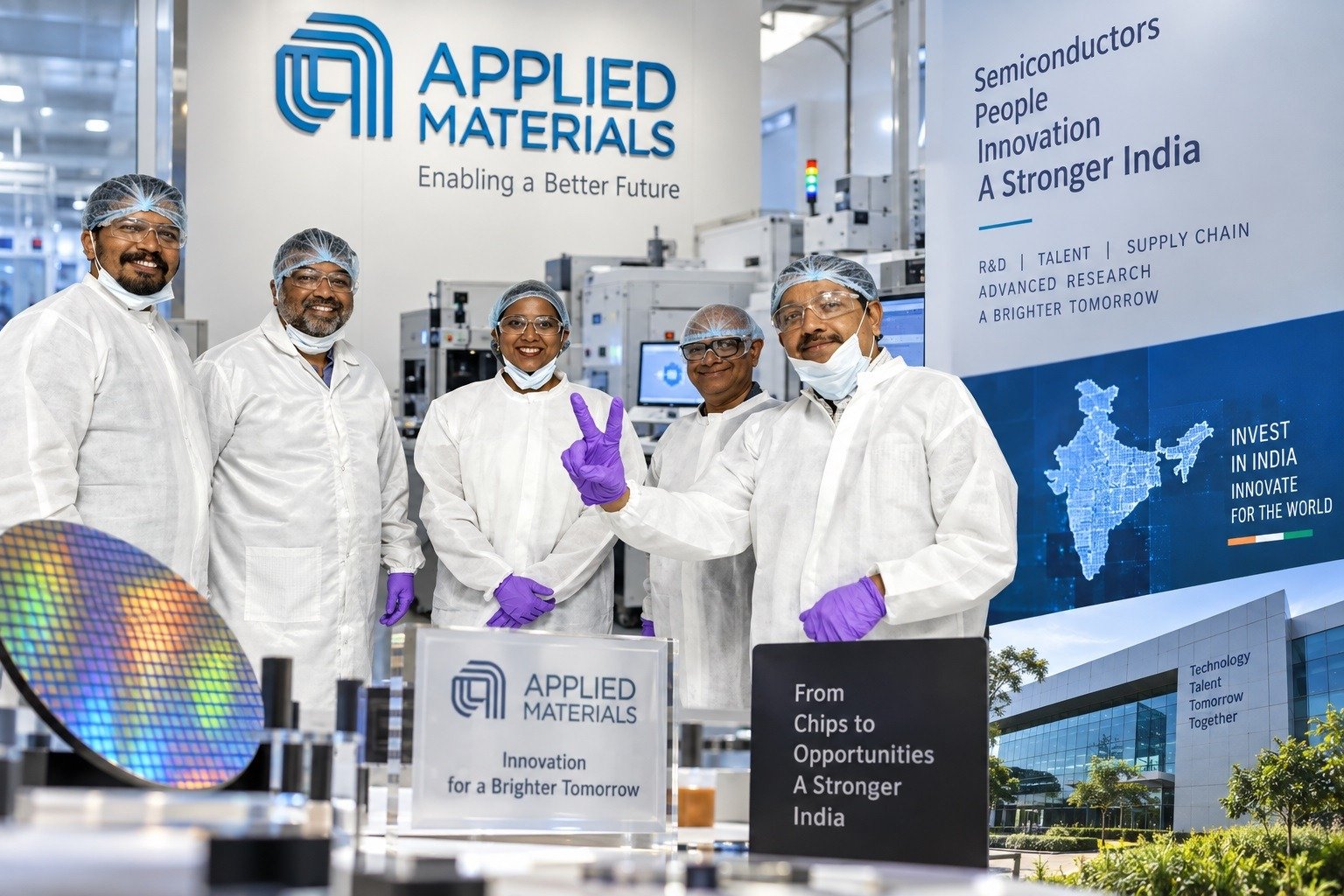
US semiconductor-equipment major Applied Materials plans to invest $5 billion in India over the next decade, under what it calls Applied Materials India Vision 2035.
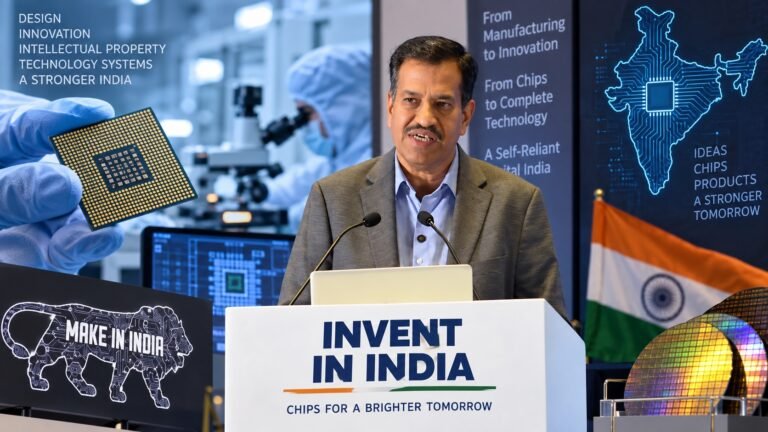
The announcement was made at SEMICON India 2026 in New Delhi, where the global semiconductor industry gathered around a question that is becoming increasingly important for India: can the country build not just semiconductor factories, but the wider ecosystem required to design, manufacture and commercialise advanced chips?
Applied Materials’ answer appears to be yes — and it is putting substantial money behind that view.
But there is an important detail.
This is not a $5 billion promise to build one giant chip fab.
The company’s investment is focused on three broad areas: strengthening research and development in India, accelerating the semiconductor ecosystem and developing future talent. Applied Materials has also announced plans for a 140-acre Advanced Semiconductor Research Park, intended to bring together cleanroom capabilities, engineering expertise and collaborative R&D involving customers and suppliers.
That makes the announcement considerably more interesting than a headline number.
Why Would a Semiconductor Equipment Company Need India?
Applied Materials is not primarily a chip manufacturer.
It is one of the world’s major suppliers of equipment and technologies used to manufacture semiconductors. Its products and engineering capabilities sit further upstream in the chip-production chain — helping semiconductor manufacturers develop and produce increasingly sophisticated devices.
That position matters.
The semiconductor industry is often described as though the entire business begins and ends inside a fabrication plant.
It does not.
A modern chip ecosystem requires equipment, materials, process engineering, metrology, software, R&D, suppliers, packaging, testing and highly specialised talent.
A fab without that ecosystem is rather like a Formula 1 circuit without mechanics, engineers and spare parts: technically impressive, but not particularly useful on race day.
Applied Materials’ decision therefore points to something broader happening in India.
The company is not merely looking at India as a future location for semiconductor production.
It is looking at India as a place where semiconductor technology itself can be developed.

The 140-Acre Research Park Could Be the Bigger Story
The proposed 140-acre Advanced Semiconductor Research Park is one of the most consequential parts of the announcement.
Applied Materials says the park will bring together cleanroom capabilities, engineering expertise and collaborative R&D with customers and suppliers.
That model is important because semiconductor innovation increasingly depends on collaboration.
Developing new manufacturing processes or equipment cannot happen in isolation. Equipment companies need to understand what chipmakers require. Chipmakers need equipment that can achieve increasingly precise manufacturing. Materials companies have to develop products compatible with those processes.
The research park is therefore intended to create a physical environment where different parts of that chain can interact.
For India, that could mean an opportunity to participate in semiconductor process innovation, rather than simply importing finished manufacturing technology.
And that distinction is significant.
From Engineering Services to Technology Creation
India has long been a major engineering and R&D destination for global technology companies.
Applied Materials itself established semiconductor engineering capabilities in India years ago. At SEMICON India, company president of the Semiconductor Products Group Prabu Raja said Applied Materials had been among the early companies to establish semiconductor engineering capability in the country and had ordered India’s first 300-millimetre laboratory in 2024.
The new investment suggests an expansion of that trajectory.
The company’s stated objective is not simply to employ more engineers.
It wants innovations developed in India to become part of its global technology and supply-chain network.
Applied Materials has said that by 2035 it aims to increase its India-based supply-chain capacity tenfold, creating opportunities for Indian suppliers while also bringing global suppliers into the country.
This is where the announcement intersects with India’s larger ambition to move from “Made in India” to “Invented in India.”
A semiconductor ecosystem becomes much deeper when local companies are not only assembling or supplying products, but developing technologies, components and intellectual property that can compete globally.
India Wants the Suppliers Too
Building semiconductor capability requires more than attracting the headline companies.
There must be hundreds of specialised businesses behind them.
Semiconductor manufacturing requires extraordinarily controlled environments and specialised materials. Equipment needs precision components. Facilities need chemicals, gases, electronics, maintenance and engineering services. Suppliers need certification and the ability to meet demanding quality requirements.
The Indian government has increasingly highlighted this supply-chain dimension.
At SEMICON India 2026, the government said the next phase of India’s semiconductor programme would expand beyond fabs and packaging to include design, materials and machines, R&D and talent. Semicon 2.0 has an approved outlay of ₹1,27,500 crore.
Applied Materials’ tenfold supply-chain target therefore fits directly into the country’s broader strategy.
The objective is not simply to put semiconductor factories on Indian soil.
It is to persuade a larger portion of the ecosystem to develop around them.
AI Is Making This Race More Urgent
There is another reason semiconductor investment is accelerating: artificial intelligence.
The global build-out of AI infrastructure is driving demand for increasingly powerful and energy-efficient computing systems. That, in turn, increases demand for advanced semiconductor manufacturing technologies.
At the same time, geopolitical tensions have encouraged companies and governments to diversify semiconductor supply chains beyond established manufacturing hubs.
Reuters reported that Applied Materials’ announcement came as the semiconductor industry faces strong AI-driven demand and continuing geopolitical pressure to diversify supply chains. India has committed more than $21 billion to semiconductor incentives and expects domestic semiconductor consumption to rise substantially by 2030.
This gives India an unusual combination of opportunity and pressure.
The opportunity is that companies are actively looking for additional locations and partners.
The pressure is that other countries are doing exactly the same thing.
India is not competing in an empty field.
The Numbers Are Impressive — But They Need Context
A $5 billion announcement naturally attracts attention.
But investment announcements should not be confused with completed investment.
The programme stretches across the next decade. The proposed research park has to be developed. Supply-chain capacity has to be built. Talent has to be trained. Research has to produce commercially useful results.
And perhaps most importantly, India still has to demonstrate that the ecosystem can operate at global scale.
Reuters noted that India has made progress, including approved semiconductor projects and commercial production at chip-packaging facilities, but the country has yet to produce chips from a large-scale fabrication facility. The much-discussed Tata Electronics fab in Gujarat has also faced delays.
That is the reality behind the excitement.
India is making progress, but the semiconductor industry is measured in years, not press conferences.
The Real Prize Is Not the Factory
This is where Applied Materials’ announcement becomes more significant.
A semiconductor factory can create manufacturing capacity.
A research centre can create knowledge.
A supplier ecosystem can create industrial depth.
A trained workforce can create continuity.
And companies that own semiconductor technology can create intellectual property and exportable products.
India needs all of these.
The country’s semiconductor programme has already begun shifting towards this broader model. The government said in September 2026 that Semicon 2.0 would focus on six areas: design; materials and machines; more fabs; advanced packaging; R&D; and talent.
The direction is therefore becoming clearer.
India is trying to build the ecosystem around the silicon, not merely the silicon itself.
What Could This Mean for Indian Companies?
For Indian businesses, one of the most interesting consequences could be the emergence of new supplier opportunities.
A tenfold expansion of India-based supply-chain capacity would potentially create demand for specialised manufacturing, precision engineering, materials, components, software and technical services.
That does not mean every Indian engineering company automatically becomes a semiconductor supplier.
Semiconductor supply chains have extremely high qualification standards.
A component can be inexpensive compared with a complete chip factory and still be mission-critical. Reliability, purity, precision, traceability and consistency matter enormously.
For Indian suppliers, therefore, the opportunity comes with an equally demanding message:
Global semiconductor customers will pay for quality, not patriotic enthusiasm.
That may be one of the healthiest pressures the industry can receive.
Bengaluru, India and the Next Technology Layer
Applied Materials’ deeper R&D commitment also reinforces India’s position as an engineering and technology hub.
Its proposed research expansion is particularly relevant to Bengaluru, where the company already has a substantial presence and where the wider semiconductor design ecosystem is concentrated. Economic Times reported that the planned investment includes a new R&D facility in Bengaluru and that Applied Materials intends for products developed in India to serve advanced fabs globally.
That global orientation is important.
The strongest version of India’s semiconductor story is not:
“Companies are coming to India because India needs chips.”
It is:
“Companies are developing technology in India because technology developed here can serve the world.”
That is a much bigger proposition.
What India Must Prove Next
The $5 billion announcement creates momentum, but it also raises expectations.
India will need to demonstrate that:
- research can move from laboratories into commercial products;
- Indian suppliers can meet global semiconductor quality standards;
- skilled engineers can be retained and developed;
- semiconductor startups can progress from design to customer qualification and volume production;
- universities and industry can collaborate more effectively;
- manufacturing projects can reach commercial scale;
- and innovations developed in India can become globally competitive.
The last point may ultimately be the most important.
A country does not become a technology leader merely because multinational companies build facilities there.
It becomes one when knowledge created there turns into products that the world needs.
The Bigger Indian Semiconductor Story
Applied Materials’ $5 billion commitment should therefore be read as part of a much larger transition.
India is attempting to move through several layers at once — from engineering services to product development, from semiconductor design to manufacturing, from imported supply chains to domestic supplier networks, and from being a large technology market to becoming a technology creator.
The road will not be short.
There will be delays, cost pressures, technology risks and projects that do not work exactly as planned.
That is normal in an industry where a tiny defect can matter more than a giant building.
But the direction is unmistakable.
India wants to become a place where semiconductor technology is researched, engineered, manufactured, supplied and eventually exported.
Applied Materials is now committing $5 billion to that possibility.
And perhaps the most revealing part of the announcement is not the dollar figure.
It is the idea behind it:
India is increasingly being treated not simply as the destination for semiconductor investment, but as part of the global semiconductor innovation engine.
For the country’s technology ambitions, that may be the real story.
DOONITED Editorial Perspective
The semiconductor race should not be judged by investment announcements alone.
The real scoreboard will emerge several years from now: commercial products, qualified suppliers, exportable technology, successful startups, skilled people and intellectual property created in India.
Applied Materials’ announcement matters because it targets several of those foundations simultaneously.
The intelligent question for India is therefore not “How much money is coming?”
It is:
“What technological capability will remain in India after that money has been invested?”
That is the measure worth watching.
Meaningful Learning for Readers
Semiconductors are not just about making computer chips. They represent an entire industrial ecosystem — from research laboratories and equipment to materials, precision manufacturing, design, software and talent.
Applied Materials’ India investment shows why the next phase of India’s technology story may be less about attracting individual factories and more about building the industrial knowledge network around them.
If India succeeds in connecting those pieces, the benefits could extend well beyond semiconductors into AI, electric mobility, telecommunications, defence, energy and advanced manufacturing.

World Beyond the News
Why Elephants Stay Close to Their Herd
Elephants live in highly social family groups and use calls, touch and body movements to maintain strong bonds.
Most of the Deep Ocean Remains Difficult to Explore
Extreme pressure, darkness and distance make deep-ocean exploration one of Earth’s greatest scientific challenges.
Spacecraft Can Travel Without Traditional Roads
Spacecraft use carefully calculated trajectories and gravity assists to travel enormous distances through space.
Why Movie Trailers Are Released in Stages
Major films often use teaser trailers, full trailers and final promotional spots to build awareness over time.