Amity University: From a Noida Campus to a Research, Skills and Global Education Network
There was a time when choosing a university largely meant asking three questions: What course? What campus? What job after graduation? Today, the question is considerably bigger: What can a university actually help a student become?
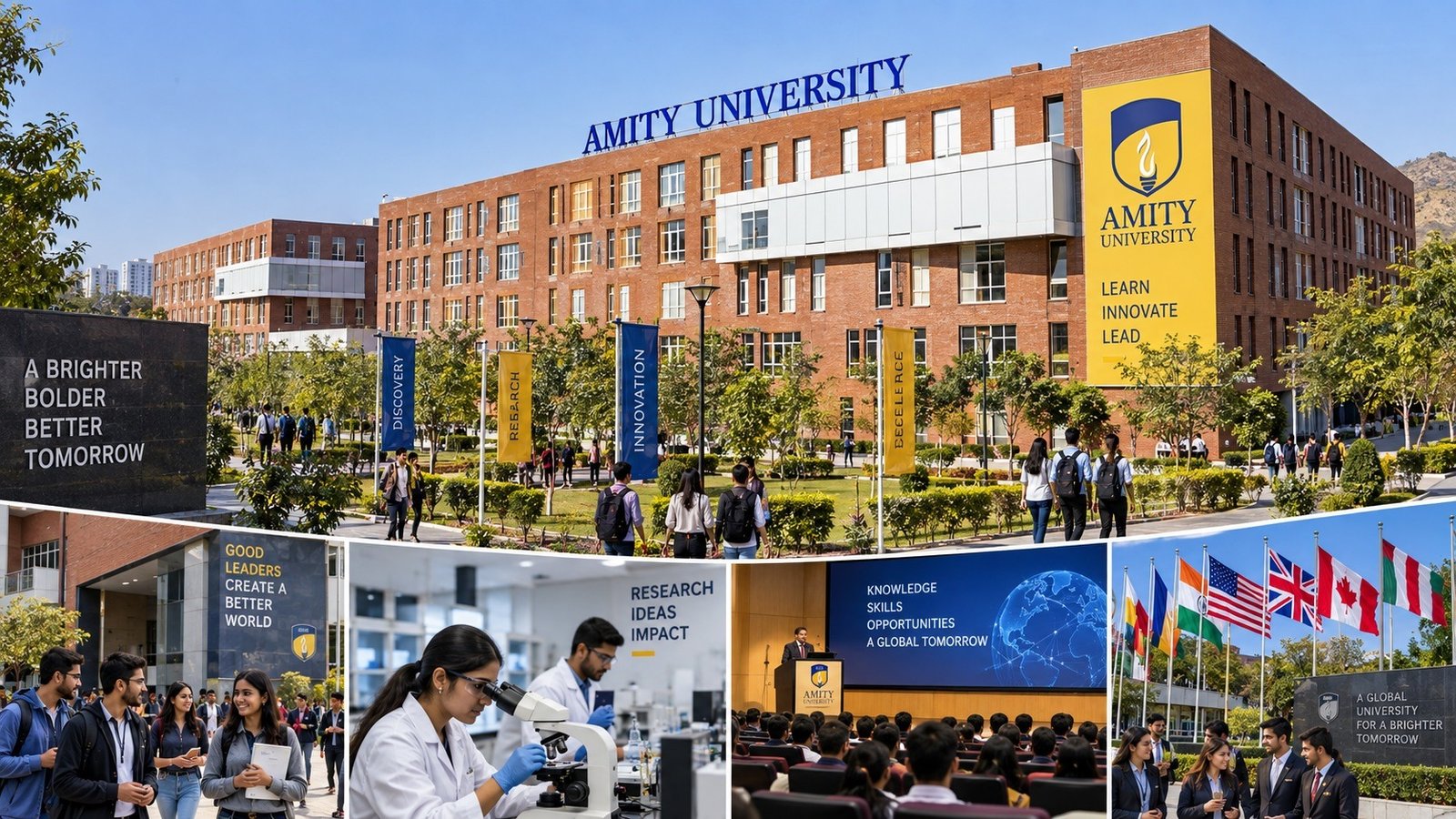
That question is particularly relevant to Amity University, whose flagship institution, Amity University Uttar Pradesh, was established under a state Act in 2005 in Noida. Over two decades later, Amity has grown into a large education network with universities across India and an international footprint. Its Noida campus alone is now presented by the university as an 85-acre academic environment offering more than 600 undergraduate and postgraduate programmes across 18 disciplines.
But size is easy to advertise. The more interesting story is what happens underneath the size: research, professional skills, industry exposure, entrepreneurship and the increasingly unavoidable presence of artificial intelligence in higher education.
From Noida to a National Education Network
Amity University Uttar Pradesh is recognised by the University Grants Commission and has been accredited by NAAC with an A+ grade. Its current institutional material also cites a 22nd position among not-for-profit private universities in NIRF 2025.
The larger Amity Education Group says it now has 14 university campuses in India, 28 schools and 13 overseas campuses, with more than 250,000 students across its broader education network. The figures describe the scale of the group rather than the student population of Amity University Noida alone.
That distinction matters.
A university network this large is no longer simply competing on classrooms and lecture halls. It is competing on ecosystems — the combination of academics, technology, industry connections, research, international exposure and the opportunities students can access while studying.
The Campus Is Becoming a Laboratory
Amity’s Noida campus includes air-conditioned classrooms, laboratories, libraries, sports facilities, hostels and other student amenities. But infrastructure becomes meaningful only when students actually use it to acquire capabilities.
The university has developed research and technology-transfer structures designed to move academic work closer to practical application. Its Directorate of Innovation and Technology Transfer describes its role as helping move ideas towards prototypes, industry collaboration and potentially market-ready technologies.
Its current patent information says Amity researchers have filed more than 2,600 research patents across areas including biotechnology, nanotechnology, sensors, pharmaceuticals, software, electronics, food processing and renewable-energy-related technologies. Patent filings, of course, should not automatically be interpreted as commercial breakthroughs. A patent is evidence of an intellectual-property claim; it is not by itself proof that a technology has reached the market or achieved social impact.
That is an important distinction for students and parents navigating the increasingly crowded higher-education market.
AI Is Moving From a Course to a Campus-Wide Skill
One of the clearest changes in higher education is the expansion of AI beyond specialist computer-science programmes.
Amity’s latest Noida prospectus says the university is providing AI training across disciplines, alongside study-abroad opportunities, industry interaction and an on-campus incubator.
That approach reflects a larger shift in the Indian employment market.
A management student may encounter AI-driven analytics. A designer may use generative tools. A law student may work with legal research technology. A biotechnology student may encounter computational methods. Even communication and media students increasingly need to understand algorithmic distribution.
The challenge is that having AI in a curriculum and being genuinely AI-ready are not the same thing.
The real test will be whether students leave university able to understand the technology, question its output, use it responsibly and combine it with domain expertise.
In other words, pressing an AI button is not yet a professional skill.
Where Education Meets Employment
Employability remains one of the most visible measures by which students judge a university.
Amity’s current placement information reports 8,000 placements during 2025–26, more than 1,200 companies visiting for placements, and more than 150,000 alumni working in organisations worldwide. These are university-reported figures, so they should be read as institutional placement statistics rather than an independent guarantee of employment for every student.
The university’s recruiter records include companies from technology, banking, consulting, manufacturing, healthcare, automotive, aviation and other sectors. Its placement portal currently lists recruiters and selections involving organisations such as Amazon, EY, Samsung, Capgemini, IBM, Accenture and others across different batches and campuses.
This breadth is significant because India’s graduate employment market is no longer neatly divided into engineering, management and everything else.
Modern careers increasingly cross disciplines.
A computer-science graduate may work in finance. A biotechnology graduate may enter data-driven research. A management graduate may work in technology. A designer may become an entrepreneur.
The university that can connect these worlds has an advantage — but again, the student has to convert opportunity into capability.
The Global Classroom
International exposure has also become part of Amity’s model.
The wider group lists campuses and operations in cities including London, New York, Singapore, Dubai, Abu Dhabi, Sharjah, Amsterdam, Tashkent and others. It also promotes study-abroad opportunities and international academic collaborations.
For Indian students, global exposure has a practical dimension.
India’s graduates increasingly compete not only for Indian jobs but also for multinational roles, international postgraduate education, remote work and cross-border entrepreneurship.
The value of internationalisation, therefore, is not simply the number of campuses on a map. It is whether students develop the ability to work across cultures, understand international markets and operate in globally distributed teams.
The Question Amity — and Indian Universities — Still Have to Answer
There is a natural temptation in private higher education to measure success through large campuses, impressive buildings, rankings, placement numbers and long lists of programmes.
All of those indicators have some value.
But they are not the complete scorecard.
The harder questions are more fundamental:
How strong is the teaching in a particular programme? How much meaningful research reaches students? What proportion of students build real projects rather than simply complete assignments? How transparent are placement outcomes? And what happens to graduates several years after leaving campus?
These questions matter because a university can be excellent at creating opportunity without every student benefiting equally from that opportunity.
Amity’s scale is therefore both an asset and a responsibility. The larger the institution becomes, the more important academic consistency, transparent outcomes and student-level quality become.
The DOONITED View
The most interesting development in Indian higher education is not that universities are becoming bigger.
It is that the definition of a university is changing.
The old model was largely:
Classroom → Examination → Degree → Job
The emerging model looks more like:
Learning → Research → Project → Industry → Innovation → Entrepreneurship → Career
Amity’s current emphasis on research, patents, AI training, industry interaction, international exposure and entrepreneurship fits into that broader transition.
But the distinction between education as infrastructure and education as outcome will become increasingly important.
A spectacular campus can attract a student.
A strong academic environment can transform one.
The Learning Point
For students considering a university such as Amity, the useful lesson is simple: do not choose only by the university’s brand name or campus photograph.
Look at the exact programme.
Check accreditation.
Examine faculty and curriculum.
Ask what laboratories, internships, projects and industry opportunities are actually available.
Look at placement data — and understand what the numbers include.
And, most importantly, ask what you will be able to do at the end of four years that you could not do when you entered.
Because in India’s rapidly changing education economy, a degree is becoming the starting line.
Capability is the real qualification.

World Beyond the News
Why Elephants Stay Close to Their Herd
Elephants live in highly social family groups and use calls, touch and body movements to maintain strong bonds.
Most of the Deep Ocean Remains Difficult to Explore
Extreme pressure, darkness and distance make deep-ocean exploration one of Earth’s greatest scientific challenges.
Spacecraft Can Travel Without Traditional Roads
Spacecraft use carefully calculated trajectories and gravity assists to travel enormous distances through space.
Why Movie Trailers Are Released in Stages
Major films often use teaser trailers, full trailers and final promotional spots to build awareness over time.