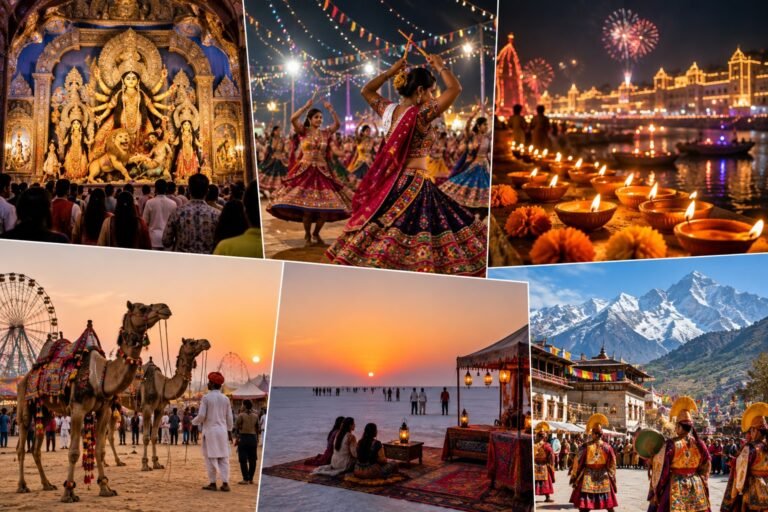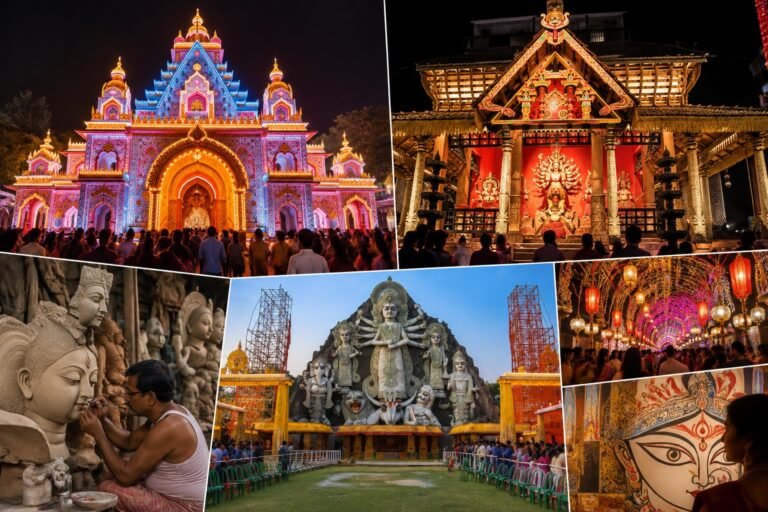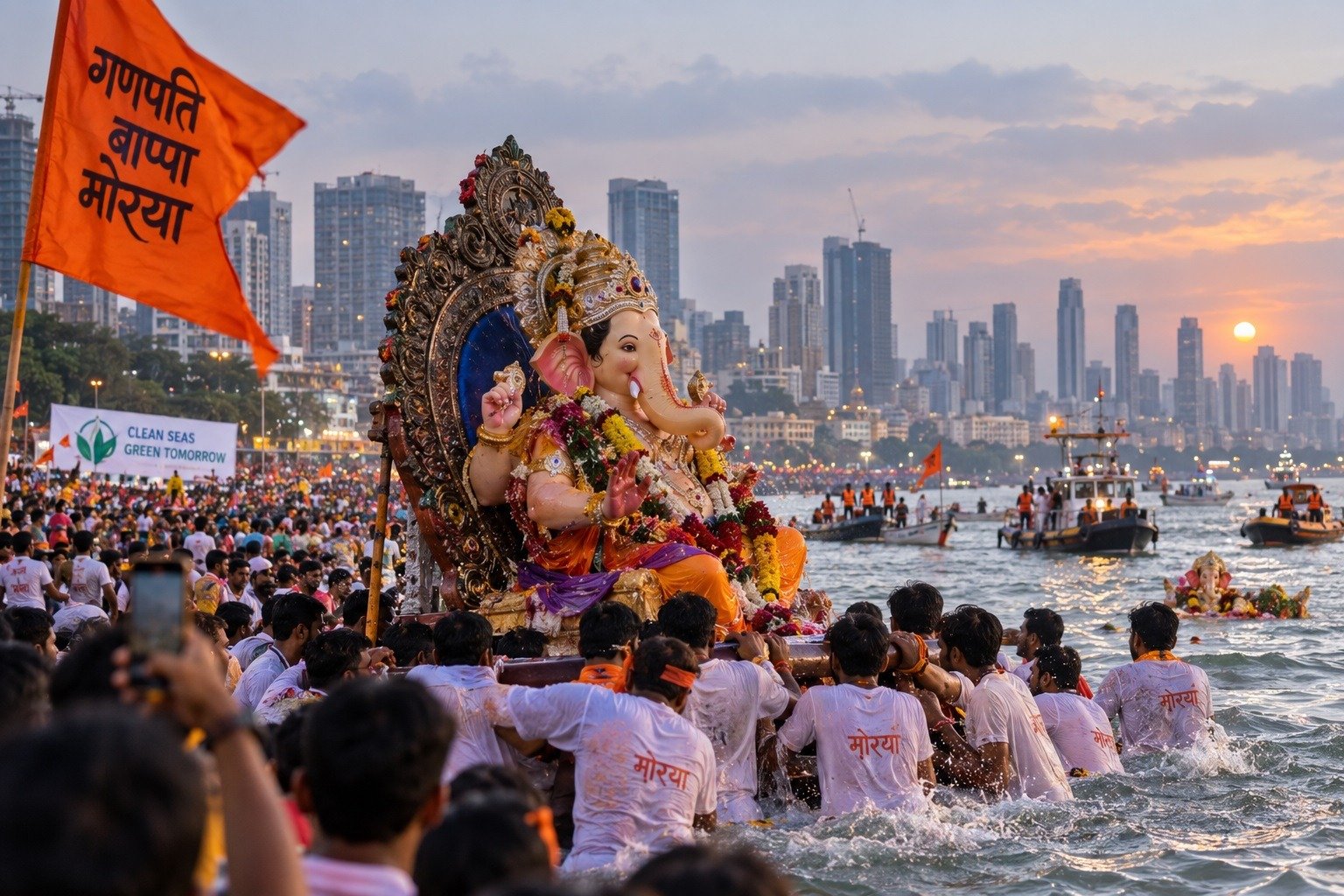
Ganpati Visarjan 2026: For ten days, Lord Ganesha becomes part of the neighbourhood.
He arrives with music, flowers and prayers. Children visit the pandal. Families prepare modaks. Friends stop by after work. Streets become brighter, noisier and considerably less interested in ordinary traffic rules.
And then comes the difficult moment.
Visarjan.
On Friday, September 25, 2026, Anant Chaturdashi will mark one of the major concluding days of Ganeshotsav, when large numbers of devotees across India will take Ganesha idols in procession for immersion. Maharashtra Tourism notes that Ganeshotsav is observed through different immersion cycles, including one-and-a-half-day, five-to-seven-day and 11-day traditions, culminating in Anant Chaturdashi.
The farewell is emotional, noisy, colourful and deeply communal.
But in 2026, there is another question accompanying the familiar chant:
How do you celebrate a festival of nature and devotion without damaging the water bodies that surround you?
A farewell that belongs to the whole city
In Maharashtra, particularly Mumbai and Pune, Ganeshotsav is much more than a religious observance.
It is public culture.
Neighbourhood mandals become temporary community centres. Art, music, decoration, food, volunteering and social activities converge around the festival.
The Maharashtra Department of Tourism describes Ganesh Chaturthi as a celebration of devotion, unity, culture and environmental awareness, and notes that mandals increasingly undertake social activities including blood donation, tree planting and assistance to disadvantaged communities.
That helps explain why visarjan is not simply an idol-immersion operation.
It is a city-wide event involving roads, police, municipal workers, emergency services, railways, public transport, volunteers and millions of individual decisions.
Mumbai does not merely host visarjan.
For one night, Mumbai reorganises itself around it.
September 25 will test Mumbai’s transport network
The scale of the movement is enormous enough to require additional public transport.
Central Railway has announced 22 special night local trains for September 25 and 26, serving routes including CSMT–Kalyan, CSMT–Thane and CSMT–Panvel. The additional services are intended to accommodate devotees travelling to and from immersion-related activities late into the night.
Mumbai Metro has also extended late-night services during Ganeshotsav, with additional services on Lines 2A, 7, 9 and 2B and last-train timings extended to around 12:30 a.m. during the specified festival period.
This is an easily overlooked part of the festival story.
When thousands of processions converge on the same evening, public transport becomes part of the religious infrastructure.
A local train is no longer simply a train.
It becomes the way a family gets home after saying goodbye to Bappa.
The festival has many visarjan days
Although Anant Chaturdashi is the major concluding day, Ganesh immersion does not happen everywhere on one date.
Maharashtra Tourism explicitly lists different traditions, including one-and-a-half-day, five-to-seven-day and 11-day celebrations.
That means the environmental and logistical challenge is spread across the festival rather than concentrated exclusively on September 25.
Nashik’s experience this year illustrates the point.
During the early immersion phase, the Nashik Municipal Corporation collected around 700 idols from devotees as part of an initiative intended to reduce immersion in natural water bodies.
The city is therefore experimenting with a practical compromise:
preserve the ritual, change the location and method.
That may ultimately be one of the most important developments in modern Ganeshotsav.
The artificial-tank revolution
For years, environmental campaigns around Ganeshotsav often sounded like a difficult argument between tradition and ecology.
The newer approach is more practical.
Instead of telling devotees simply, “Don’t immerse the idol in a lake,” civic authorities increasingly provide an alternative:
Here is an immersion tank. Use this.
Nagpur provides one of the clearest examples.
The Nagpur Municipal Corporation expanded its artificial-immersion infrastructure dramatically in 2026, with plans for 447 artificial tanks at 225 locations across the city.
The initiative is designed to reduce idol immersion in natural water bodies.
Early results this year are notable. NMC data showed that 2,079 idols were immersed in artificial tanks during the first two days, with clay idols accounting for more than 96% of those immersions.
That is more significant than it may initially appear.
Environmental behaviour changes much faster when the sustainable option is also the convenient option.
Clay is making a comeback
The material of the idol matters.
Traditional natural-clay idols can dissolve more readily than plaster-of-Paris idols, although paints, decorative materials and the scale of the idol can still affect environmental outcomes.
Nagpur’s early 2026 figures showed 2,010 clay idols versus 69 POP idols among the 2,079 idols immersed in the artificial tanks during the first two days.
The city’s experience suggests that awareness campaigns combined with convenient immersion infrastructure can influence behaviour.
But there is an important caveat.
“Eco-friendly” should not become another festival marketing label.
A large idol described as environmentally friendly still requires consideration of its paints, decorations, structural materials, transport and eventual disposal.
The complete lifecycle matters.
When creativity becomes sustainability
This year’s Ganeshotsav is also producing examples in which environmental thinking is becoming part of idol design itself.
In Nagpur’s Dabha area, organisers created a 55-foot paper Ganesh idol, using a steel framework and specially sourced paper. The organisers said the paper was designed to dissolve and ultimately become part of the soil through their planned immersion process, with the steel framework removed separately.
Whether such giant installations become widespread remains to be seen.
But the idea is interesting.
The environmental question is moving upstream.
Instead of asking only:
“How do we dispose of the idol?”
People are beginning to ask:
“How should we design the idol in the first place?”
That is a much more useful question.
India’s Ganpati is no longer only Maharashtra’s festival
Maharashtra remains the cultural centre of the modern public Ganeshotsav tradition, but Ganesh worship and Ganesh Chaturthi celebrations extend across many parts of India.
Goa, Karnataka, Telangana, Andhra Pradesh and Gujarat have their own local expressions, while communities elsewhere also observe the festival through household and public celebrations.
The form changes.
The underlying sentiment remains remarkably recognisable:
Bappa comes home.
Bappa is worshipped.
Bappa is celebrated.
And eventually Bappa returns to the elements.
That final act gives the festival a philosophical dimension that is easy to miss amid the drums and lights.
The economics behind the farewell
Visarjan also represents a vast temporary economic ecosystem.
Idol makers, artists, decorators, flower sellers, musicians, transport operators, food vendors, electricians, event workers, security personnel and countless small businesses participate in the festival economy.
The public celebration creates demand for work that begins weeks or months before Ganesh Chaturthi.
And the final procession brings another layer of activity.
Vehicles need to move.
Roads need to be managed.
Medical facilities need to be prepared.
Waste must be collected.
Public transport must operate late.
Police and civic workers remain on duty while most people are celebrating.
The spectacle visible to the public is therefore supported by an enormous amount of largely invisible labour.
The environmental test is the real final ritual
There is a certain irony in celebrating Ganesha, a deity associated with wisdom and auspicious beginnings, while allowing festival waste to become somebody else’s environmental problem.
That is why artificial immersion tanks, clay idols, responsible decoration, nirmalya collection and proper waste management matter.
Nagpur’s civic authorities, for example, have expanded artificial immersion infrastructure and separate arrangements for collecting nirmalya, the floral and other devotional offerings generated during the festival.
These systems are not glamorous.
Nobody takes a selfie with a waste-collection vehicle.
But they may be among the most meaningful parts of a sustainable Ganeshotsav.
The DOONITED View
The most interesting evolution of Ganesh Visarjan is not that the celebration is becoming smaller.
It is that the celebration is learning to become smarter.
The goal should not be to strip the festival of music, colour, devotion or community spirit.
Nor should environmental responsibility be treated as an attack on tradition.
The better solution is to redesign the systems around the tradition.
Artificial immersion tanks instead of fragile lakes.
Natural materials instead of persistent pollutants.
Public transport instead of thousands of additional private vehicles.
Better waste collection instead of post-festival clean-up chaos.
And civic planning that understands that religious festivals are major urban events, not temporary inconveniences.
Because the real meaning of Ganpati Bappa Morya, pudhchya varshi lavkar ya is not simply that Ganesha should return next year.
It is also an invitation to ask what kind of city we want him to return to.
A cleaner one would be a good start.
The Learning Point
Ganesh Visarjan is not the end of Ganeshotsav’s environmental responsibility; it is the moment when that responsibility becomes most visible.
In 2026, India’s most meaningful festival innovation may not be a bigger idol or a louder procession.
It may be a simple idea:
Celebrate fully. Immerse responsibly. Let Bappa return without leaving the city behind in pollution.


World Beyond the News
Why Elephants Stay Close to Their Herd
Elephants live in highly social family groups and use calls, touch and body movements to maintain strong bonds.
Most of the Deep Ocean Remains Difficult to Explore
Extreme pressure, darkness and distance make deep-ocean exploration one of Earth’s greatest scientific challenges.
Spacecraft Can Travel Without Traditional Roads
Spacecraft use carefully calculated trajectories and gravity assists to travel enormous distances through space.
Why Movie Trailers Are Released in Stages
Major films often use teaser trailers, full trailers and final promotional spots to build awareness over time.