Puri Beach Festival: Can the Sea Become Odisha’s Most Open Cultural Stage?
Every November, Puri moves some of its cultural conversation from temple streets to the shoreline. The Puri Beach Festival brings dance, music, theatre, sand art, crafts, handlooms, food and sport together beside the Bay of Bengal—but its real test is whether tourism can showcase Odisha without flattening its culture into a beachside spectacle.
There are few places in India where the boundary between pilgrimage and holiday is as thin as it is in Puri.
A visitor can spend the morning thinking about Lord Jagannath, the afternoon walking beside the Bay of Bengal and the evening watching artists perform against the sea.
The Puri Beach Festival deliberately occupies that space.
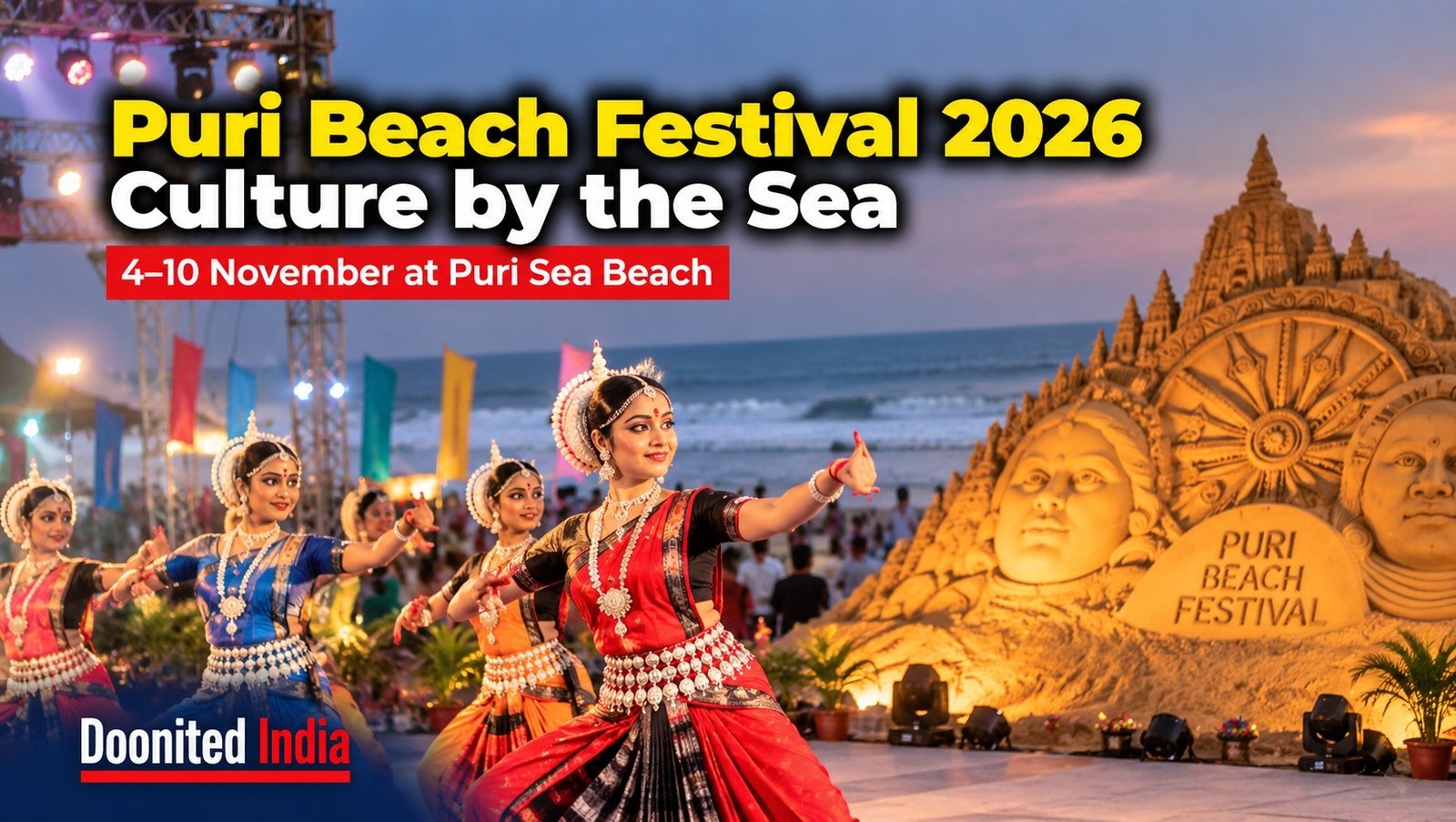
For its 2026 edition, the Ministry of Tourism’s Incredible India portal lists the festival for 4–10 November at Puri Sea Beach, with no entry ticket. It describes a programme combining dance, music, theatre, art, crafts, handlooms, sand art, sports and gastronomy.
That combination is what makes the festival more interesting than its name suggests.
It is not simply a beach party.
It is an attempt to put Odisha’s cultural identity on an open-air stage—and to invite visitors from outside the state to encounter it.
The question is whether that encounter can remain meaningful.
A festival born with a tourism ambition
The Puri Beach Festival began in 1993, with the first edition inaugurated on 29 October that year. The festival was conceived as a broad cultural and tourism event rather than a purely religious celebration.
That origin is important.
Puri already possessed something many destinations spend decades trying to manufacture: a globally recognisable religious identity, an established tourist economy and an extraordinary natural setting.
The festival added another layer.
Instead of asking visitors to experience Odisha only through its temples and pilgrimage traditions, it created a platform for dance, music, crafts, food, fashion and recreation.
Earlier editions included classical and folk performances, sand art, handicraft stalls, food and beach activities. Contemporary tourism material continues to position the festival as a meeting point between culture and leisure.
In other words, the festival was never meant to be only about the sea.
The sea was the stage.
Why the beach changes the cultural experience
Performing Odissi inside a conventional auditorium is one experience.
Performing beside the Bay of Bengal is another.
The landscape changes the audience’s relationship with the performance.
A classical dance form associated with Odisha’s long cultural history is suddenly being encountered alongside waves, sand, tourists and an open horizon.
That can make culture feel accessible to visitors who might never buy a ticket to a formal classical performance.
The same principle applies to crafts.
Odisha’s textile and handicraft traditions can seem distant to visitors when encountered only as finished products in a shop. A festival environment can instead show them as part of a living cultural economy—something made, demonstrated, sold and discussed.
Odisha Tourism currently describes the festival as combining classical and contemporary performances with sand art and craft bazaars, including handicrafts and handlooms.
That is an important distinction.
A cultural festival is most useful when it gives the audience access to people and processes, not merely objects.
Sand is the perfect symbol for Puri
Few art forms fit a beach festival better than sand sculpture.
The material is available beneath the artist’s feet.
It can become a monument in the morning and disappear with the tide or human intervention later.
Odisha has developed this idea into a much larger cultural identity through the International Sand Art Festival at Chandrabhaga, near Konark, where artists from India and abroad create large-scale sculptures. Odisha Tourism says the festival began in 2015 and has become part of the wider Konark cultural season.
Puri’s own beach festival similarly uses sand as part of its visual identity.
There is a nice metaphor here.
A beach festival is temporary.
So is a sand sculpture.
Yet both can leave a lasting memory.
That may explain why sand art works particularly well for tourism: it photographs beautifully, is immediately understandable to international visitors and connects the destination itself to the artwork.
But the challenge is obvious too.
A photograph of a sand sculpture can travel around the world in seconds.
The cultural story behind it takes considerably longer.
Food can become the most democratic part of the festival
Dance requires attention.
Theatre requires time.
Art exhibitions require curiosity.
Food needs none of these introductions.
You simply take a bite.
That makes cuisine potentially one of the most powerful parts of a cultural festival.
Odisha Tourism describes the state’s food culture as a combination of temple food, coastal seafood, rural traditions and seasonal cuisine. It highlights dishes and food traditions including Mahaprasad, Dalma, Pakhala and Pitha, alongside seafood from the state’s coast and Chilika region.
Puri adds another important dimension through its connection with the Jagannath Temple.
The temple’s Mahaprasad tradition is not merely a collection of recipes. It is a ritual food system associated with one of India’s major pilgrimage centres.
That makes culinary tourism in Puri unusually layered.
A visitor can encounter street food, coastal seafood, sweets and everyday Odia cooking while also being surrounded by a much older sacred food culture.
The distinction should be respected.
Not every dish sold at a beach festival should be presented as temple food, and not every restaurant interpretation should be treated as an authentic ritual preparation.
Authenticity becomes more valuable when it is precise.
The festival’s real cultural asset may be its diversity
Official descriptions of the Puri Beach Festival emphasise that it brings together cultural forms from Odisha as well as other parts of India.
That makes it different from a narrowly regional cultural showcase.
Its identity is partly Odisha and partly India meeting Odisha.
Historically, festival programmes have included artists and cultural groups from outside India as well. A 2012 report, for example, recorded participation from cultural troupes from countries including Spain, Malaysia, Sri Lanka, China and Sweden.
That international dimension matters because Puri is already an international-facing destination.
But it also creates an editorial challenge.
The more cultures a festival brings together, the easier it becomes for the host culture to become just one colourful component among many.
The solution is not to reduce diversity.
It is to give the host culture enough depth that visitors understand what makes Puri and Odisha distinctive before moving outward to the wider programme.
Tourism is useful—until culture becomes decoration
There is a temptation in modern destination marketing to turn everything into an “experience.”
Temples become backdrops.
Food becomes Instagram content.
Traditional dancers become photo opportunities.
Artisans become demonstrations.
A beach becomes an event venue.
Tourism is not inherently the problem. In fact, festivals can create valuable markets for artists, craftspeople, performers, food businesses and hospitality providers.
Odisha Tourism’s annual report for 2024–25 lists the Puri Beach Festival among events supported by the state’s Department of Tourism.
That public support indicates that the festival is part of a wider tourism and cultural strategy.
But support should also come with a responsibility to measure outcomes.
How many artisans make meaningful sales?
How many performers receive fair remuneration?
How much local food business is generated?
Do visitors stay longer because of the festival?
Does the event create repeat demand for crafts after the tents come down?
Those questions are more important than simply counting crowds.
A large audience is evidence of attention.
It is not automatically evidence of cultural or economic success.
Puri’s bigger advantage is that the festival does not stand alone
The best reason to visit Puri during a cultural festival may be that the city is already surrounded by an extraordinary cultural ecosystem.
The Jagannath Temple gives the city its spiritual centre.
The beach gives it a natural public space.
Raghurajpur offers Pattachitra and other traditional crafts.
Konark provides one of India’s great architectural landmarks.
Chandrabhaga connects the coast with the International Sand Art Festival.
Odisha’s cuisine provides another route into the region’s identity.
Odisha Tourism itself promotes the wider Bhubaneswar–Konark–Puri coastal circuit, linking temples, heritage, crafts, cuisine and beaches rather than treating each attraction as an isolated destination.
That may be the festival’s greatest opportunity.
Instead of being the destination, Puri Beach Festival can become the gateway.
The international lesson: culture works best when it has a place
For an overseas visitor, Puri can initially appear to contain too many stories.
Religion.
Architecture.
Dance.
Food.
Craft.
Ocean.
Pilgrimage.
Tourism.
The festival can make those connections easier to understand because it puts several of them into one physical setting.
But international audiences should not be shown only the spectacular side.
The deeper story is how a coastal town negotiates modern tourism while retaining a cultural identity that long predates the tourism industry.
That is a much more interesting story than simply calling Puri a “vibrant destination.”
The future of the festival should be measured beyond the beach
The Puri Beach Festival has survived for more than three decades because the basic idea remains attractive: bring culture, recreation and tourism together beside one of India’s best-known beaches.
But the next stage should be more ambitious.
The festival can become a stronger platform for local artisans, regional food entrepreneurs, young performers and cultural institutions if participation translates into continuing opportunity rather than five days of visibility.
Its environmental footprint also deserves attention.
A festival on a beach has an obvious responsibility to protect the very landscape that makes it attractive. Waste management, temporary infrastructure, crowd pressure and responsible use of the shoreline should be treated as part of festival design rather than post-event housekeeping.
That is where modern cultural tourism should be heading.
Not merely:
How many people came?
But:
What did they learn, who benefited, what did they buy, what did they remember—and what did the destination preserve?
When the waves become part of the programme
The most successful cultural festivals do not merely place performances in attractive locations.
They make the location part of the meaning.
Puri has an unusual advantage.
The Bay of Bengal is not scenery added to the festival brochure. It is part of the city’s identity.
The temple is not simply another attraction. It shapes the city’s cultural life.
The food is not merely a menu. It carries regional and ritual histories.
The crafts are not souvenirs. They represent living skills.
And the festival sits at the point where all those worlds meet.
That is why Puri Beach Festival deserves to be seen as more than an annual entertainment event.
Its real experiment is whether a modern tourism festival can make Odisha easier for the world to discover without making Odisha less itself in the process.
The answer will not be found in the loudest concert or the biggest crowd.
It will be found in what remains after the temporary stages disappear, the sand is levelled and the sea returns to being the main attraction.
A good festival fills a beach. A great one leaves visitors understanding why that beach belongs to a particular culture.


World Beyond the News
Octopuses Can Change Their Appearance
Octopuses can rapidly alter their skin colour and texture to communicate, camouflage themselves and respond to danger.
Some Cities Exist Across Two Continents
A small number of cities are geographically associated with two continents, creating unusual cultural and geographic identities.
Earth’s Climate Is Measured in Many Ways
Scientists track temperature, atmospheric gases, sea level, ice cover and other indicators rather than relying on a single climate number.
Streaming Changed How Audiences Discover Shows
Recommendation systems and global streaming releases allow audiences to discover programmes far beyond their original markets.