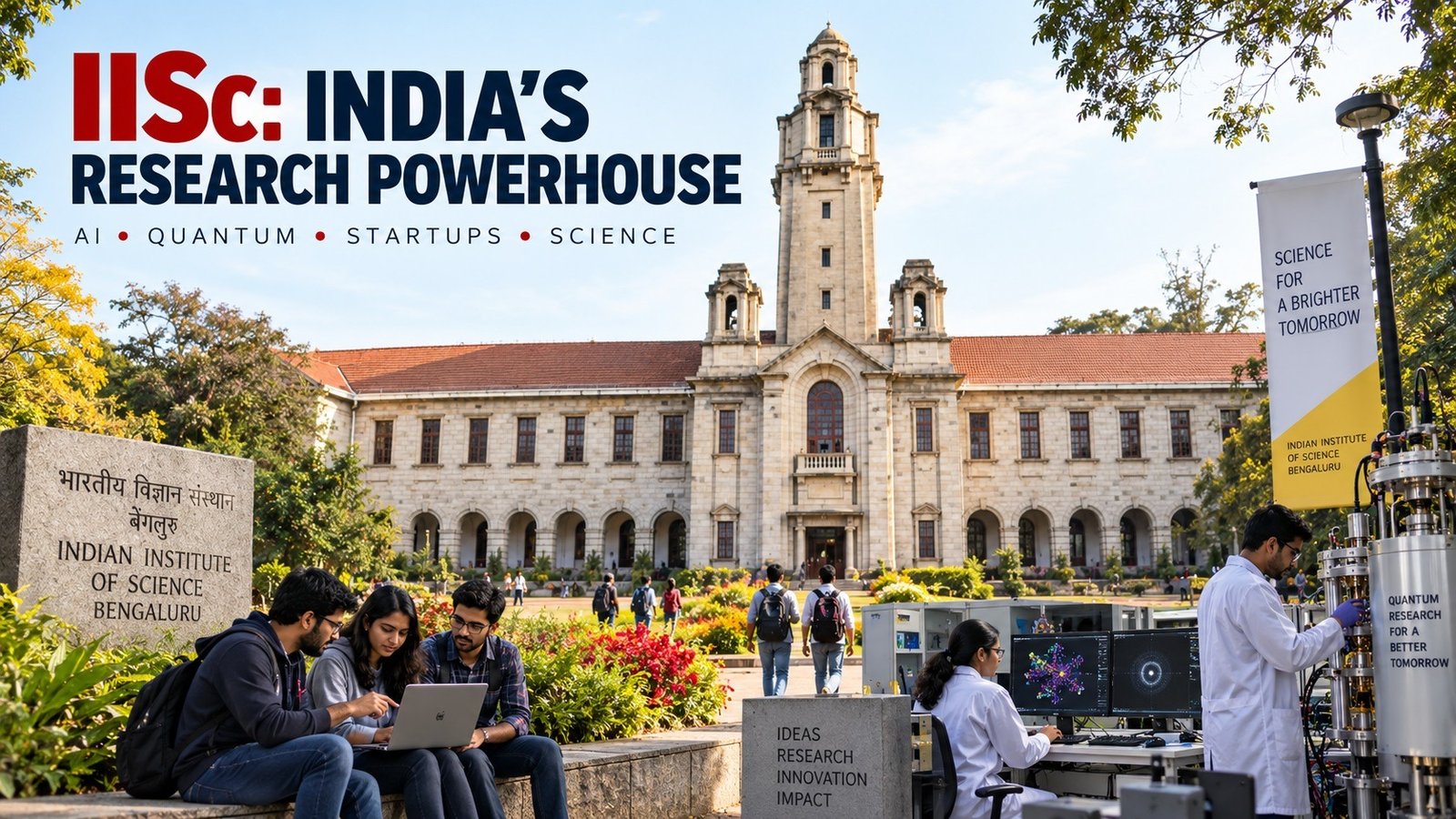
IISc: Where India’s Scientific Ambition Becomes Research, Technology and Innovation
In Bengaluru, there is a university campus where the trees are old, the laboratories are serious and the homework can occasionally involve problems that do not have answers at the back of the textbook.
That institution is the Indian Institute of Science (IISc).
Founded in 1909 through the vision and support of industrialist Jamsetji Tata, the Maharaja of Mysore and the Government of India, IISc was created with an unusually ambitious purpose: advanced scientific education and original research that could contribute to India’s material and industrial development. More than a century later, that mission remains remarkably relevant.
Today, IISc describes itself as India’s premier institute for advanced research and education across science and engineering. It is a deemed-to-be university and was formally notified as an Institution of Eminence in 2018.
But IISc’s real story is not simply about reputation.
It is about what happens when a university is designed around the idea that research is not an optional extra to education — research is the education.
A 1909 Idea That Still Looks Surprisingly Modern
IISc began with just two academic departments — General and Applied Chemistry and Electrical Technology — and its first students arrived in 1911.
The institution has since expanded into a complex research ecosystem spanning more than 42 academic departments and centres across six divisions. IISc’s current director is Prof. Govindan Rangarajan.
Its main Bengaluru campus covers about 440 acres, with extensive greenery that has become part of the character of the institution itself. Some trees on the campus are more than two centuries old — meaning they have been around considerably longer than most university rankings.
The campus is therefore an unusual combination: old trees, advanced laboratories, fundamental science and technologies that did not exist when the institution was founded.
That is probably the most IISc combination imaginable.
Where Undergraduate Education Starts With Research
IISc is particularly unusual in India’s higher-education landscape because its undergraduate programme is explicitly research-oriented.
Its four-year Bachelor of Science (Research) programme gives students an early exposure to scientific inquiry rather than treating research as something that begins only after a master’s degree or PhD.
For the 2026–27 cycle, Indian and OCI/PIO candidates could seek admission through national-level routes including JEE Advanced 2026 and the IISER Aptitude Test (IAT) 2026. IISc also has B.Tech programmes whose 2026 admissions are conducted through JoSAA.
At postgraduate and doctoral levels, the institute covers areas ranging from physical and mathematical sciences to chemical sciences, biological sciences, engineering, computer science and interdisciplinary research. Its research admissions include routes involving examinations such as GATE and NET-JRF, depending on the programme.
The underlying philosophy is clear:
Don’t just teach students what is known. Teach them how to investigate what is not yet known.
That is a very different proposition from simply preparing someone to pass an examination.
AI, Quantum Technology and the New Research Frontier
The image of IISc as a place devoted only to traditional physics, chemistry and engineering is increasingly outdated.
The institute has established interdisciplinary research clusters in areas including Artificial Intelligence, brain and computation, cyber-physical systems, quantum technologies, materials informatics, microelectronics and VLSI, security research, speech and language processing and visual analytics.
This interdisciplinary approach matters because many of India’s technological challenges do not fit neatly inside one department.
A semiconductor problem may involve physics, materials science and electronics.
A healthcare problem may require biology, medicine, computation and engineering.
A climate problem may involve atmospheric science, mathematics, energy systems and policy.
The boundaries between disciplines are increasingly becoming inconvenient — which is precisely why institutions such as IISc are trying to cross them.
Research That Tries to Leave the Laboratory
One of the most important changes in Indian research institutions is the movement from research publication to research translation.
IISc reports 3,818 publications during 2025, including journal articles, conference proceedings and book chapters. It also reported 137 startups incubated so far, with 54 currently under incubation as of January 2026.
That startup ecosystem covers areas with direct industrial relevance.
IISc-linked ventures have worked in areas such as drones and autonomous systems, semiconductor technologies, renewable energy and other deep-tech fields. The institute’s current intellectual-property showcase also highlights technologies in sensors, photonics, aerospace, UAVs, navigation and biomedical applications.
This is important for India because scientific self-reliance is not created merely by importing sophisticated equipment and assembling it domestically.
It requires researchers who can develop new materials, algorithms, devices, manufacturing techniques and systems.
In other words, the journey from paper to prototype matters.
Challakere: IISc’s Second Experiment
The IISc story extends well beyond Bengaluru.
The institute has a 1,500-acre campus at Challakere in Karnataka’s Chitradurga district, established during its centenary period. The campus is part of a developing science-and-technology ecosystem in which organisations including DRDO, BARC and ISRO have a presence.
Challakere is particularly interesting because it demonstrates that a research institution can have a social mission alongside its scientific one.
IISc’s Talent Development Centre has trained thousands of science and mathematics teachers. The campus also hosts research and training activities involving climate, solar energy and sustainable technologies.
The institute has also worked with HAL on a Skill Development Centre intended to address technical skill gaps.
So the second campus is not simply about putting more buildings on 1,500 acres.
It is an attempt to connect advanced science with teachers, workers, local communities and national technological capability.
Rankings Are Useful. They Are Not the Whole Story.
IISc’s current rankings reinforce its national standing.
Its 2025 annual report records IISc as Rank 1 in both the NIRF University and Research categories, while it was Rank 2 in the overall category and Rank 3 in innovation.
In the QS World University Rankings 2027, IISc is ranked #=221 globally.
Those numbers are useful indicators, but rankings inevitably reduce complicated institutions to comparable metrics.
A university is not a cricket team. There is no single scoreboard that captures everything.
For IISc, research quality, doctoral training, scientific infrastructure, faculty strength, technology transfer and the long-term influence of its graduates and research may tell us more than one position on a global table.
The Question India Should Be Asking
The larger IISc story raises a question that goes beyond one institution.
India has spent decades building elite research organisations, engineering institutes and universities. The next challenge is to make the country’s research ecosystem produce more globally competitive intellectual property, technologies, companies and solutions to Indian problems.
IISc is already moving in that direction through interdisciplinary research, technology transfer and incubation.
But there is still a long road between an excellent laboratory and a product that millions of people can use.
A patented technology is not automatically a successful business.
A research paper is not automatically a solution.
A startup is not automatically an industry.
The difficult middle — scaling — is where much of India’s research ambition will ultimately be tested.
The DOONITED View
IISc’s greatest strength may not be that it has existed since 1909.
It is that its original question still makes sense in 2026:
How can advanced knowledge improve India’s scientific, technological and industrial capabilities?
The answer today is much broader than chemistry and electrical technology.
It includes artificial intelligence, quantum technologies, semiconductors, climate science, healthcare, advanced materials, aerospace, robotics and sustainable technologies.
The lesson for India’s universities is equally important.
The future of higher education cannot be built entirely around producing more graduates.
India needs institutions that produce questions, discoveries, technologies, entrepreneurs and researchers.
IISc was built around that idea more than a century ago.
The challenge now is to make that philosophy work at the scale India needs.
The Learning Point
For students, IISc offers a useful reminder: prestige is not the product; capability is.
If a student enters a research institution merely chasing a famous name, the opportunity can be wasted.
But if the student learns to question assumptions, design experiments, work across disciplines, understand evidence and turn an idea into something testable, the education becomes considerably more valuable.
That is ultimately what makes IISc different.
It does not merely ask students to learn what India already knows.
It puts them closer to the much harder question:
What should India know next?

World Beyond the News
Why Elephants Stay Close to Their Herd
Elephants live in highly social family groups and use calls, touch and body movements to maintain strong bonds.
Most of the Deep Ocean Remains Difficult to Explore
Extreme pressure, darkness and distance make deep-ocean exploration one of Earth’s greatest scientific challenges.
Spacecraft Can Travel Without Traditional Roads
Spacecraft use carefully calculated trajectories and gravity assists to travel enormous distances through space.
Why Movie Trailers Are Released in Stages
Major films often use teaser trailers, full trailers and final promotional spots to build awareness over time.