Lohum’s Nickel Bet: Why India Is Going Abroad for the Minerals Behind Its Clean-Energy Future
India’s clean-energy ambitions have created an awkward little paradox.
The country wants more electric vehicles, batteries, renewable-energy equipment and advanced manufacturing. But many of the minerals needed to build those technologies are not available domestically in sufficient quantities.
So India increasingly has to go looking for them abroad.
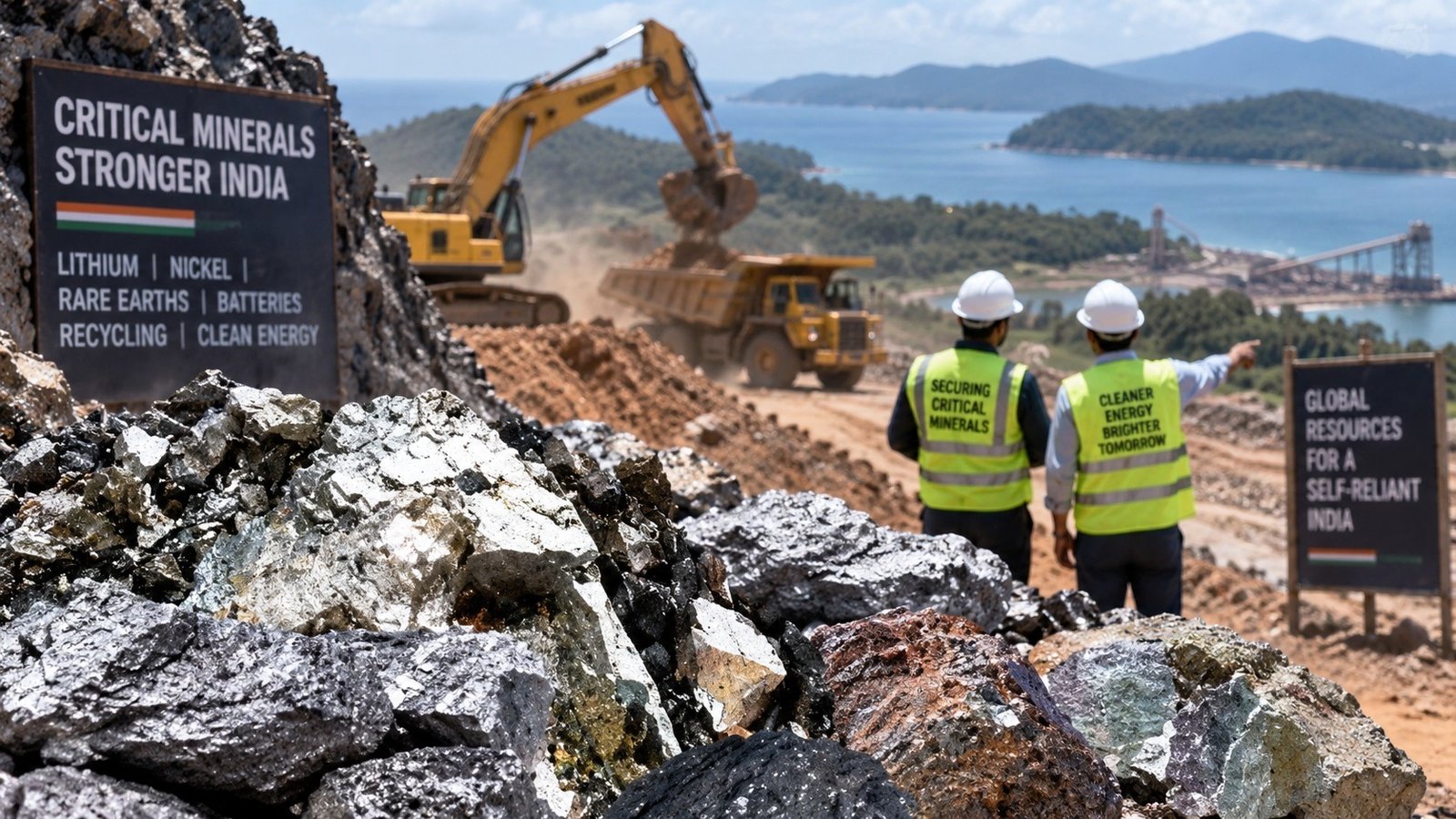
The latest example is Lohum, the Indian critical-minerals company that plans to acquire nickel mines in Indonesia and the Philippines and increase its nickel production tenfold—from about 1,000 metric tonnes a year currently produced through recycling in Gujarat to a targeted 10,000 tonnes within 18 months, according to a September 22 Reuters report. Lohum says it plans to raise about ₹30 billion ($315 million) through debt and equity to support its expansion.
That sounds like a corporate expansion story.
It is actually a story about something much bigger:
Who controls the raw materials behind India’s next industrial economy?
India has a nickel problem
Nickel may not have the public profile of lithium or rare earths, but it is an important industrial metal, including in stainless steel and several battery chemistries.
And India’s dependence is striking.
NITI Aayog’s latest trade analysis says India remains 100% import-dependent on nickel, while its estimated 2025–30 demand is about 11,543 kilotonnes across the assessment period. NITI Aayog specifically recommends diversifying suppliers, securing overseas nickel assets and developing domestic recovery and recycling capabilities.
That gives Lohum’s strategy a particularly Indian logic.
If the ore cannot be mined economically at home, perhaps an Indian company can secure the resource abroad and bring more of the downstream value chain into India.
It is less “dig everything in India” and more:
source globally, process strategically, manufacture domestically, recycle eventually.
That distinction matters.
Why Indonesia and the Philippines?
Because this is where the world’s nickel geography becomes very concentrated.
USGS estimates that global mined nickel production reached about 3.9 million tonnes in 2025. Indonesia produced approximately 2.6 million tonnes, while the Philippines produced around 270,000 tonnes.
Together, that is roughly three-quarters of global mined production.
Indonesia alone accounted for about two-thirds.
For an Indian company looking for scale, these are not random destinations on a map.
They are two of the world’s most important nickel jurisdictions.
But concentration creates another problem.
If most of the world’s supply comes from a handful of countries, then geopolitical decisions, environmental rules, export restrictions, weather, mining disruptions or changes in downstream-processing policy can affect everyone further down the chain.
In other words, the world’s electric-car revolution still has to deal with something remarkably old-fashioned:
rocks, mines and national borders.
Lohum wants to move beyond recycling
Lohum’s existing nickel production is significant precisely because it comes from recycling.
The company currently produces about 1,000 tonnes of nickel annually from recycled material in Gujarat, according to Reuters. Its proposed mine acquisitions would add primary resources to a business that already has a secondary-resource component.
That creates an interesting model.
A conventional mining company generally begins with:
mine → ore → processing → metal.
A circular-materials company wants:
used battery/material → recovery → refined material → new product.
Lohum is attempting to operate across both worlds.
That could become increasingly important because critical-mineral security is not simply about finding more mines. Recycling can provide a domestic secondary supply source once batteries, electronics and other products reach end of life.
The Indian government has recognised this problem. The National Critical Mineral Mission includes support for domestic exploration, overseas asset acquisition, processing, recycling and recovery from end-of-life products. The government has also approved a ₹1,500 crore incentive scheme for critical-mineral recycling.
So Lohum’s strategy is broadly moving in the same direction as India’s emerging critical-mineral architecture.
The company is building more than a nickel business
The nickel plan becomes more interesting when placed alongside Lohum’s other projects.
Reuters reports that the company has secured rights to 10 lithium mining blocks in Zimbabwe, plans to invest around $100 million, and intends to process lithium ore into lithium sulphate before sending it to India for further refining. Lohum says it wants to become the first Indian company to produce lithium from overseas mining assets.
At home, it is building a 5,000-tonne-per-year cathode active material plant in Uttar Pradesh.
It is also developing:
- a lithium-ion battery recycling facility in Sharjah, UAE;
- a 1,200-tonne-per-year rare-earth permanent magnet plant in Uttar Pradesh;
- and exploration for rare-earth resources in Southeast Asia.
That starts to look less like a single mining bet and more like an attempt to construct a multi-country critical-minerals platform.
The geography is revealing.
Zimbabwe for lithium.
Indonesia and the Philippines for nickel.
Uttar Pradesh for downstream manufacturing.
Gujarat for recycling.
Sharjah for another recycling operation.
The raw material may travel internationally, but the strategic objective is to capture more of the value chain.
This is also about China’s role
The geopolitical context cannot be ignored.
China is a major force in global mineral processing and battery-material supply chains. India’s government has openly identified dependence on external sources and concentrated processing capacity as vulnerabilities.
In March 2026, the Ministry of Heavy Industries said India’s current lithium demand was entirely import-dependent and warned that China’s policy changes affecting lithium-ion batteries, cathode materials and related technologies could tighten supply conditions for Indian manufacturers.
But there is an important distinction between reducing dependence on China and removing China from the supply chain.
The latter is not a realistic description of today’s global mineral economy.
Critical-mineral supply chains are international. Ore, refining technology, equipment, chemicals, financing and downstream manufacturing can involve multiple countries.
The more realistic Indian objective is diversification.
If India depends on one country, it has a vulnerability.
If it depends on five countries, plus domestic recycling and some domestic production, the vulnerability can be distributed.
That is supply-chain resilience—not complete isolation.
India’s government is already thinking overseas
Lohum’s move also fits a broader policy shift.
The National Critical Mineral Mission, approved in January 2025, explicitly includes acquisition of critical-mineral assets abroad. The mission has a seven-year framework through 2030–31 and includes exploration, mining, beneficiation, processing and recovery from end-of-life products.
The government’s own mission document sets an ambition for Indian companies to secure at least 50 overseas mining assets involving minerals such as lithium, nickel, copper, cobalt and graphite by 2031, with overseas assets expected to contribute to India’s critical-mineral demand.
Khanij Bidesh India Ltd. (KABIL), meanwhile, has already signed an agreement covering five lithium brine blocks in Argentina.
And by June 2026, the Ministry of Mines said 56 critical and strategic mineral blocks had been successfully auctioned domestically.
The message is becoming clear:
India’s mineral strategy is no longer purely domestic.
But owning a mine is not the same as securing a supply chain
This is where some of the excitement around critical minerals needs a reality check.
Finding or acquiring a mine does not automatically create reliable supply.
There are exploration risks, geological uncertainty, permitting, environmental requirements, local-community issues, infrastructure, commodity-price cycles, processing technology, shipping costs and geopolitical risks.
The Philippines, for example, has experienced fluctuations in nickel production. USGS estimated its 2025 production at 270,000 tonnes, down from 354,000 tonnes in 2024.
Indonesia presents a different challenge: its enormous nickel industry has increasingly focused on domestic processing and downstream value addition rather than simply exporting ore. USGS notes that Indonesia’s nickel production expanded alongside new processing plants and the country’s long-standing ore-export restrictions.
Therefore, Lohum’s target of 10,000 tonnes within 18 months should be understood as an ambitious corporate objective, not a guaranteed outcome.
The mine acquisition still has to happen.
Then the material has to be produced.
Then transported.
Then processed.
Then incorporated into products.
That is a long chain for a very short headline.
The real prize is the middle of the chain
For India, the biggest opportunity may not be simply owning mines.
It may be controlling more of what happens after the mine.
A country that imports ore and exports sophisticated battery materials captures more value than one that merely imports finished components.
That is why Lohum’s proposed cathode-material plant is strategically interesting.
Cathode active material sits much closer to the battery-manufacturing stage than raw ore.
Likewise, rare-earth magnet manufacturing moves the country toward a finished industrial component rather than simply securing mineral resources.
The broader objective is therefore:
mine → concentrate → refine → chemical/material → component → battery/product → recycle.
The further India can move along that chain, the greater the potential industrial value captured domestically.
There is an environmental question too
Critical minerals are essential to many clean-energy technologies, but mining them is not environmentally cost-free.
Nickel mining can involve land disturbance, water use, waste generation and emissions. Battery-material processing can also have significant environmental footprints.
That means “critical” should not become a magic word that makes environmental questions disappear.
India’s future critical-mineral strategy will have to balance three things:
security of supply, industrial competitiveness and environmental responsibility.
Recycling can help with the first two while potentially reducing pressure on virgin resources, but recycling itself requires energy, technology and safe handling.
The green economy cannot simply move the environmental bill to a different chapter.
DOONITED View: India’s mineral strategy is becoming global by necessity
Lohum’s expansion plan is interesting because it represents a new kind of Indian industrial ambition.
The old model of self-reliance was often interpreted as make everything domestically.
The emerging model is more sophisticated:
secure resources globally, diversify suppliers, build processing capacity in India, manufacture higher-value products domestically and recover materials when those products reach the end of their useful life.
That is a very different idea of self-reliance.
India cannot manufacture a nickel deposit.
It cannot relocate Indonesia’s geology to Uttar Pradesh.
But it can decide where the economic value created from that nickel is captured.
That may ultimately be the more important question.
Lohum’s 10,000-tonne target is therefore worth watching—not because one company’s expansion will solve India’s mineral-security problem, but because it illustrates how Indian companies are beginning to participate in a global resource race that was once dominated almost entirely by governments and giant mining corporations.
And there is a little irony here.
The technology of the future—electric cars, batteries, renewable energy, advanced electronics—still begins with some remarkably old-fashioned questions:
Where is the mine?
Who controls it?
Who processes the material?
And who gets the value?
Learning Point
For India’s clean-energy transition, technology alone is not enough.
A battery factory without secure access to critical minerals remains vulnerable. A mine without refining and manufacturing capacity captures limited value. And manufacturing without recycling eventually creates another resource problem.
The strongest supply chain is therefore not a single mine or factory.
It is an ecosystem connecting overseas resources, Indian processing, domestic manufacturing and recycling.
India’s critical-mineral race has begun to look less like a hunt for rocks and more like a contest to build the entire industrial chain around them.


World Beyond the News
Bees Communicate Where Food Is
Honeybees use movement patterns known as waggle dances to communicate information about food locations.
Street Food Reflects Local History
Many famous street foods developed from migration, trade, local ingredients and the everyday needs of working communities.
A Day on Venus Is Extremely Long
Venus rotates so slowly that one rotation relative to distant stars takes longer than its trip around the Sun.
Human Achievement Continues to Push Limits
Athletes, engineers, scientists and explorers regularly establish new benchmarks in speed, endurance, scale and precision.