Rini Dhumal’s Art Returns to Ahmedabad in a Five-Decade Tribute
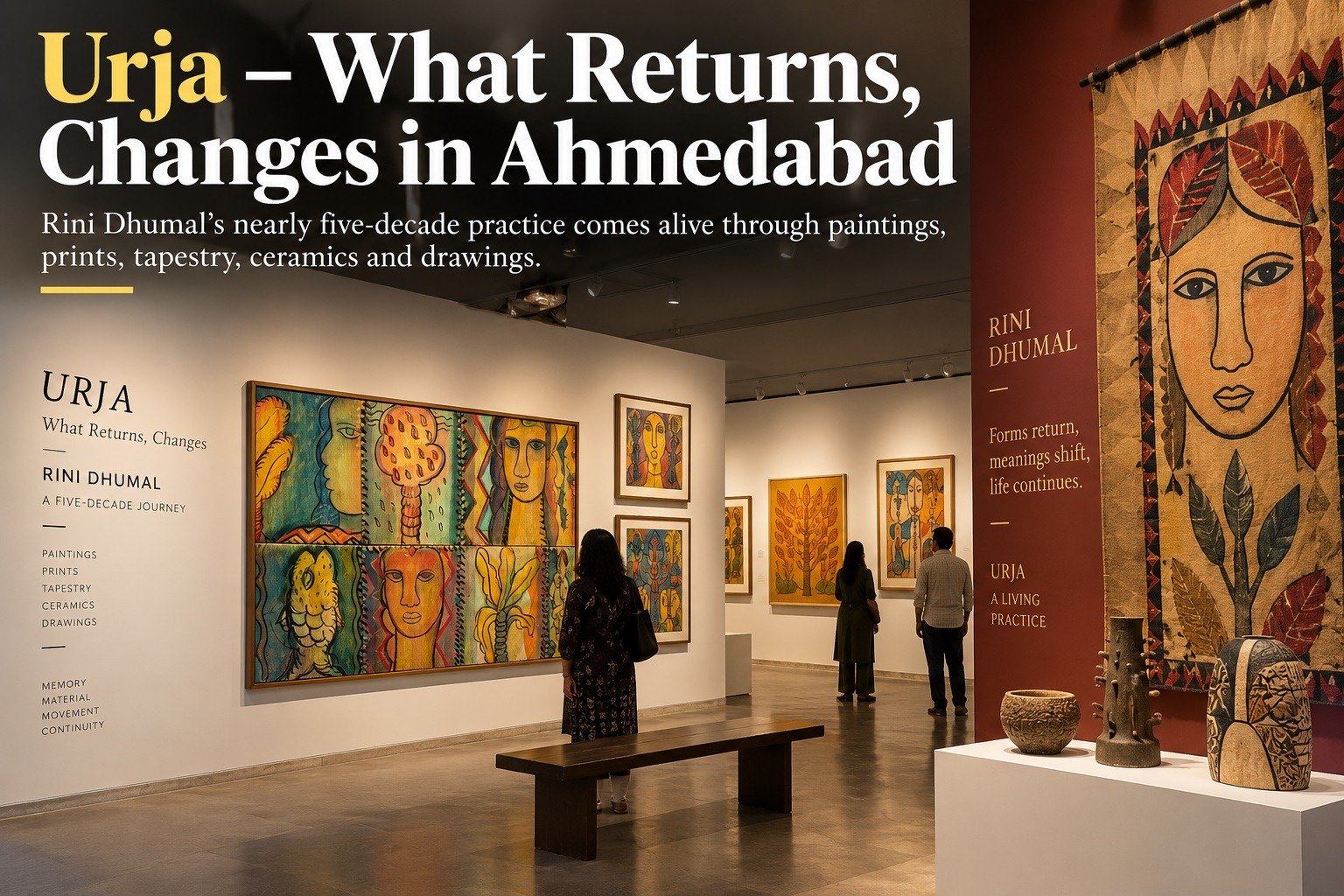
“Urja – What Returns, Changes” brings nearly five decades of Rini Dhumal’s paintings, drawings, prints, tapestry and ceramics to Ahmedabad, revisiting an artistic language shaped by women, mythology, nature, memory and the subconscious.
Some artists leave behind a recognisable visual vocabulary.
Rini Dhumal left behind something more interesting: a world.
Women appear in it. So do goddesses, birds, trees, landscapes and mysterious figures that seem to belong simultaneously to mythology and everyday life. Her imagery can feel ancient without being trapped in the past, while her treatment of the human figure often carries both vulnerability and quiet force.
That world returns to Ahmedabad this September.
“Urja – What Returns, Changes – A Tribute to Rini Dhumal” is being presented by Nexus Art and Catharsis Art Gallery at Eff.co, Sardar Patel Ring Road, Ambli, Ahmedabad, from September 18 to October 17, 2026. The exhibition spans nearly five decades of Dhumal’s artistic practice and brings together paintings, sketches, prints, tapestry and ceramics.
The title itself provides the exhibition’s central thought.
What returns does not necessarily return unchanged.
Memory does that.
Art does it too.
A world built from memory and myth
Dhumal’s work repeatedly moves between the personal and the archetypal.
According to the India Art Fair exhibition description, her practice developed a deeply personal language around memory, mythology and lived experience, with recurring figures including women, goddesses, birds, trees and landscapes. Her work explores femininity, nature, desire and the subconscious.
This combination helps explain why her paintings rarely feel like straightforward illustrations of mythology.
A goddess in Dhumal’s work is not necessarily there simply to tell an old story.
The figure can become a contemporary presence — a way of thinking about female identity, vulnerability, strength or the relationship between human beings and nature.
The myth becomes material for a personal visual language.
That is an important distinction.
Indian contemporary art has frequently drawn from mythology, but the interesting question is always what an artist does after borrowing the myth.
Dhumal transforms it.

The woman at the centre
The female figure occupies a particularly important place in Dhumal’s artistic vocabulary.
Her recurring women are not merely decorative figures placed inside elaborate compositions. They often appear as psychologically charged presences, carrying associations of strength, desire, vulnerability and introspection.
This concern with gender has been recognised across accounts of her career. Dhumal’s work is noted for its powerful female figures and sustained engagement with questions surrounding femininity.
Yet reducing the work to “women’s art” would be too narrow.
The figures exist within a larger ecosystem.
Trees, birds, landscapes, animals and mythological forms surround them. The human body becomes part of nature rather than something completely separate from it.
That relationship gives the work an ecological dimension without turning it into environmental propaganda.
Nature is not a slogan.
It is a character.
From Santiniketan to Baroda
Dhumal’s artistic education also helps explain the range of her practice.
Born in 1948 in Bengal, she studied printmaking under Somnath Hore at Santiniketan and painting under K. G. Subramanyan at Baroda. She later taught at Baroda for 18 years.
Those associations place her within important traditions of Indian modern and contemporary art education.
Santiniketan encouraged an engagement with material, nature and artistic experimentation, while Baroda developed into one of India’s important centres for modernist and contemporary artistic practice.
Dhumal’s work consequently cannot be neatly placed inside one stylistic box.
Painting and printmaking remained central, but her practice expanded into other forms.
The Ahmedabad tribute reflects that breadth by bringing together paintings, sketches, prints, tapestry and ceramics rather than presenting her legacy through paintings alone.
Printmaking was never a side note
Dhumal’s connection with printmaking is particularly significant.
She studied under Somnath Hore at Santiniketan, and printmaking became an important component of her practice. Her 1992 linocut Magician, for example, is held by the Kerala Museum and demonstrates her ability to use the graphic power of the medium to construct a strong female figure.
Printmaking demands a different relationship with an image from painting.
The artist has to think about reversal, pressure, surface and process.
Marks can become more deliberate.
A line has consequences.
And because printmaking can produce multiple impressions from a matrix, it also creates an intriguing relationship between repetition and variation.
That is particularly relevant to Urja.
The exhibition is not simply bringing back individual artworks. It is bringing back a visual vocabulary that evolved through repetition, experimentation and change.
The importance of material
One of the pleasures of the exhibition is its refusal to define Dhumal through a single medium.
Painting, drawing and printmaking sit alongside tapestry and ceramics.
That matters because material changes the way an idea behaves.
A painted figure can float within a pictorial space.
A woven figure has a physical relationship with thread and surface.
A ceramic object occupies the viewer’s physical environment.
A print introduces another kind of relationship between image and reproduction.
The same artistic concerns can therefore return in different physical forms.
That may be the deeper meaning of What Returns, Changes.
An idea can return without repeating itself.
Earthy colours, compressed worlds
The India Art Fair description of the exhibition points to Dhumal’s layered surfaces, earthy palette and compressed spaces, describing them as elements that bring the archaic and contemporary into a singular visual world.
That is a useful way to approach the work.
Rather than expecting conventional perspective or straightforward narrative, viewers can enter Dhumal’s compositions as dense psychological spaces.
Figures, symbols, plants and landscapes appear to coexist.
The resulting visual world can feel dreamlike, but it is not necessarily escapist.
Dreams, after all, are where memory, desire and anxiety frequently ignore the neat filing system imposed by everyday life.
Dhumal’s art seems comfortable with that disorder.
Why Ahmedabad matters
Holding the tribute in Ahmedabad is significant within India’s art landscape.
The city has long been associated with design, architecture, textiles, museums and a serious collector and gallery ecosystem. Bringing a five-decade artistic practice into this environment creates an opportunity to reconnect Dhumal’s work with audiences beyond the major metropolitan exhibition circuit.
It also gives the exhibition a useful regional context.
Dhumal’s art draws upon Indian cultural memory without becoming a straightforward exercise in heritage display.
That makes the work relevant to contemporary audiences who may recognise the mythology while encountering it through a very different visual language.
An artist remembered through more than one medium
A retrospective or tribute can sometimes become an exercise in nostalgia.
Urja has the opportunity to avoid that trap because Dhumal’s work is not confined to a single period.
Her practice stretched across decades and media, and the exhibition’s format allows those different strands to sit beside one another.
The result is not simply a chronological biography.
It is a conversation between forms.
A sketch can speak to a print.
A print can speak to a painting.
A painting can lead towards tapestry or ceramic.
The artist’s concerns remain recognisable even as the material changes.
That is often the most revealing way to understand a long career.
DOONITED VIEW: What returns is never exactly the same
The smartest idea in Urja – What Returns, Changes is contained in its title.
Artistic memory does not work like a photograph stored on a hard drive.
It changes when it is revisited.
A myth remembered in childhood may mean something different decades later.
A woman seen in one context may become a goddess in another.
A tree may begin as part of a landscape and eventually become a symbol of endurance.
Dhumal’s practice demonstrates how these transformations can become an artistic method.
Her recurring figures and motifs do not simply repeat.
They accumulate meaning.
That gives this Ahmedabad exhibition value beyond commemoration.
It asks viewers to consider how artists — and, by extension, all of us — carry the past into the present.
Not intact.
Not untouched.
But transformed.
And perhaps that is the real lesson of Rini Dhumal’s legacy.
The past does not stay alive because we preserve it exactly as it was. It stays alive because each generation finds a new way to see it.
In Dhumal’s work, mythology becomes personal, memory becomes image, and the familiar returns carrying something new.
That is what makes Urja more than a tribute.
It is a conversation with an artist whose visual world continues to change each time we enter it.


World Beyond the News
Why Elephants Stay Close to Their Herd
Elephants live in highly social family groups and use calls, touch and body movements to maintain strong bonds.
Most of the Deep Ocean Remains Difficult to Explore
Extreme pressure, darkness and distance make deep-ocean exploration one of Earth’s greatest scientific challenges.
Spacecraft Can Travel Without Traditional Roads
Spacecraft use carefully calculated trajectories and gravity assists to travel enormous distances through space.
Why Movie Trailers Are Released in Stages
Major films often use teaser trailers, full trailers and final promotional spots to build awareness over time.