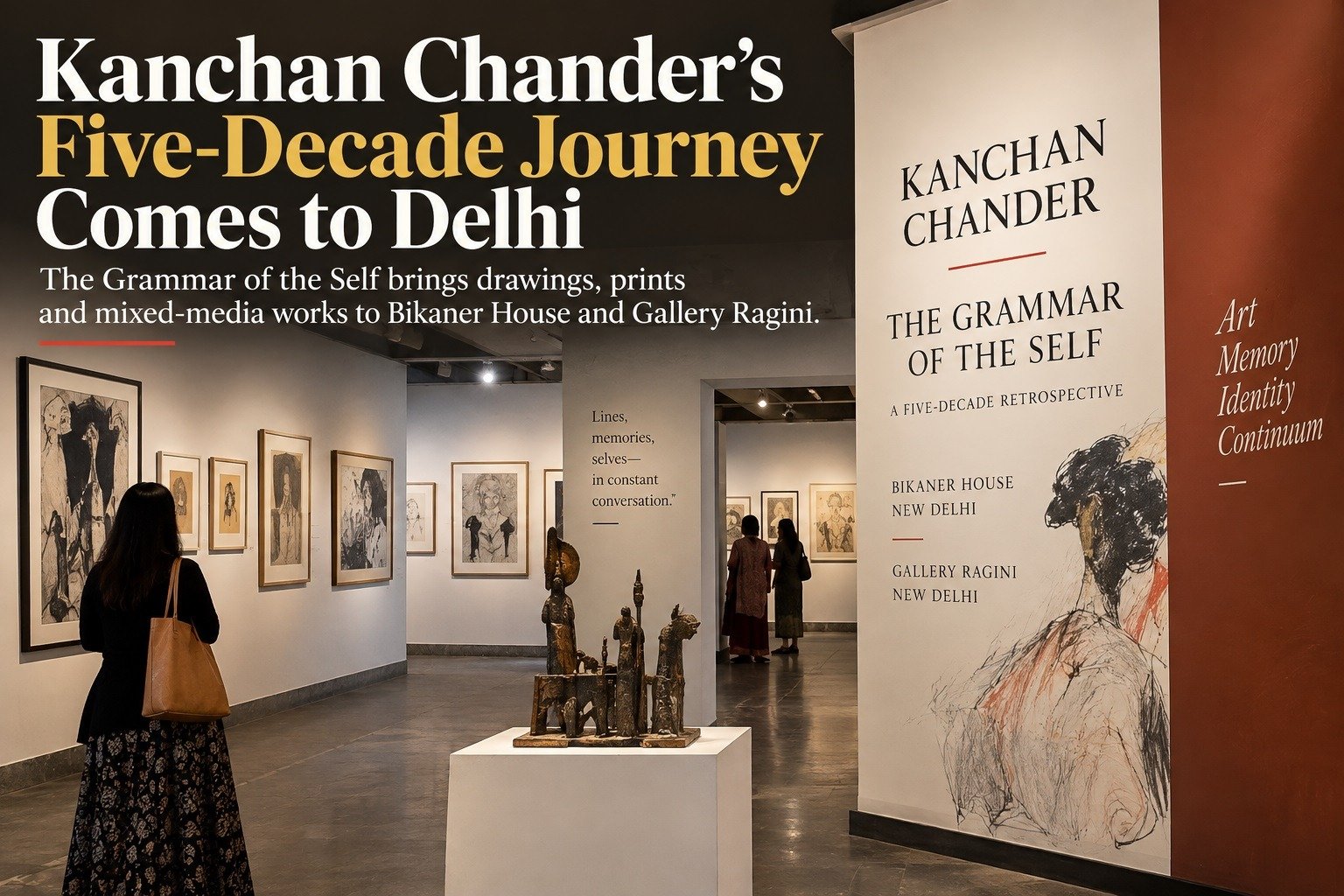
The Grammar of the Self: Kanchan Chander’s Five-Decade Journey Comes to New Delhi
A major New Delhi retrospective brings together more than five decades of Kanchan Chander’s drawings, prints and mixed-media works, revealing how observation, memory and identity have shaped one of India’s distinctive printmaking practices.
There are artists whose careers can be understood through a few famous works.
Then there are artists whose careers become more interesting when you see the years between those works.
“The Grammar of the Self: Kanchan Chander – Prints and Drawings” belongs to the second category.
On view in New Delhi through October 31, 2026, the retrospective brings together more than five decades of work by artist and printmaker Kanchan Chander, moving across drawings, prints and selected mixed-media works. Curated by Kishore Singh and presented by Gallery Ragini, the exhibition traces recurring concerns around observation, memory, identity and the human experience.
And there is something appropriate about calling this exhibition The Grammar of the Self.
Grammar is what gives language structure.
For Chander, drawing appears to have played a similar role: a visual vocabulary through which experience can be observed, processed and transformed.
Two Delhi venues, one evolving practice
The exhibition began at LTC Gallery, Bikaner House, from September 12 to 18.
It then moves to Gallery Ragini’s new Lado Sarai space from September 21 to October 31. This two-stage presentation means the exhibition is not simply a single gallery event but a larger Delhi art-season project.
For visitors planning a visit, that distinction is useful.
If someone arrives at Bikaner House expecting the exhibition to continue through October, they may discover the oldest rule of gallery-going: always check the venue before leaving home.
The longer run is at Gallery Ragini in Lado Sarai, one of Delhi’s established art districts.
Drawing is the thread holding it together
At the centre of The Grammar of the Self is drawing.
The exhibition brings together early portraits, self-portraits and figurative studies alongside prints and more recent abstract works. Rather than presenting drawing as merely preparation for a finished artwork, the retrospective treats it as an enduring part of Chander’s artistic language.
That makes the exhibition particularly valuable as a career survey.
Viewers can see how an artist’s relationship with line, figure, space and observation changes over time.
An early work can appear intensely concerned with looking at the world.
A later work may be more concerned with distilling that world.
Between the two is the artist’s accumulated experience.
That is one of the pleasures of a retrospective: it allows the audience to see time itself as part of the artwork.

From the human figure to abstraction
Chander’s practice has moved through different subjects and techniques without abandoning its underlying interest in visual observation.
The exhibition includes works executed through etching, lithography, woodcut and drawing, alongside selected mixed-media works and recent abstract explorations.
Among the works highlighted in coverage of the exhibition are Self (1978), Study from Model II (1979), Bawri (1981), Encaged I (1981), Encaged Nose (1987) and The Forlorn Queen (1992), alongside later works such as Golden Torso on Red I from 2022.
The dates are revealing.
They demonstrate that the retrospective is not built around one artistic period or one signature style.
Instead, it creates a conversation between different moments in Chander’s career.
That is where the title becomes particularly useful.
A grammar does not consist of one word.
It is a system that allows different words, structures and meanings to coexist.
Identity without a single portrait
The word “self” in the exhibition title might initially suggest self-portraiture.
There is certainly a place for the figure and self-observation in Chander’s work. But the exhibition’s larger concern is more expansive.
Identity is not necessarily a face.
It can be memory.
It can be the way we observe a room.
It can be a figure remembered rather than directly seen.
It can be the psychological atmosphere surrounding a person.
The exhibition therefore uses the language of drawing and printmaking to explore something much harder to put on paper: how a person experiences the world and turns that experience into memory.
This is also why the works can feel personal without being narrowly autobiographical.
A viewer does not need to have lived the artist’s life to recognise the basic human experience of looking, remembering, questioning and changing.
An international education, an Indian artistic vocabulary
Chander’s artistic development was shaped by formative years in New Delhi, East Berlin, Santiago and Paris, according to exhibition coverage. Those experiences introduced different artistic environments while her practice continued to develop around drawing and printmaking.
The result is not easily reduced to a simple “Indian versus international” narrative.
That would actually miss the point.
Artists rarely develop in sealed geographical containers.
Ideas travel.
Techniques travel.
Artists travel.
What matters is what happens after those influences are absorbed.
In Chander’s case, the exhibition presents a practice that developed across different environments while maintaining a sustained engagement with observation, the human figure and the possibilities of printmaking.
Why printmaking still matters
There is another reason The Grammar of the Self is relevant to India’s current art conversation.
Printmaking can sometimes occupy an awkward position in a contemporary art world fascinated by enormous installations, immersive technology and increasingly spectacular exhibition design.
A print can look modest.
It can fit on a wall.
It does not require a warehouse.
It does not necessarily glow, move or ask visitors to photograph themselves inside it.
And yet printmaking possesses something contemporary art should not underestimate: discipline.
Etching, lithography and woodcut require technical decisions that leave traces. The relationship between mark and material is part of the meaning.
Chander’s retrospective therefore provides an opportunity to reconsider the expressive possibilities of a medium that rewards close looking rather than instant spectacle.
A career is also a record of change
The most valuable aspect of a five-decade retrospective is not simply quantity.
It is comparison.
Seeing early figurative works beside later abstract explorations allows viewers to identify continuities that may not be obvious when individual works are encountered separately.
What changed?
What remained?
Which ideas disappeared?
Which returned in another form?
These questions are often more revealing than trying to identify a single “best” period in an artist’s career.
After all, artistic development is not a smartphone operating-system update. The newest version is not automatically the most interesting one.
Sometimes an early experiment explains a later breakthrough.
Sometimes a seemingly minor drawing contains the seed of an idea that becomes important decades later.
That is exactly what retrospective exhibitions are designed to reveal.
DOONITED VIEW: The self is built from accumulated observation
The intelligent idea behind The Grammar of the Self is that identity may be less fixed than we imagine.
Chander’s career demonstrates this through practice rather than proclamation.
The same artist can move from portraiture to figurative studies, from printmaking to mixed media, and toward abstraction without abandoning the fundamental act of looking.
The “self” consequently becomes something constructed over time.
Every observation adds something.
Every memory changes something.
Every technique opens another possibility.
And every new work becomes part of the record.
That makes this retrospective more than a celebration of an established artist.
It becomes a lesson in how artistic identity is actually formed: not in a single breakthrough moment, but through decades of looking, making, revising and continuing.
For Indian audiences, there is an additional value.
At a moment when contemporary art is increasingly discussed through market prices, blockbuster exhibitions and social-media visibility, The Grammar of the Self redirects attention towards something quieter — the sustained development of an artistic language.
That may be the exhibition’s most meaningful invitation.
Slow down.
Look closely.
Then look again.
Because sometimes the most revealing story an artwork tells is not what it depicts.
It is how the artist learned to see.


World Beyond the News
Why Elephants Stay Close to Their Herd
Elephants live in highly social family groups and use calls, touch and body movements to maintain strong bonds.
Most of the Deep Ocean Remains Difficult to Explore
Extreme pressure, darkness and distance make deep-ocean exploration one of Earth’s greatest scientific challenges.
Spacecraft Can Travel Without Traditional Roads
Spacecraft use carefully calculated trajectories and gravity assists to travel enormous distances through space.
Why Movie Trailers Are Released in Stages
Major films often use teaser trailers, full trailers and final promotional spots to build awareness over time.