Karishma Swali: How Indian Craft Is Finding a New Language Through Contemporary Art
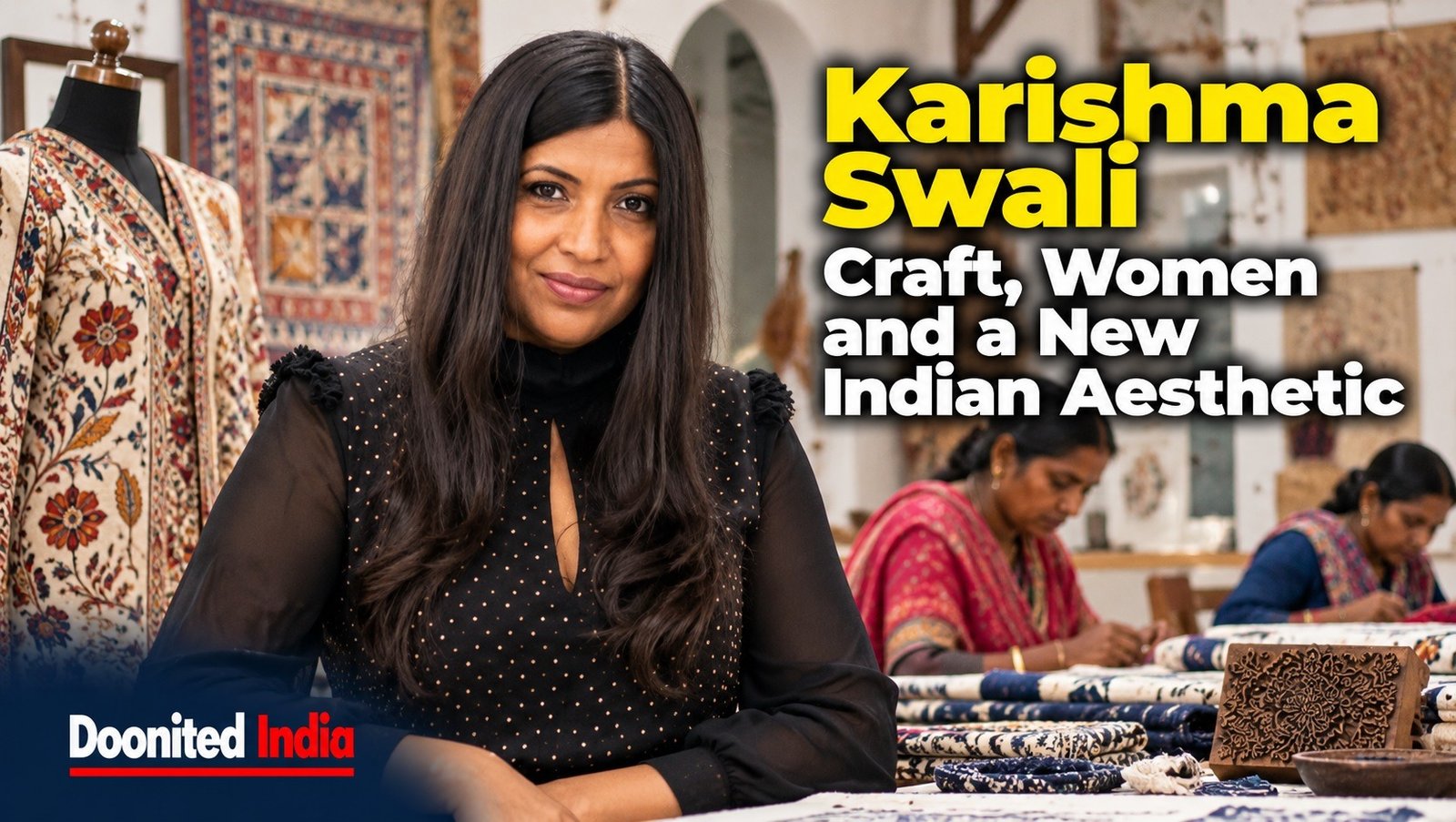
Karishma Swali’s work sits at an increasingly important intersection in Indian culture: traditional embroidery, contemporary art, fashion and the economic agency of women artisans. Through the Chanakya School of Craft and her own artistic practice, she is part of a movement asking a difficult question—can India preserve its craft traditions without freezing them in the past?
When craft stops being “just craft”
For generations, Indian embroidery has been admired for its patience, intricacy and beauty. It has also frequently been treated as something ornamental: a technique associated with clothing, domestic labour or traditional communities rather than as a serious contemporary artistic language.
Karishma Swali’s work challenges that hierarchy.
As Creative Director of Chanakya International and the force behind the Chanakya School of Craft, Swali has developed a practice that places Indian textile traditions in conversation with contemporary art and fashion. Her approach does not require embroidery to abandon its history in order to enter a gallery. Instead, it asks what happens when the knowledge of the artisan becomes the starting point for something new.
That distinction is important.
The contemporary art world has become increasingly interested in textiles, handwork and material processes. But there is a danger in this renewed fascination: craft can become fashionable while the people who possess the knowledge remain invisible.
Swali’s work is interesting precisely because the conversation extends beyond the finished object.
The woman behind the stitch
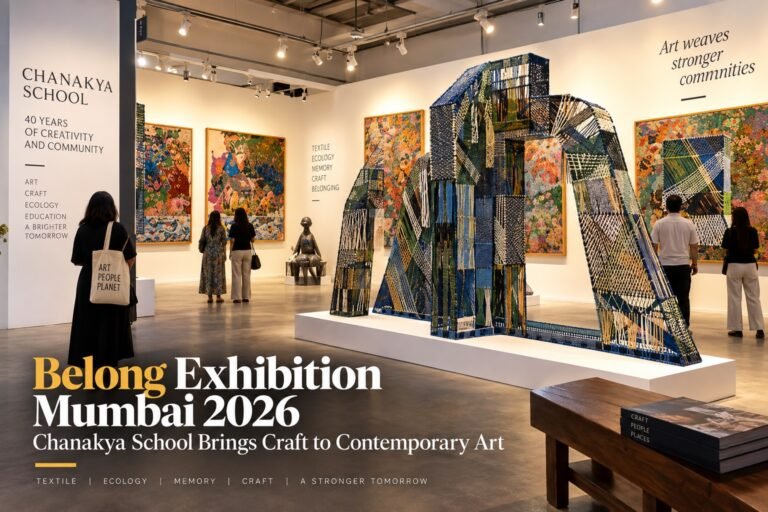
The Chanakya School of Craft was established with a focus on preserving and developing India’s master craft traditions while creating opportunities for women artisans.
The school describes its approach as combining traditional craft knowledge with contemporary design and artistic practice. This creates an unusual model: the artisan is not simply a person executing somebody else’s design but part of a creative ecosystem in which inherited skills can evolve.
That has social significance.
India’s craft economy has historically depended heavily on women’s labour, much of it taking place away from formal workplaces and often without the visibility associated with other creative professions. Embroidery can require extraordinary technical expertise, yet the person doing the work may remain unnamed while the designer or fashion house receives most of the public recognition.
A craft institution that places greater emphasis on training, professional development and visibility can therefore change more than aesthetics. It can alter how society understands the value of skilled manual work.
But there is an important caveat.
No single school or creative director can solve the structural problems facing India’s craft communities. Sustainable livelihoods depend on fair remuneration, consistent demand, access to markets, training, social security and the ability of younger generations to see craft as a viable occupation.
The romantic image of the artisan alone is not enough.
From atelier to gallery
Swali’s emergence as an artist has become increasingly visible beyond fashion.
Her “Garden of Gestures” presented monumental textile and sculptural works that explored making, movement and the relationship between material and the human hand. More recently, her work has been discussed in connection with exhibitions and presentations that place textile practice firmly within the contemporary-art conversation.
This transition is significant because it changes the question being asked of embroidery.
Instead of asking, How beautifully is this garment decorated?, contemporary art allows another set of questions:
What does the gesture mean?
What does repetition communicate?
What happens when thousands of stitches become a large-scale image or sculpture?
Who carries the knowledge embedded in the technique?
And can an inherited craft vocabulary express the anxieties and experiences of the present?
These are questions traditionally associated with painting, sculpture and conceptual art. Swali’s practice suggests that they can equally belong to embroidery.
“En Route” and the memory of Mumbai
That idea becomes particularly relevant in “En Route,” an exhibition at Mumbai’s Dr Bhau Daji Lad Museum that explores the city’s history through textile and embroidery practices.
Mumbai is an especially appropriate setting for such a conversation.
The city has long been shaped by movement: migrants arriving for work, communities establishing neighbourhoods, factories and mills transforming the urban landscape, ships connecting the port to the wider world, and industries continually replacing one another.
Textiles are embedded in that history.
Mumbai’s relationship with textiles is often remembered through the rise and decline of its cotton mills. But the city’s textile story is considerably broader. It includes trade, migration, clothing, embroidery, artisanal knowledge, industrial production and the continuing influence of fashion.
An exhibition that uses textile and embroidery to reconsider Mumbai’s history therefore does something more interesting than simply displaying beautiful objects. It treats fabric as an archive.
A stitch can record labour. A pattern can carry cultural memory. A textile can reveal movement between communities and places.
That is where Swali’s practice becomes particularly relevant: craft becomes a method of remembering, rather than merely a method of decorating.
The global language of Indian craft
India’s fashion industry has already demonstrated that traditional craftsmanship can travel internationally. Indian embroidery, weaving, dyeing and surface techniques appear regularly in global fashion collections and luxury markets.
But international recognition creates a complicated opportunity.
Global demand can provide income, prestige and new markets for artisans. It can also create pressure to simplify, standardise or commercialise traditions for consumers who may know little about their cultural context.
The challenge is therefore not simply to “take Indian craft global.”
It is to determine what kind of Indian craft reaches the world—and on whose terms.
Swali’s model offers one possible answer: retain the technical intelligence of traditional craftsmanship while allowing artists and artisans to experiment with scale, form and meaning.
That approach avoids two opposite traps.
The first is treating tradition as untouchable heritage that belongs in a museum and nowhere else.
The second is stripping traditional techniques of their identity until they become generic luxury decoration.
The most productive space lies between those extremes.
Craft as contemporary knowledge
There is another reason Swali’s work deserves attention.
In an increasingly digital creative economy, the physical act of making can look almost old-fashioned. Generative technology can produce images in seconds; automated manufacturing can reproduce patterns at enormous scale; global fashion can move from concept to product at extraordinary speed.
Hand embroidery operates according to a completely different logic.
It is slow.
It is tactile.
It records the movement of a human hand.
Its imperfections can be part of its character.
That does not automatically make handmade work better than machine production. Nor should “handmade” become an excuse for romanticising poorly paid labour.
But it does make craftsmanship a particularly powerful counterpoint to a culture increasingly obsessed with speed.
The value of craft may ultimately lie not only in what it produces, but in the knowledge it preserves.
The economic question cannot be ignored
The celebration of artisans must eventually lead to a more practical question: who benefits financially?
A contemporary exhibition can raise the visibility of craft. A luxury fashion collaboration can create orders. An international presentation can attract new clients. But sustainable craft economies require continuity between those moments.
For women artisans in particular, meaningful economic empowerment means more than being described as the “hands behind” a celebrated creation. It requires professional recognition, predictable income, opportunities for advancement and a meaningful role in the creative process.
This is where institutions such as the Chanakya School of Craft have a potentially important role.
The strongest craft model is not one in which designers rescue artisans.
It is one in which designers and artisans recognise each other as holders of different but equally important forms of knowledge.
That shift in language may sound subtle. Economically and culturally, it is not.
India does not need to choose between heritage and modernity
Karishma Swali’s significance lies less in being a bridge between “old” and “new” than in questioning why they were separated in the first place.
Indian craft has never been static. Techniques have changed with materials, patrons, markets and communities. Artisans have always adapted. Fashion has always borrowed, transformed and reinterpreted.
The contemporary moment simply gives that evolution a new platform.
Swali’s work suggests that embroidery can occupy the fashion atelier, the design studio and the art gallery without losing its connection to the people and knowledge that made it possible.
That may be the more interesting future for Indian craft.
Not preservation behind glass.
Not nostalgia stitched into luxury.
But living knowledge—made visible, economically valued and given permission to evolve.
And perhaps that is the real contemporary language Indian craft is beginning to find.


World Beyond the News
Octopuses Can Change Their Appearance
Octopuses can rapidly alter their skin colour and texture to communicate, camouflage themselves and respond to danger.
Some Cities Exist Across Two Continents
A small number of cities are geographically associated with two continents, creating unusual cultural and geographic identities.
Earth’s Climate Is Measured in Many Ways
Scientists track temperature, atmospheric gases, sea level, ice cover and other indicators rather than relying on a single climate number.
Streaming Changed How Audiences Discover Shows
Recommendation systems and global streaming releases allow audiences to discover programmes far beyond their original markets.