When “South Indian art” means more than geography
There is a danger in calling something a “South Indian art movement” too quickly.
India’s contemporary art scene is too diverse for a single regional label to explain it. Kerala is not Tamil Nadu; Hyderabad is not Bengaluru; Chennai is not Kochi. Artists move between cities, institutions and international exhibitions, and their practices cannot always be contained by the place where they were born.
Yet something important is happening in the way artists from the South are bringing regional histories, social tensions and lived experience into contemporary Indian art.
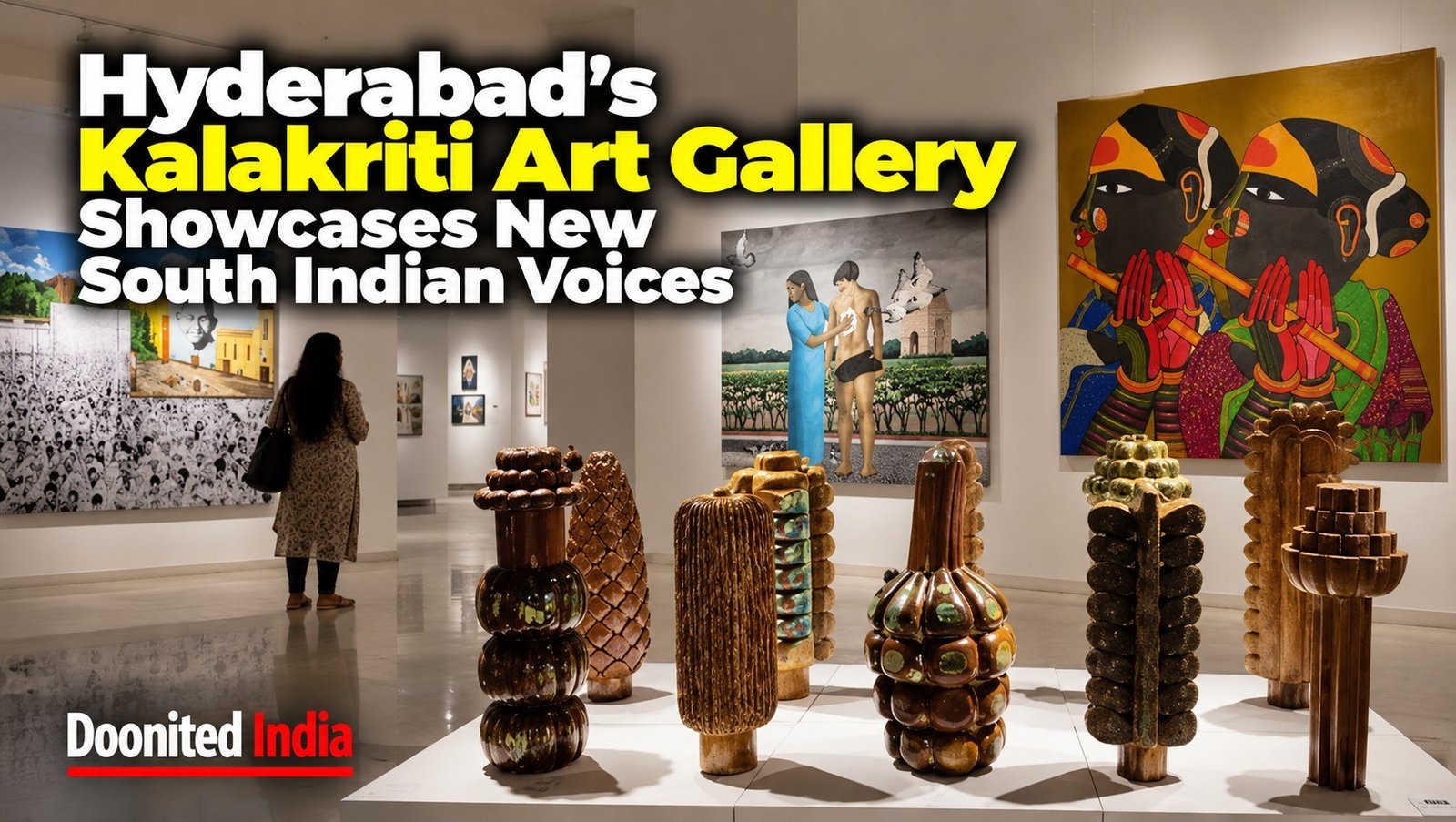
That conversation comes sharply into focus at Kalakriti Art Gallery in Hyderabad, where I Know What I Am Doing, curated by artist and curator P. S. Jalaja, opens on October 9, 2026 and continues through November 17.
The exhibition brings together contemporary artists from South India who are practising in different parts of India. Rather than presenting regional identity as a decorative theme, the exhibition places political consciousness, medium and conceptual clarity at its centre.
That makes the show interesting not merely as an exhibition, but as a snapshot of where contemporary Indian art may be heading.
A title that is deliberately confident
“I Know What I Am Doing” sounds almost defiant.
It could be read as an artist responding to a viewer who does not understand the work. It could also be read as a declaration of independence in an art world shaped by galleries, collectors, institutional expectations, digital visibility and market trends.
Jalaja’s curatorial premise is more nuanced.
The exhibition describes the title as both a revelation and a provocation. The participating artists are not claiming that their interpretations are infallible; rather, they are asserting intentionality—the idea that the choice of subject, material and method is itself meaningful.
That is an important distinction.
Contemporary art can sometimes appear deliberately obscure to audiences outside the gallery system. Here, the exhibition turns that difficulty into part of the conversation: what does it mean for an artist to make a deliberate position in a complicated social environment?
Seventeen artists, many different realities
The exhibition brings together a broad intergenerational group rather than a single aesthetic school.
Among the artists represented are Adarsh Baji, Alamu Kumaresan, Anupama Alias Anil, George Martin P J, Greeshma C, Indu Antony, Jaya P S, K P Reji, Lakshmi Madhavan, Priyanka Aelay, Reghunadhan K, Sanam C Narayanan, Santosh T V, Siji Krishnan, Sujith S N and Vinu V V, among others listed in the gallery’s exhibition catalogue.
The works themselves immediately resist the idea of one “South Indian style.”
Greeshma C’s Continuum 44 (2026), for example, uses callography and copper foil. Indu Antony’s പൊന്നുപോലെ വളർത്തിയവളാ (2021) combines cyanotype, gold leaf, artists’ hair, pen, brass, Gampi paper and found jewellery boxes. Adarsh Baji’s Silent Steps is an oil-on-canvas work.
The diversity of materials matters because the exhibition is not treating medium as decoration.
It argues that how an artist makes something can be part of what the work says.
A material can become metaphor. A technique can become critique. A familiar object can become evidence of memory.
From private experience to public questions
The subjects selected by Jalaja are deliberately difficult: power, labour, environment, caste, gender, memory, migration, place and existence.
These are not themes confined to one state or language.
Migration, for example, is simultaneously a South Indian experience and a national one. Millions of people move between cities and states for education, employment and family reasons. A contemporary artist can therefore approach migration through a deeply local experience while addressing a global condition.
The same applies to labour.
Industrialisation, informal work, domestic work and the changing relationship between manual and digital labour affect communities differently, but they also connect Indian experiences to broader international debates.
That gives regional art a potential advantage in the contemporary conversation: it can start with a specific place without remaining trapped inside it.
Why the South matters in contemporary Indian art
For much of the international art market, Indian contemporary art has often been narrated through a relatively small group of metropolitan centres.
Mumbai and New Delhi have long occupied major positions in the gallery and auction ecosystem. But India’s artistic geography is considerably larger.
Bengaluru, Chennai, Hyderabad, Kochi and Thiruvananthapuram have their own institutions, artist communities, independent spaces, collectors and cultural histories.
The growth of these networks changes the relationship between “regional” and “national.”
An artist does not necessarily need to leave a regional context behind to become nationally or internationally relevant.
Indeed, the opposite may be increasingly true.
The specificity of place can provide the material through which an artist speaks to a wider audience.
Jalaja’s own career illustrates this wider movement. She is a visual artist as well as a curator, with work presented in exhibitions and biennales in India and internationally. Her background includes participation in the Kochi-Muziris Biennale, Prague Biennale, Art Gwangju in South Korea and Biennale Arte Dolomiti in Italy.
Her curatorial position is therefore informed not only by a regional perspective but by experience within a broader contemporary-art network.
A younger generation enters the conversation
One of the most revealing aspects of the exhibition is its intergenerational structure.
Kalakriti describes the younger artists as bringing experimentation and energies shaped by post-liberalisation realities and digital culture, while senior artists contribute perspectives informed by historical memory and sustained political engagement.
That contrast is significant.
An artist who grew up with smartphones, social media and constant digital imagery experiences the world differently from someone whose artistic formation occurred before the internet became part of everyday life.
But the exhibition does not frame the two generations as opposites.
Instead, their works can be read as a conversation about continuity.
The older generation carries memories of political and social transformations. The younger generation inherits those histories while negotiating a faster, more visually saturated world.
Contemporary Indian art is therefore not simply replacing one generation with another. It is negotiating what should be remembered, questioned and transformed.
The gallery as a space for disagreement
Perhaps the most valuable aspect of I Know What I Am Doing is that it does not promise a single interpretation.
The gallery describes the exhibition as a space where practices can “converge, diverge, and collide.”
That is exactly what a serious group exhibition should do.
An exhibition becomes less interesting when every work confirms the same thesis.
Art can disagree with itself.
One artist may address memory through an intimate object; another may approach political history through large-scale imagery; another may use material experimentation to examine the environment or identity.
The viewer does not have to agree with all of them.
In fact, disagreement can be productive.
The challenge for the audience is to move beyond the familiar question—Do I like this?—and ask another one: What is this work asking me to reconsider?
Beyond the label “regional”
There is an irony in the phrase “South Indian contemporary art.”
The label helps audiences discover artists who might otherwise be overlooked. But the same label can eventually become restrictive if it suggests that artists from the region are somehow peripheral to the national art conversation.
That is why this exhibition is more interesting when viewed as part of Indian contemporary art rather than as an isolated regional event.
Its artists may come from particular histories and geographies, but their concerns are not provincial.
Power, labour, environmental anxiety, caste, gender, migration and memory are questions that extend well beyond India’s southern states.
The regional perspective is the point of departure—not the destination.
What the exhibition tells us about India now
The contemporary Indian art scene is increasingly difficult to divide neatly between “traditional” and “modern,” “regional” and “national,” or “political” and “aesthetic.”
Those categories overlap.
A painting can be formally sophisticated and politically charged. An installation can be rooted in local memory while addressing a global issue. A traditional material can be used to question a contemporary problem.
That complexity is precisely what I Know What I Am Doing places before its audience.
The exhibition’s strongest idea may ultimately be its insistence that artistic intention matters.
In a culture increasingly driven by algorithms, trends and instantaneous visual consumption, making a deliberate artistic decision can itself become an act of resistance.
The artists gathered in Hyderabad are not necessarily speaking with one voice. They do not need to.
Their value lies partly in the friction between their voices.
The larger lesson
India’s contemporary art story is no longer adequately told from a few metropolitan addresses.
It is being built through multiple cities, languages, histories and artistic communities. Hyderabad’s I Know What I Am Doing provides one window into that larger transformation.
The exhibition does not prove that there is a single new “South Indian art movement”—and it would be misleading to claim that it does.
What it does reveal is something more interesting: artists rooted in South Indian histories are increasingly using those histories as active contemporary material rather than as background identity.
That distinction matters.
A region becomes culturally powerful not when everyone speaks in the same artistic language, but when its artists feel confident enough to speak differently.
And perhaps that is the most revealing meaning behind the exhibition’s provocative title.
They know what they are doing.
The interesting part is seeing what happens when the rest of us stop trying to tell them what they should be doing.


World Beyond the News
Octopuses Can Change Their Appearance
Octopuses can rapidly alter their skin colour and texture to communicate, camouflage themselves and respond to danger.
Some Cities Exist Across Two Continents
A small number of cities are geographically associated with two continents, creating unusual cultural and geographic identities.
Earth’s Climate Is Measured in Many Ways
Scientists track temperature, atmospheric gases, sea level, ice cover and other indicators rather than relying on a single climate number.
Streaming Changed How Audiences Discover Shows
Recommendation systems and global streaming releases allow audiences to discover programmes far beyond their original markets.