Belong in Mumbai: When Indian Craft Steps Beyond the Fabric
At Experimenter in Colaba, Chanakya School’s “Belong” turns textile into landscape, sculpture and a meditation on ecology, memory and inherited knowledge — as Mumbai hosts three exhibitions marking 40 years of Chanakya and a decade of its School of Craft.
There is a funny thing about textile.
We tend to think of it as something that covers us, decorates us or sits politely on a sofa.
At “Belong”, currently on view at Experimenter in Colaba, Mumbai, textile refuses to behave so politely.
It climbs into sculpture, becomes landscape, gathers thousands of tiny materials into expansive surfaces and asks a rather large question: what does it actually mean to belong?
Running from September 10 to October 17, 2026, Belong is presented by Experimenter as Chanakya School’s first solo exhibition at its Colaba space and its second solo exhibition with the gallery. The exhibition marks four decades of Chanakya’s collective practice, using textile as both material and a way of thinking about body, ecology, memory and inherited knowledge.
This is contemporary art, certainly.
But it is also an argument for why traditional craft should not be placed permanently behind museum glass and labelled “heritage.”
When the thread becomes the artwork
The works in Belong demonstrate how far textile can travel when artists stop treating it simply as cloth.
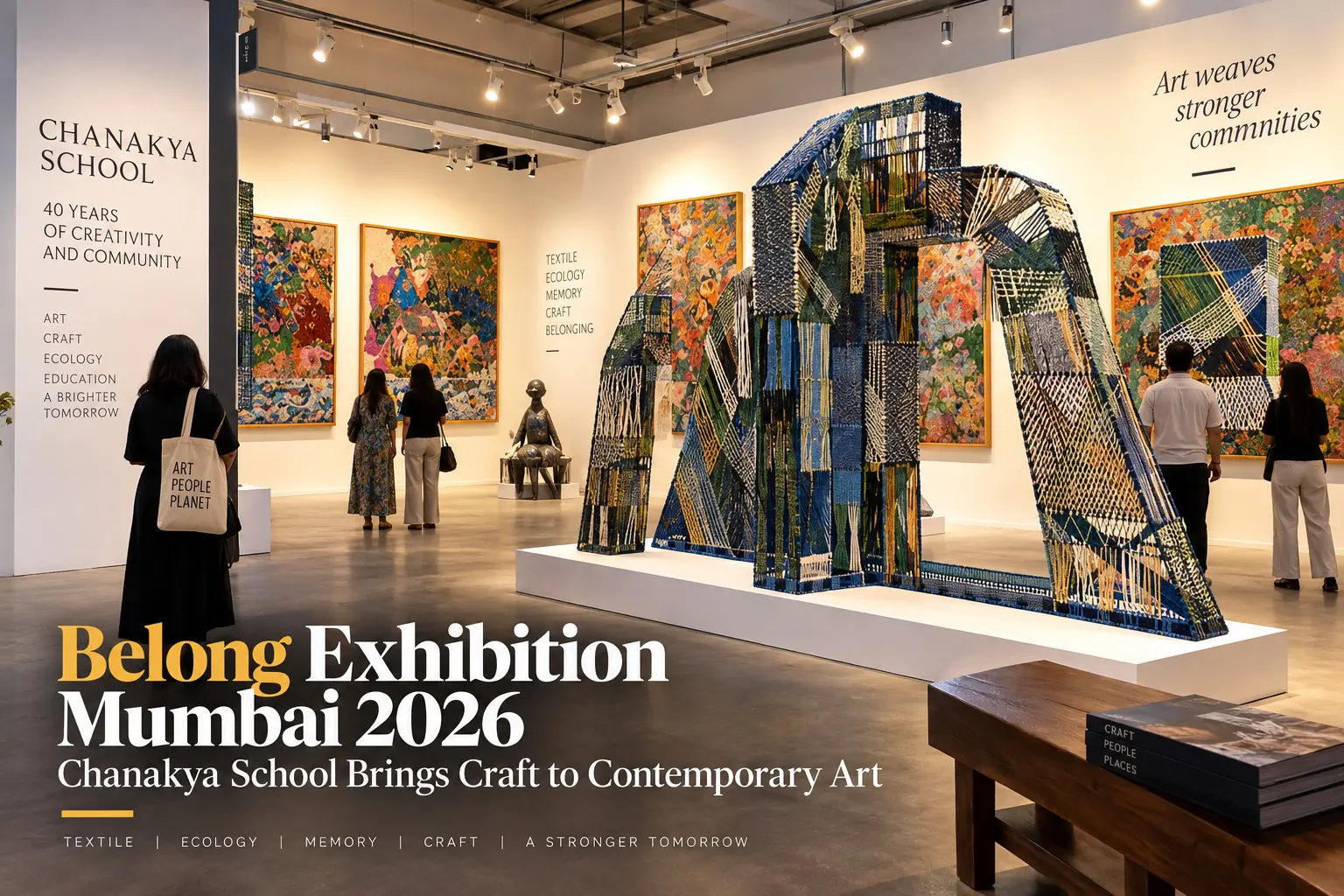
The exhibition includes expansive textile works and monumental sculptural forms. In the “Within” body of works, organic cotton and silk threads are combined with glass and recycled seed beads. Thousands of individually placed elements build surfaces in which figures, landscapes and atmospheric forms appear to emerge and disappear.
The effect is deliberately different from looking at a conventional embroidered textile.
Instead of asking only What is this made of?, the viewer begins asking What am I looking at?
A landscape?
A body?
A memory?
Perhaps all three.
That ambiguity is central to Chanakya School’s approach. The material remains recognisably textile, but the scale and composition encourage the viewer to encounter it as contemporary visual art.

From weaving to sculpture
One of the most intriguing developments in the exhibition is the movement of textile techniques from surface into three-dimensional form.
The Saptamatrika works use fibres including coconut, banana and jute. Techniques associated with textile-making — braiding, coiling, binding, wrapping and weaving — become sculptural processes.
This is where Belong becomes particularly interesting.
A conventional definition of sculpture tends to begin with something solid: stone, metal, wood or another substantial material.
Chanakya School reverses that assumption.
A sculpture can begin with a strand.
It can begin with joining.
It can begin with wrapping.
It can begin with thousands of repetitive movements made by human hands.
The resulting objects occupy an unusual territory somewhere between textile, architecture, body and organic matter.
And suddenly the humble act of tying something together becomes an artistic philosophy.
Nature is not merely decoration
Ecology is another important thread running through the exhibition.
In works such as “Flowers In Our Forest I”, forests, flowers, skies and the sun come together with woven female presences. Chanakya describes nature here as a living presence rather than simply a backdrop. The conceptual framework draws on Prakriti, the primordial and animating force of nature associated with the feminine.
That distinction matters.
Contemporary art frequently uses environmental imagery. But Belong approaches ecology through the very material from which the works are made.
Fibre comes from plants.
Textiles require cultivation, harvesting, processing and labour.
Craft carries the memory of those material relationships.
In “Common Ground”, raffia fibres move across embroidered surfaces and loosen toward unfinished edges, creating associations with cultivated terrain, plants, fields and the ecological histories embedded within textile production.
The exhibition therefore asks viewers to look at fabric differently: not as a finished commodity, but as something with a material history.
Four decades — and a second anniversary
Belong is part of a much larger moment for Chanakya.
The Mumbai-based textile atelier was founded in 1986, while the Chanakya School of Craft was established in 2016 as a non-profit initiative focused on craft, culture and creating greater autonomy for women.
That makes 2026 a double milestone: 40 years of Chanakya and 10 years of the School of Craft.
Rather than marking the anniversaries with one conventional retrospective, Chanakya has spread the celebration across Mumbai through three simultaneous exhibitions.
The approach is fitting.
The organisation’s work has always occupied territory between fashion, craft, education and cultural practice. The anniversary therefore becomes less about looking backwards and more about showing how the vocabulary of craft can keep expanding.
Three exhibitions, three ways of seeing craft
Alongside Belong, visitors can encounter “En Route” at the Dr. Bhau Daji Lad Museum, running from September 9 to October 20. The exhibition brings together work developed by Karishma Swali and Maria Grazia Chiuri with the Chanakya School, including textile interpretations of journeys by six women travellers and new works responding to Mumbai’s history and maps.
Then there is “Garden of Gestures” at the Chanakya Ateliers, running through September 30. The presentation includes monumental forms and goddess-inspired sculptures created through materials such as bamboo, cotton and raffia.
Together, the three exhibitions create an unusually broad picture.
One looks inward at belonging and the relationship between body, ecology and memory.
Another turns journeys and maps into textile histories.
The third transforms craft gestures into monumental sculptural forms.
The common language is the hand.
The real subject may be knowledge
It would be easy to describe Belong as an exhibition celebrating Indian craftsmanship.
That description would be accurate — but incomplete.
The deeper subject is how knowledge survives.
A technique survives because somebody teaches it.
A gesture survives because somebody repeats it.
A material survives because somebody understands what it can do.
And a tradition survives not by remaining frozen but by being used differently by the next generation.
That philosophy is particularly relevant to the Chanakya School of Craft, whose work connects contemporary artistic practice with craft education. Karishma Swali has spoken about the importance of both “craft thinking” and “craft doing”, including educational initiatives that introduce young people to the patience and discipline involved in making things by hand.
In an era when an image can be generated in seconds and a trend can disappear from social media almost as quickly, there is something quietly radical about an art practice built on repetition.
A bead placed.
A thread pulled.
A fibre twisted.
Again.
And again.
And again.
DOONITED VIEW: Craft does not need rescuing from the present
The most interesting lesson from Belong is that Indian craft does not necessarily need to be protected by keeping it unchanged.
It can be reinterpreted without becoming irrelevant.
That is an important distinction.
Heritage becomes fragile when it is treated only as something from the past. It becomes living culture when practitioners are allowed to experiment with it, question it and take it into new forms.
Belong demonstrates precisely that transition.
The exhibition does not abandon the knowledge embedded in weaving, embroidery, braiding, coiling and binding. Instead, it asks what those techniques can become when they leave the familiar scale of clothing and enter contemporary art.
Mumbai, appropriately, becomes the setting for that conversation.
A city built through migration, trade, labour, reclamation and constant reinvention is hosting an exhibition about belonging that refuses to define belonging as a fixed location.
Perhaps that is the smartest idea in the entire show.
Belonging is not necessarily about staying in one place. It can also mean carrying knowledge forward.
And when that knowledge travels from the artisan’s hand to contemporary sculpture, from fabric to landscape, and from one generation to another, the thread is no longer merely holding the artwork together.
It is holding a history together.

World Beyond the News
Why Elephants Stay Close to Their Herd
Elephants live in highly social family groups and use calls, touch and body movements to maintain strong bonds.
Most of the Deep Ocean Remains Difficult to Explore
Extreme pressure, darkness and distance make deep-ocean exploration one of Earth’s greatest scientific challenges.
Spacecraft Can Travel Without Traditional Roads
Spacecraft use carefully calculated trajectories and gravity assists to travel enormous distances through space.
Why Movie Trailers Are Released in Stages
Major films often use teaser trailers, full trailers and final promotional spots to build awareness over time.