From Banana Waste to Fabric: How India Could Turn Farm Residue Into a New Textile Economy
What if the next interesting textile in your wardrobe did not begin in a cotton field?
What if it began with something farmers usually regard as a problem to be cleared away?
After a banana harvest, the plant’s large pseudostem — the trunk-like structure formed from tightly packed leaf bases — is left behind. The fruit has been harvested; the plant has done its job.
For decades, much of that biomass has been treated as agricultural residue.
Now researchers, entrepreneurs and agricultural institutions are asking a rather different question:
What if the banana stem is not waste at all, but raw material?
Recent research is giving that idea serious scientific attention. A 2026 review published in the Textile Research Journal estimates global banana pseudostem residue at about 114 million tonnes annually, with India contributing approximately 51.18 million tonnes. The review identifies the fibre’s high cellulose content and mechanical properties as reasons it could become a useful natural textile fibre.
This is where agriculture starts looking surprisingly like a textile factory.
The banana plant has more to give
Banana pseudostems are bulky, wet and fibrous.
That combination has historically made them inconvenient to handle economically. But those same fibres can be separated from the pseudostem and processed into material for textiles and other products.
The basic principle is relatively straightforward.
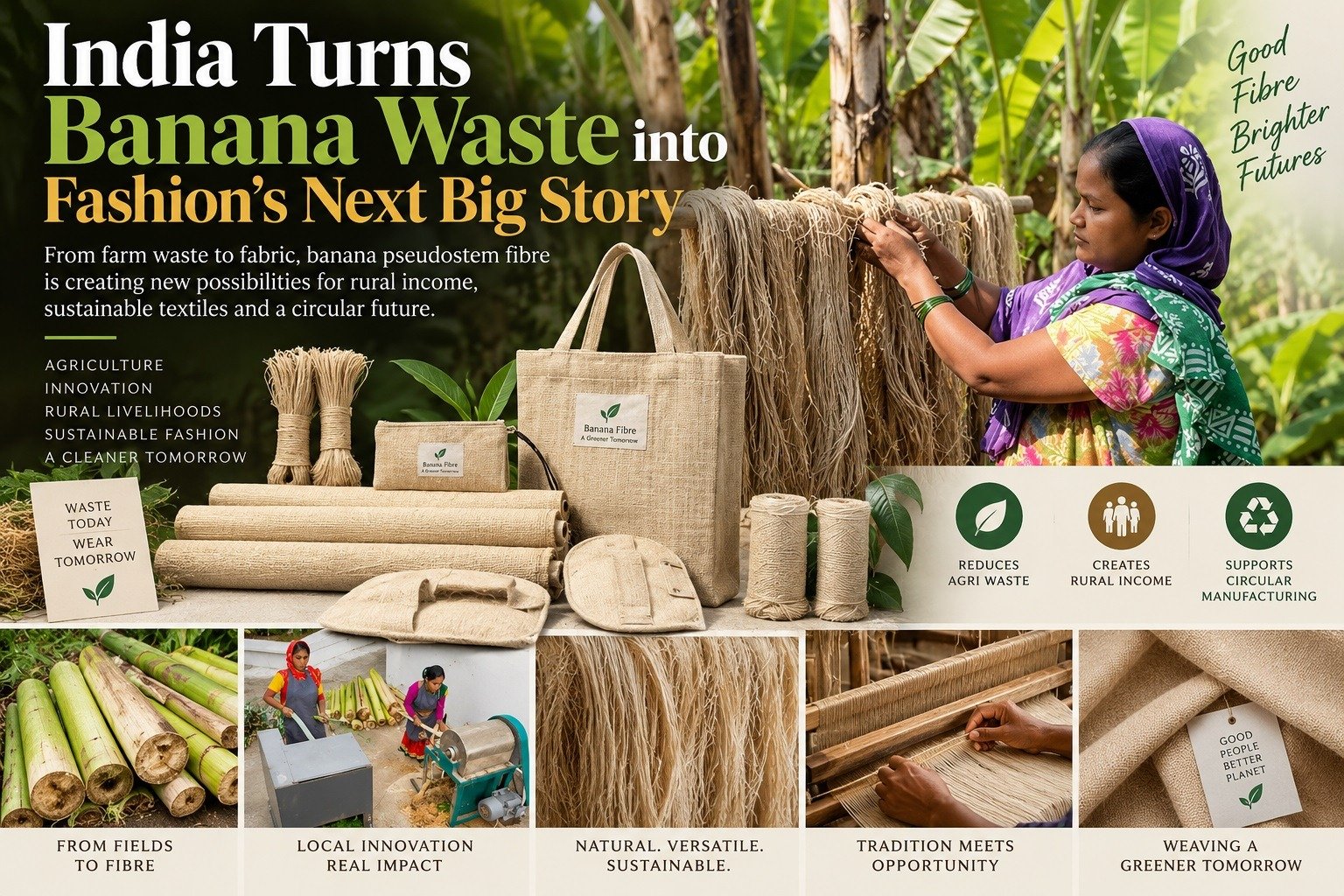
After harvesting, the pseudostem is collected and cut into manageable sections. Mechanical decortication or extraction separates the fibre from the softer non-fibrous material. The extracted fibres are then washed and dried, followed by processes such as combing, alignment and preparation for spinning or other applications.
Recent Indian research describes mechanical extraction followed by washing and drying as a practical route for converting pseudostem into usable fibre.
It sounds simple.
Industrialising it is not.
And that distinction matters.

The difficult part is not finding the banana
India already has plenty of bananas.
The challenge is building an economically viable system that gets the pseudostem from the field to a processing unit quickly enough and at sufficiently consistent quality.
The fibre varies depending on the banana variety, the layer of the pseudostem from which it is extracted and the processing method used.
Researchers therefore continue to work on fibre quality, extraction efficiency, spinning behaviour and standardisation. A 2024 open-access study specifically identified inconsistent availability, limited awareness of applications and difficulties in assessing fibre quality as barriers to wider textile-market adoption.
This is an important reality check.
The banana-fibre story is promising.
It is not yet a magic replacement for cotton and polyester.
India is already experimenting with the opportunity
This is not merely a theoretical laboratory exercise.
The ICAR–National Research Centre for Banana held a two-day training programme in February 2026 on banana fibre and value addition for farmers, entrepreneurs and rural youth in Tamil Nadu. The programme explicitly presented pseudostem as an opportunity for new businesses and additional farm income.
ICRISAT has also established a banana pseudostem fibre extraction unit in Puri district for a women’s self-help group, with the objective of turning post-harvest residue into natural fibre while creating additional income opportunities.
And the Indian government’s NECTAR programme has been developing a broader value chain around banana pseudostem in the Northeast, including fibre, yarn, paper, biodegradable materials, vegan leather and fertiliser. Its stated model is explicitly based on using different parts of the pseudostem rather than treating the entire plant residue as waste.
That is the more interesting Indian story.
Not simply “banana becomes cloth.”
Rather:
banana cultivation → residue collection → fibre extraction → processing → multiple products → additional rural economic activity.
A circular economy hiding in the plantation
The circular-economy argument is compelling.
Instead of allowing a post-harvest material to remain a disposal problem, part of it can become an industrial input.
The residue can potentially produce fibre, while lower-grade material and other fractions can be directed toward products such as paper, composites, fertiliser or other applications.
This is particularly relevant for agriculture because farmers rarely produce only the commodity that reaches the market.
Every crop generates secondary material.
The economic question is whether that material has enough value to justify collection and processing.
Banana pseudostem is interesting precisely because its fibre gives at least part of that residue a potential higher-value destination.
But is banana fibre really greener than everything else?
Here the conversation needs some discipline.
It is tempting to put “banana fibre” on one side and “polyester” on the other and declare victory.
The environmental reality is more complicated.
Life-cycle impacts depend on extraction technology, transportation, drying, chemical treatment, electricity sources, spinning, dyeing, blending and what happens to the material at the end of its life.
Recent research does support environmental potential. A 2026 review reports lower blue-water requirements and lower projected greenhouse-gas impacts for banana pseudostem fibre than cotton under the scenarios it examined.
But that does not justify claiming that every banana-fibre textile automatically has 80% lower emissions than polyester.
Nor does “natural” automatically mean environmentally perfect.
For example, another recent life-cycle study of plantain pseudostem biocomposites found that chemical treatment could substantially increase environmental impacts compared with untreated-fibre scenarios.
That is the uncomfortable bit of sustainability journalism.
The greenest-looking raw material can acquire a less-green footprint if the processing chain becomes unnecessarily energy- or chemical-intensive.
And biodegradability needs a footnote
Banana fibre is a natural lignocellulosic material and is generally described in the scientific literature as biodegradable.
But the claim that a banana-fibre textile will “completely biodegrade in 90 days” should not be treated as a universal fact.
Actual decomposition depends on the fibre, yarn construction, fabric, dyes, finishes, blends and environmental conditions.
A pure untreated fibre in a controlled composting environment is not the same thing as a finished commercial garment containing synthetic blends, coatings or chemical finishes.
That distinction is crucial.
Otherwise, “biodegradable fashion” becomes another marketing phrase that sounds better than the science.
The farmer could become part of the textile supply chain
This may be the biggest economic opportunity.
A banana farmer traditionally earns from bananas.
A circular value chain could potentially allow another revenue stream to emerge from the post-harvest plant material.
That does not mean farmers will suddenly become textile entrepreneurs.
They don’t need to.
A better model could involve local collection networks, fibre-extraction units, cooperatives, self-help groups, rural enterprises and textile processors.
The farmer supplies the residue.
A local enterprise extracts the fibre.
A textile company purchases processed material.
Another business turns it into yarn or fabric.
The value chain becomes longer — and potentially more people participate in it.
India’s NECTAR programme explicitly envisages common facility centres that can provide processing, training, employment and enterprise opportunities around banana pseudostem products.
That is circular manufacturing with a rural-economic dimension.
From banana stem to fashion fabric
There is also a technical hurdle.
Banana fibre can be relatively stiff, and researchers have found that blending it with other fibres can sometimes be useful for producing practical textiles. A study published through ICAR’s research journal found banana-cotton blends particularly promising because both fibres are cellulose-based and can be blended for fabric production.
That matters commercially.
The future may not necessarily be a wardrobe filled entirely with banana fabric.
It could be banana blended with cotton or other fibres, depending on the performance required.
That is less dramatic than saying “banana replaces cotton.”
It is also much more realistic.
The fashion industry’s real test
Fashion brands are increasingly interested in agricultural waste.
But a sustainable material has to satisfy several customers at once.
The designer wants aesthetics.
The manufacturer wants consistency.
The consumer wants comfort and durability.
The retailer wants reliable supply.
The farmer wants a worthwhile return.
And the environment, unfortunately, does not accept marketing brochures as payment.
A successful banana-fibre industry therefore needs more than clever storytelling.
It needs standards, collection infrastructure, quality control, efficient processing and predictable markets.
DOONITED Editorial Perspective: The future of fashion may begin in the farm waste pile
The most interesting aspect of banana fibre is not that bananas can become textiles.
Humans have been remarkably creative about turning plants into useful materials for centuries.
The interesting part is where the value can be created.
Agricultural waste is often treated as something that must be removed.
Circular manufacturing asks a different question:
Can the cost of disposal become the starting point for a new industry?
For India, that question has particular significance.
The country already has a massive agricultural base, a large textile industry and millions of rural producers.
If even a fraction of banana pseudostem can be efficiently collected and converted into higher-value products, the result could connect agriculture, rural entrepreneurship, materials science and fashion in one supply chain.
But India should avoid another familiar trap: producing a brilliant pilot project and then struggling to scale it.
The real breakthrough will come when banana fibre is not an interesting sustainability experiment, but a reliable commercial material.
The bigger takeaway
Banana pseudostem is not going to make polyester disappear tomorrow.
It does not need to.
The more realistic opportunity is to create another material stream — one based on agricultural residue rather than virgin fossil resources.
India’s emerging work in this field shows that the idea has already moved beyond social-media videos and sustainability slogans into research, farmer training and pilot-scale value chains.
The next stage is harder:
Can India make the economics work at scale?
If the answer is yes, something remarkable happens.
The banana farmer is no longer producing only fruit.
The pseudostem becomes a resource.
The fibre becomes a material.
The material becomes a product.
And what once looked like agricultural waste begins to look like the first link in another rural industry.
Perhaps the future of sustainable fashion is not hanging in a luxury showroom after all.
Perhaps some of it is lying beside a banana field, waiting for somebody to stop calling it waste.
DOONITED Reader Insight
When evaluating “sustainable” textiles, don’t stop at the raw material.
Ask how it is extracted, how much energy and water the process uses, whether chemicals are involved, whether the fibre is blended with synthetics, how far it travels and what happens to the finished garment at the end of its life.
A genuinely circular textile is not created by a fashionable material alone.
It is created by a responsible supply chain.


World Beyond the News
Why Elephants Stay Close to Their Herd
Elephants live in highly social family groups and use calls, touch and body movements to maintain strong bonds.
Most of the Deep Ocean Remains Difficult to Explore
Extreme pressure, darkness and distance make deep-ocean exploration one of Earth’s greatest scientific challenges.
Spacecraft Can Travel Without Traditional Roads
Spacecraft use carefully calculated trajectories and gravity assists to travel enormous distances through space.
Why Movie Trailers Are Released in Stages
Major films often use teaser trailers, full trailers and final promotional spots to build awareness over time.