When Everyday India Becomes Art: From Kitchen Utensils to Streets, Memory and Labour
A steel tiffin, a family photograph, a charcoal-covered wall or a fishing dock can become more than an object or a place. Across contemporary Indian art, everyday materials and familiar surroundings are being used to explore identity, migration, memory, labour and the changing face of the country.
In India, art does not always begin with a blank canvas. Sometimes it begins in the kitchen, where steel utensils have served generations; in a family cupboard filled with photographs; on a city wall layered with posters; or in a landscape shaped by mining and industry.
For contemporary artists, these ordinary spaces and objects are not merely convenient materials. They carry stories about how people live, work, migrate, remember and adapt. By bringing them into galleries and public spaces, artists invite audiences to reconsider what deserves attention—and what society usually overlooks.
The boundary between art and everyday life has not disappeared completely. Galleries, collectors and institutions still influence what is recognised as art. But many artists are making that boundary more permeable, allowing the familiar world outside the gallery to enter the artistic conversation.
The domestic world: when the kitchen becomes a gallery
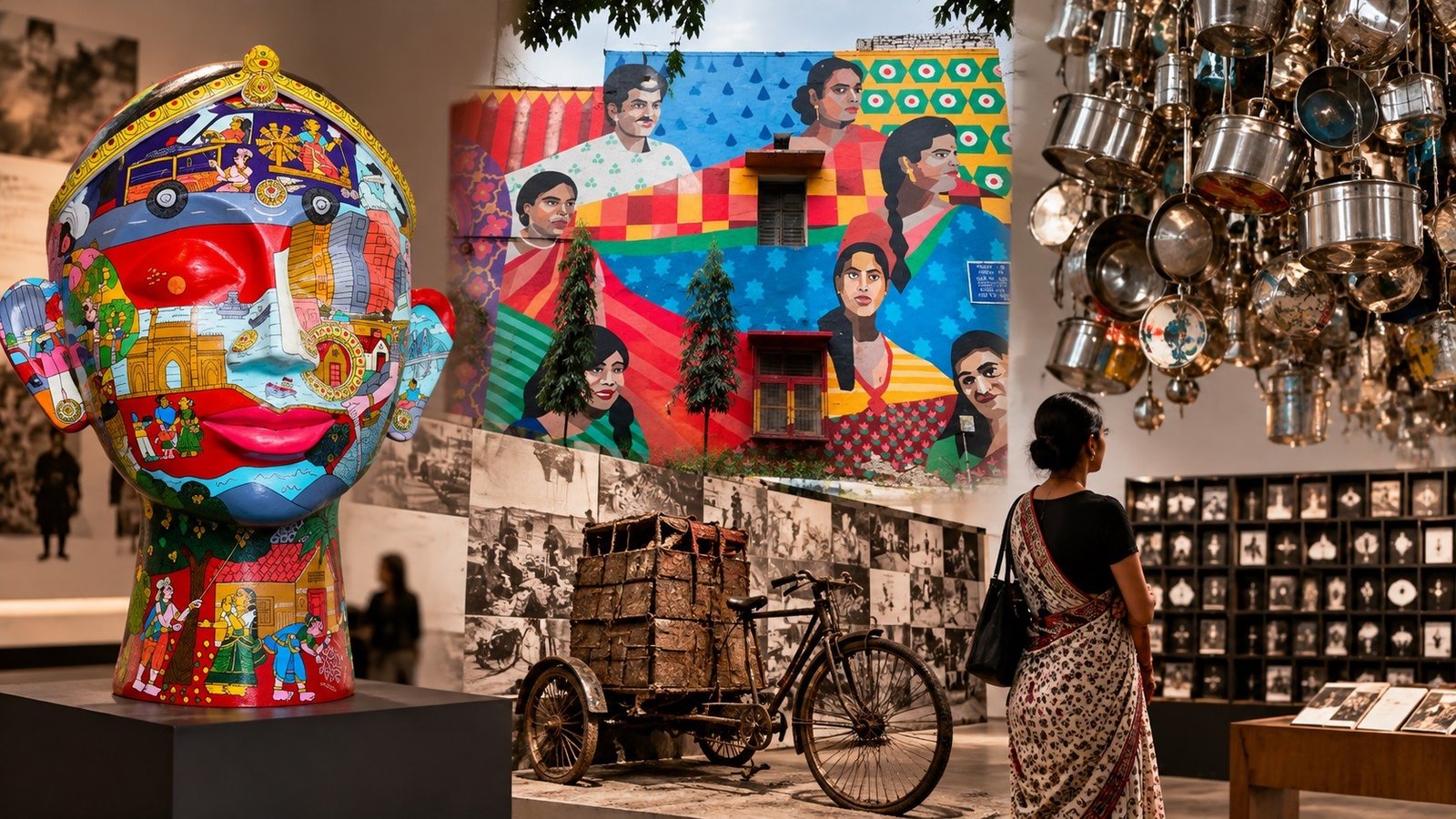
Few artists have made ordinary Indian household objects as recognisable in contemporary art as Subodh Gupta. His sculptures and installations use familiar items such as stainless-steel tiffins, thalis, pots, pans and milk pails, often assembled on a monumental scale.
In works such as Hungry God, everyday utensils become a towering sculptural form. Their reflective surfaces may initially suggest spectacle, but the objects also carry associations with food, domestic work, social class, migration and the changing economy. The dents and marks on used vessels can evoke the lives of the people who owned them.
There is a particularly Indian familiarity to this material. A steel plate is not an exotic object to someone who eats from one every day. Yet when hundreds of such objects are assembled into a vast installation, the viewer is encouraged to see them differently. The kitchen, for a moment, becomes a place of cultural memory.
Dayanita Singh approaches everyday life through photography, archives and the physical display of images. Her Museum Bhavan brings together a family of handcrafted wooden structures containing photographs from her wider body of work. The structures can be rearranged, opened and displayed in different configurations.
The result is neither a conventional photo exhibition nor simply a collection of framed pictures. It is a flexible, mobile museum in which the act of storing, sequencing and revisiting images becomes part of the artwork.
Singh’s practice raises a quietly important question: who decides how memories should be organised? A photograph kept in a drawer, a family album passed around at a gathering and an image displayed in a museum may all contain the same basic material—a moment preserved. Their meanings, however, change with context.
For L.N. Tallur, the relationship between the familiar and the unexpected often takes shape through sculpture and installation. He combines traditional visual references with found, handmade, organic and industrial materials. The resulting works can unsettle familiar ideas about modernity, belief and the objects through which society expresses them.
In these practices, the everyday is not simply decorated or enlarged. It becomes a way of asking how contemporary India understands itself.
The streetscape: public space as a place for art
The city is another major source of material. Its walls, markets, transport networks, construction sites and public gathering places contain visual information that formal galleries cannot easily reproduce.
Public art initiatives have helped bring contemporary art into neighbourhoods where people may not routinely visit museums. St+art India Foundation, for example, has developed urban art projects and art districts in several Indian cities, using murals and public interventions to engage with local environments.
Delhi’s Lodhi Art District is among the best-known examples. Building walls have become large-scale surfaces for artworks, changing the experience of walking through an ordinary neighbourhood. In Mumbai, the From Sassoon to the Moon project at Sassoon Docks by French artist duo Ella & Pitr included murals depicting the people and working life of the dockyard.
These projects can make art more accessible: no ticket, formal dress code or prior knowledge of art history is required to encounter a mural on the way to work. A wall can become an unexpected pause in an otherwise hurried day.
But public art also raises practical questions. Who chooses the images? How are residents involved? Who maintains the work when the paint fades or the building changes hands? A mural may enliven a neighbourhood, but meaningful public art requires more than a striking photograph for social media. It should engage with the place and the people who inhabit it.
Rural landscapes and the politics of labour
The everyday is not always colourful or comfortable. For some artists, it is a way to confront the realities of work, extraction, displacement and environmental change.
Prabhakar Pachpute, born in Sasti in Maharashtra’s Chandrapur district, comes from a family with a multigenerational history of coal mining. His charcoal drawings, wall installations, sculptures and animations often explore mining labour and the effects of industry on people and landscapes.
Charcoal is an especially charged medium in this context. It connects the material of the drawing to the coal-mining world that informs the artist’s work. His surreal figures—sometimes combining human bodies with tools, machinery or other objects—suggest how workers can be reduced to functions within a larger industrial system.
Pachpute’s work takes a local history from Maharashtra and connects it to wider questions about land, labour, economic development and environmental cost. It asks viewers to look beyond the finished commodity and consider the human and ecological processes that make it possible.
Sheela Gowda also draws meaning from materials closely associated with everyday life and work. Her installations have used cow dung, kumkum, hair, coconut fibre, needles, thread, tar and other materials with practical, cultural or ritual associations.
In Private Gallery, for example, cow dung appears alongside manufactured surfaces and images connected to migration and urban change. The work places rural and urban worlds in tension, revealing how materials that may be regarded as ordinary, low-value or even undesirable can carry complex social meanings.
Gowda’s use of such materials also draws attention to labour that is often overlooked, including manual work and the gendered routines embedded in domestic and rural life. The materials are not neutral: their smell, texture, cultural associations and histories all contribute to how the work is experienced.
What happens when the ordinary enters a gallery?
The transformation of everyday materials into art is not simply a clever act of reuse. It changes the way viewers assign value.
A tiffin is made to carry food. A photograph preserves a memory. Charcoal leaves a mark. A rope serves a practical purpose. When these things enter an artwork, their original functions do not vanish; instead, they sit alongside new meanings.
That shift can be liberating. It suggests that art does not belong exclusively to expensive materials, specialist training or rarefied spaces. It can begin with close observation of the world people already inhabit.
Yet there is a contradiction worth acknowledging. An ordinary object may be inexpensive in a household but acquire a high price when presented as a work by a recognised artist. The gallery can elevate the object—and also separate it from the people and labour that gave it meaning.
This does not invalidate the artwork. It does, however, make questions of access, ownership and representation important. When artists draw on the lives of workers, migrants or neighbourhood residents, audiences should ask whether those communities are being heard as participants or simply being represented for others to view.
DOONITED View: the extraordinary is often hiding in plain sight
Contemporary Indian artists are showing that the everyday is not the opposite of the artistic. It is one of art’s richest sources.
The steel utensils in a kitchen can speak of migration and family life. A mobile photographic archive can turn memory into a space people move through. A mural can change how a street is experienced. Charcoal can connect a drawing to the history of mining and the people whose labour sustains industry.
The strongest works do more than make familiar objects look unusual. They help us see the relationships, histories and inequalities embedded in them.
That is also a useful way for audiences to approach art. Instead of asking only, “Is this beautiful?” or “Why is this in a gallery?”, ask: What does this material remember? Whose work does it represent? What changes when I look at it differently?
Sometimes the most revealing museum is the one we carry in our own memory of ordinary life.
Learning Point
Art does not always need a rare material; it needs a way of seeing. The objects and places we pass every day can reveal stories about identity, labour, memory and change. Looking closely at the familiar can help us understand not only contemporary art, but also the society that produces it.


World Beyond the News
Dolphins Use Individual Signature Whistles
Bottlenose dolphins develop distinctive whistles that function somewhat like individual acoustic identifiers.
The Pacific Is Earth’s Largest Ocean
The Pacific Ocean covers more area than any other ocean basin and stretches between Asia, Australia and the Americas.
Artificial Intelligence Learns Statistical Patterns
Modern machine-learning systems identify patterns in large datasets and use those patterns to generate predictions or outputs.
Why Some Stories Spread So Quickly
Emotion, novelty, visual appeal and easy sharing can make a story travel rapidly across social platforms.