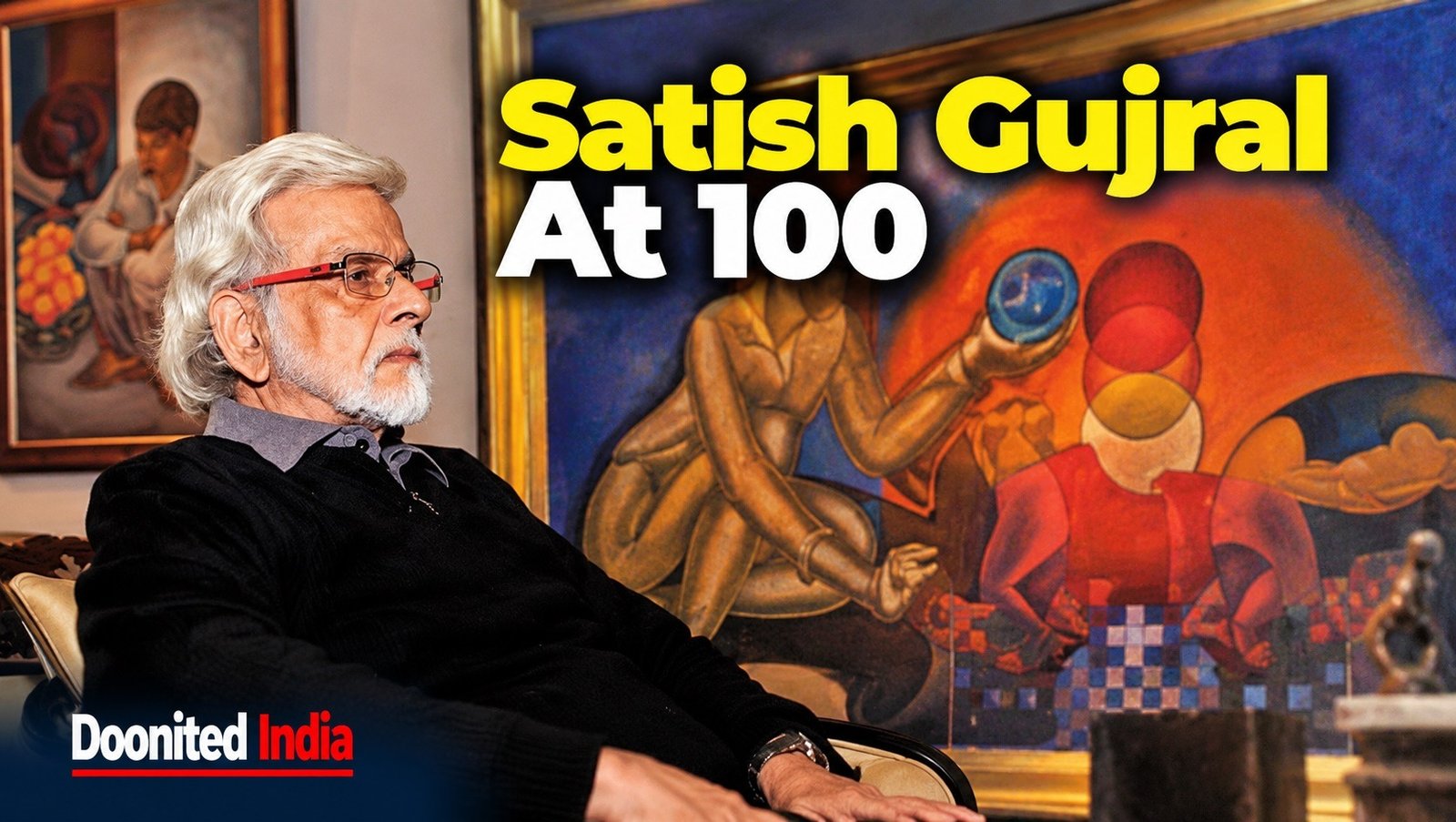
As India marks the centenary of Satish Gujral’s birth, exhibitions and conversations in Mumbai are bringing renewed attention to an artist who treated painting, sculpture, murals, architecture and design not as separate careers, but as different languages of the same creative mind.
Some artists spend a lifetime perfecting one language.
Satish Gujral spent his life learning several.
He painted. He sculpted. He created murals. He worked with ceramics. He designed buildings. He wrote. And throughout those changes of medium, certain concerns kept returning: memory, displacement, human suffering, material, space and the uneasy process of rebuilding after historical trauma.
That makes the renewed attention around Gujral in his centenary year more than an exercise in nostalgia.
At the National Gallery of Modern Art (NGMA), Mumbai, an exhibition connected with his centenary is scheduled to open on 9 October 2026, in collaboration with the Gujral Foundation and JSW Foundation.
Then, at ART MUMBAI on 14 November, a dedicated programme titled Satish Gujral: The Modernist and His Many Worlds will examine his multidisciplinary practice and his place in Indian modernism. A Gujral sculpture is also being presented at the fair.
The timing is appropriate.
Because in an age when designers move between fashion, film, architecture, technology and digital media almost without apology, Gujral’s career looks remarkably contemporary.
He simply arrived there decades earlier.
An artist shaped by a divided subcontinent
Gujral was born in 1925 in Jhelum, then part of British India and now in Pakistan. His formative years unfolded against a political landscape that would eventually be transformed by Partition.
The experience left a profound mark on his artistic imagination.
The Gujral Foundation describes his early Partition paintings as a response to the trauma surrounding the creation of India and Pakistan in 1947. Human figures, displacement and memory became recurring elements of his visual vocabulary.
This is important because Gujral’s modernism was never simply an exercise in stylistic experimentation.
There was history underneath it.
The abstraction, distorted bodies, dense surfaces and dramatic forms that appeared in different phases of his work can be understood against a life shaped by upheaval, migration and the difficult process of nation-building.
His art did not merely ask, What can modern art look like?
It also asked, What does a modern society remember?
Mexico changed the scale of his imagination
One of the defining chapters of Gujral’s development came when he received a scholarship to study in Mexico in the early 1950s.
There he encountered the extraordinary mural tradition associated with artists including Diego Rivera and David Alfaro Siqueiros, as well as the broader artistic environment surrounding Frida Kahlo.
The experience expanded his understanding of what an artist could do.
Painting did not have to remain confined to a framed canvas.
It could occupy architecture.
It could become monumental.
It could speak to public audiences rather than only gallery visitors.
The influence became particularly important in Gujral’s subsequent mural practice. The Gujral Foundation notes that his Mexican experience informed his work with ceramics and the large-scale murals that became an important part of his career.
This was an important lesson for Indian modernism.
The question was no longer simply how to imitate European modern art.
Indian artists could absorb international influences and transform them through their own histories, materials and social realities.
Gujral did precisely that.
From canvas to sculpture
Gujral’s movement into sculpture was not a side project.
It became another major chapter of his practice.
He worked with stone, metal, resin and ceramics, exploring texture and volume in ways that could not be contained by a two-dimensional surface.
That movement between materials reveals something fundamental about his artistic temperament.
For Gujral, medium was not necessarily an identity.
It was a tool.
If an idea required paint, he painted.
If it demanded mass and physical presence, he sculpted.
If it needed architecture, he built.
This attitude sounds familiar today because contemporary creative culture increasingly celebrates interdisciplinary practice.
But Gujral was working this way long before the term multidisciplinary artist became fashionable.
When the artist became an architect
Perhaps the most fascinating part of Gujral’s legacy is his architecture.
He approached buildings with the eye of an artist rather than treating architecture merely as construction.
His most celebrated architectural projects include the Belgian Embassy in New Delhi, a building that has become an important example of post-Independence Indian architectural modernism.
The Gujral Foundation notes that the Belgian Embassy brought together his artistic sensibility and architectural thinking and was later recognised among the outstanding buildings of the 20th century. It also received recognition from Belgium, including the Belgian Order of the Crown.
The building is significant because it complicates the conventional categories used to describe Gujral.
Was he a painter who became an architect?
An architect who happened to be a painter?
A sculptor interested in buildings?
The better answer is probably none of these.
He was an artist who saw space itself as a medium.
The Gujral Foundation’s 2026 Architecture as Diplomacy programme at Gujral House similarly used his architectural work to explore the relationship between architecture, culture and India-Belgium diplomacy, with particular attention to the Belgian Embassy.
His house becomes part of the story
The centenary year has also allowed audiences to encounter Gujral’s architectural thinking in a more intimate setting.
His New Delhi residence, Gujral House, was opened as an exhibition space during 2026, with an architecture-focused exhibition examining significant projects from his practice. The Gujral Foundation says the exhibition presented 12 architectural projects, including embassies, public buildings, universities and civic institutions.
This is more than a convenient exhibition venue.
A building designed by an artist can become an extension of the artist’s work.
In Gujral’s case, the house itself becomes an argument: architecture was not something he did after painting.
It was part of the same intellectual journey.
Why Gujral matters to today’s multidisciplinary generation
There is an interesting irony in revisiting Gujral in 2026.
The contemporary creative world is obsessed with crossing boundaries.
Fashion designers collaborate with architects. Architects work with artists. Musicians create visual installations. Filmmakers enter galleries. Digital artists move between animation, gaming and fine art.
The vocabulary is new.
The idea is not.
Gujral’s career demonstrates that creative disciplines can be porous without becoming meaningless.
He did not abandon painting because he became interested in architecture. Nor did sculpture cancel his identity as a painter.
Instead, each discipline expanded the others.
This is perhaps the most valuable lesson for younger artists.
Interdisciplinary work does not mean doing everything. It means understanding why a different medium may be necessary for a particular idea.
That distinction matters.
There is a difference between creative curiosity and creative restlessness.
Gujral’s career had both experimentation and continuity.
The modernist who remained unmistakably Indian
Gujral was internationally exposed, but his work cannot easily be reduced to an imported version of Western modernism.
His early experience of Partition, his engagement with Indian history and mythology, his interest in material and his work in post-Independence India gave his modernism a distinctly local historical context.
The result was neither isolation from the world nor blind imitation of it.
It was synthesis.
That may be one of the central achievements of Indian modernism itself.
Artists such as Gujral had to negotiate several worlds simultaneously: a newly independent nation, inherited artistic traditions, European modernism, international cultural exchange and rapidly changing urban India.
His answer was not to choose one world.
It was to work across them.
Recognition came, but the work remained bigger than the awards
Gujral’s contribution was recognised at the national level.
The Government of India’s 1999 Padma Awards notification records him as a Padma Vibhushan recipient in Art — Painting and Sculpture.
But awards are ultimately shorthand.
They tell us that an institution has recognised achievement.
They do not explain why an artist remains relevant.
That explanation lies in the work.
More than six decades of artistic experimentation produced an unusually broad body of paintings, sculptures, murals, architectural projects and writing. The Gujral Foundation describes his career as extending across more than 70 years and identifies the movement between media as one of the defining characteristics of his practice.
The centenary is really about a question
A centenary retrospective can easily become a celebration of the past.
Gujral’s case offers an opportunity to do something more useful.
It can ask what today’s artists have inherited from the generation that built Indian modernism.
What happens when an artist refuses the boundaries of a discipline?
Can architecture be approached as sculpture?
Can sculpture carry the emotional force of painting?
Can a mural turn public space into a historical memory?
Can an artist absorb international influences without losing a sense of place?
Gujral’s career repeatedly answered yes.
And that is why the 2026 exhibitions matter.
The NGMA Mumbai programme and ART MUMBAI’s November conversation are not simply bringing an old master back into the cultural calendar. They are reopening a conversation about the nature of artistic practice itself.
The legacy of refusing a single box
The easiest way to describe Satish Gujral is as a painter, sculptor, muralist and architect.
The more accurate description may be simpler:
He was an artist who refused to let the category come before the idea.
That refusal is what makes his work particularly relevant now.
Today’s creative industries increasingly reward people who can cross boundaries. Yet Gujral’s example suggests that the real value of crossing boundaries is not novelty.
It is freedom.
Freedom to change material.
Freedom to change scale.
Freedom to move from the intimate surface of a painting to the public permanence of a building.
Freedom to carry memory from one medium into another.
And perhaps most importantly, freedom to remain curious for an entire lifetime.
Satish Gujral’s centenary therefore should not be treated simply as a look backward at one of India’s celebrated modernists.
It is an invitation to reconsider what an artist can be.
Not a painter or a sculptor.
Not an architect or a designer.
But a creative mind capable of moving between worlds — while carrying the same questions with it.
That may be the most modern thing about Satish Gujral after all.


World Beyond the News
Dolphins Use Individual Signature Whistles
Bottlenose dolphins develop distinctive whistles that function somewhat like individual acoustic identifiers.
The Pacific Is Earth’s Largest Ocean
The Pacific Ocean covers more area than any other ocean basin and stretches between Asia, Australia and the Americas.
Artificial Intelligence Learns Statistical Patterns
Modern machine-learning systems identify patterns in large datasets and use those patterns to generate predictions or outputs.
Why Some Stories Spread So Quickly
Emotion, novelty, visual appeal and easy sharing can make a story travel rapidly across social platforms.