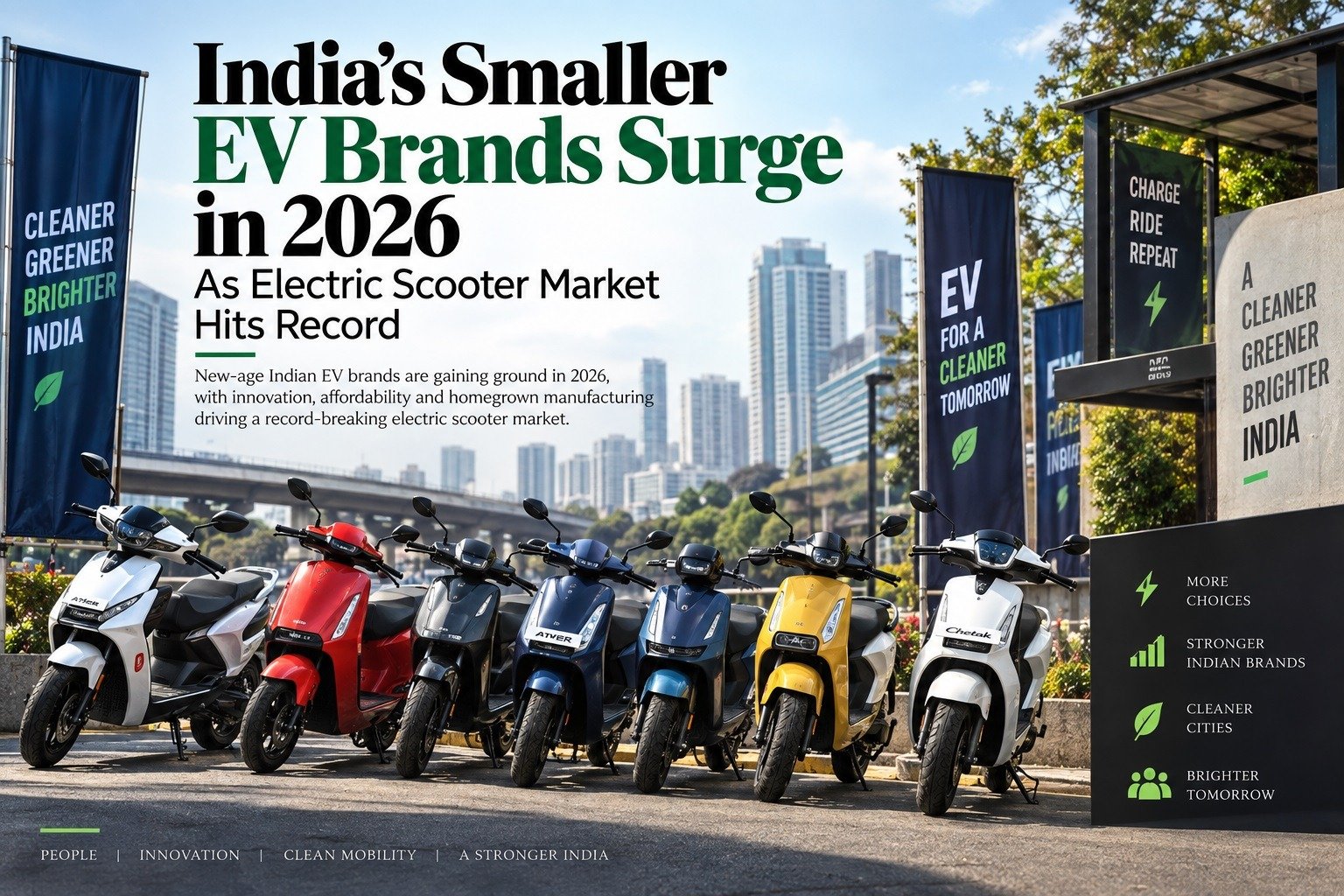
India’s Smaller Electric Scooter Makers Are Having a Very Big Year
For years, India’s electric two-wheeler story seemed to belong to a relatively small club.
TVS.
Bajaj.
Ather.
Hero.
Ola.
Then something interesting started happening.
The smaller manufacturers began selling enough scooters to make the established players pay attention.
By September 2026, India’s electric two-wheeler market had reached approximately 1.44 million registrations, already exceeding the 1.34 million record for the whole of 2025. And several smaller companies had already surpassed their individual full-year 2025 volumes in less than nine months.
The numbers do not mean India’s smaller EV makers have suddenly taken over the market.
They haven’t.
The five largest established and leading players still account for about 83% of electric two-wheeler volumes, according to the latest reporting.
But something important has changed.
The Indian electric-scooter market is becoming more crowded, more competitive and more interesting.
Greaves is the clearest example
Greaves Electric Mobility, which sells electric scooters under the Ampere brand, has emerged as one of the strongest smaller players.
According to Vahan data cited by Financial Express, Greaves registered 66,069 electric two-wheelers in 2026, already above its 57,699 registrations in all of 2025.
Earlier in September, Greaves briefly moved into fifth place among India’s electric two-wheeler manufacturers, registering 2,645 units and a 4.6% market share during the first nine days of the month, ahead of Ola Electric’s 2,607 units in that period.
That does not suddenly make Greaves a market giant.
But it demonstrates how quickly the ranking can change in an expanding market.
The company is also targeting the practical end of the scooter market, where price and everyday usability matter enormously.
And that may be an important part of India’s EV transition.
Not everyone needs a technological spaceship on two wheels.
Sometimes people simply want a scooter that gets them to work.
River Mobility is scaling too
Bengaluru-based River Mobility has also moved rapidly.
Its electric two-wheeler registrations reached 35,250 units in 2026, more than twice its 2025 volume, according to Financial Express.
The company is simultaneously raising money to expand.
River secured $120 million in Series C funding, with the capital intended for expanding manufacturing capacity, establishing a new greenfield facility, launching additional products and improving its financial performance.
That is significant because the EV business eventually becomes a manufacturing game.
A company can have a clever scooter.
It can have a clever app.
It can have a clever advertising campaign.
But eventually somebody has to build thousands of scooters reliably and deliver spare parts when somebody inevitably parks one badly and breaks something.
Scale matters.
Bgauss crosses another milestone
Mumbai-based Bgauss Auto has also been building momentum.
The company registered 32,101 electric two-wheelers in 2026, compared with 25,131 during the whole of 2025.
It has also raised $11.6 million in a Series D funding round, giving the company additional capital as it expands its presence in the electric two-wheeler market.
Bgauss recently crossed the 1 lakh cumulative-sales milestone, another indication that some of the smaller names are beginning to move beyond experimental startup territory.
The question now is whether these volumes can be sustained.

Simple Energy is still small — but growing
Bengaluru-based Simple Energy remains much smaller in absolute terms.
But percentage growth tells a different story.
The company registered approximately 11,000 electric two-wheelers in 2026, compared with 6,628 in 2025, according to the September reporting.
Simple is also reported to be working on a substantial fundraise to expand production capacity.
That distinction is important.
An 11,000-unit company and a 100,000-unit company are not remotely equivalent in scale.
But in a young industry, growth from a small base can be an important signal of whether a product is beginning to find customers.
Why are smaller brands growing now?
There isn’t one answer.
Several factors are converging.
Battery economics
Crisil Ratings has attributed part of the improvement to the scaling of domestic battery-cell manufacturing under India’s Production Linked Incentive programme, which has helped moderate cell costs and narrow the gap with imported cells.
Battery costs matter enormously because the battery is one of the most expensive components of an electric vehicle.
Lower input costs create room for manufacturers to offer more competitive products.
More products
The early EV market was dominated by a relatively narrow range of scooters.
That is changing.
Consumers can now choose across different price points, body styles, ranges and use cases.
That creates room for smaller companies to target specific segments rather than trying to beat everyone at everything.
Running costs
Petrol prices remain a significant consideration for Indian two-wheeler owners.
Electric scooters can offer lower operating costs, although the actual financial benefit depends on electricity tariffs, usage, financing, battery life, maintenance and the purchase price.
The calculation is therefore more complicated than simply comparing petrol with electricity.
But for high-mileage urban commuters, operating economics can be an important factor.
The market is growing — but the giants still dominate
This is where the excitement around smaller brands needs perspective.
TVS Motor, Bajaj Auto, Ather Energy, Hero MotoCorp and Ola Electric still account for roughly 83% of India’s electric two-wheeler volumes, according to the latest Financial Express report.
So this is not a David-versus-Goliath story in which the smaller manufacturers have suddenly defeated the established industry.
It is a story about market expansion creating room for additional players.
And even the large manufacturers are responding.
TVS, Bajaj and Ather have announced capacity expansion as demand grows, while some leading manufacturers have faced longer delivery timelines.
That tells us something useful.
The competitive battlefield is moving from simply selling an EV to building enough of them, servicing them and keeping customers satisfied.
The next battle will happen after the sale
This could be the most important part of the entire story.
A scooter is not a smartphone.
You cannot simply replace it when the nearest service centre is 150 kilometres away.
Electric vehicles still require tyres, brakes, suspension components, electronics, software support and battery-related service.
Customers also want financing.
They want spare parts.
They want resale value.
And they want confidence that the company will still exist several years after they buy the scooter.
Crisil’s Poonam Upadhyay told Financial Express that distribution and after-sales capabilities are likely to become increasingly important, noting that established dealer networks and financing partnerships can support customer retention.
That may be the real test for today’s smaller brands.
Selling the first 10,000 scooters is one challenge.
Supporting the owners of those 10,000 scooters is another.
Why the 83% figure could change — but shouldn’t be ignored
An expanding market gives smaller companies an unusual opportunity.
They don’t necessarily need to steal customers from established manufacturers immediately.
If the overall electric two-wheeler market grows, a smaller company can increase its absolute sales while the market leaders also grow.
That is one reason the current environment is different from a mature market.
But growth cannot continue indefinitely simply because the market is expanding.
Eventually, manufacturers must prove product quality, manufacturing efficiency, brand strength, distribution and customer support.
Capital can finance factories.
It cannot manufacture customer loyalty by itself.
DOONITED Editorial Perspective: India’s EV revolution may become a volume game
The most interesting development here is not that a few smaller companies have recorded impressive percentage growth.
It is that India’s electric two-wheeler market is slowly becoming less dependent on a handful of names.
That is healthy from an industrial-development perspective.
Competition creates pressure to improve products, prices, service and technology.
It also gives consumers more choices.
But India’s EV industry should resist celebrating registration numbers as if they were the final destination.
A registration is the beginning of an ownership relationship.
The real measure of a successful EV company will be what happens two, three and five years later.
Does the battery perform?
Are parts available?
Does the service network work?
Can the customer get financing?
Does the company remain financially healthy?
Can the vehicle retain reasonable value?
Those questions are less glamorous than a monthly sales chart.
They are also considerably more important.
The bigger takeaway
India’s electric two-wheeler market has entered a more mature phase.
The early race was about establishing electric scooters as a viable alternative to petrol.
The next race is about scale and trust.
Greaves is expanding.
River is raising capital and building capacity.
Bgauss is increasing volumes.
Simple Energy is growing from a smaller base.
Meanwhile, the major manufacturers are expanding their own EV operations.
The result is not the end of the established players.
It is something more interesting:
a larger Indian electric two-wheeler ecosystem.
For consumers, that means more choices.
For startups, it means a larger addressable market.
For investors, it means more companies competing for capital.
And for manufacturers, it means the easy part — convincing people that electric scooters are possible — is gradually being replaced by the difficult part:
convincing people that your particular electric scooter is worth owning for years.
That is where India’s next EV battle will be fought.
Not only on the showroom floor.
But in the service centre.
DOONITED Reader Insight
When comparing electric scooters, don’t look only at range, price or acceleration.
Also check the manufacturer’s dealer and service network, spare-parts availability, warranty terms, battery coverage, financing options and the company’s ability to support vehicles over the long term.
In India’s rapidly expanding EV market, the best-looking sales chart is not necessarily the best ownership experience.


World Beyond the News
Octopuses Can Change Their Appearance
Octopuses can rapidly alter their skin colour and texture to communicate, camouflage themselves and respond to danger.
Some Cities Exist Across Two Continents
A small number of cities are geographically associated with two continents, creating unusual cultural and geographic identities.
Earth’s Climate Is Measured in Many Ways
Scientists track temperature, atmospheric gases, sea level, ice cover and other indicators rather than relying on a single climate number.
Streaming Changed How Audiences Discover Shows
Recommendation systems and global streaming releases allow audiences to discover programmes far beyond their original markets.