Sabyasachi Returns to New York: When Bengal Met Byzantine and Broadway
For an Indian designer returning to New York Fashion Week after almost two decades, Sabyasachi Mukherjee could have chosen the obvious route.
More couture. More bridal grandeur. More embroidery. More of the visual vocabulary that has made the Sabyasachi name synonymous with Indian luxury.
Instead, he sent Christy Turlington down the runway in denim.
That was the first clue that this was not simply a comeback show.
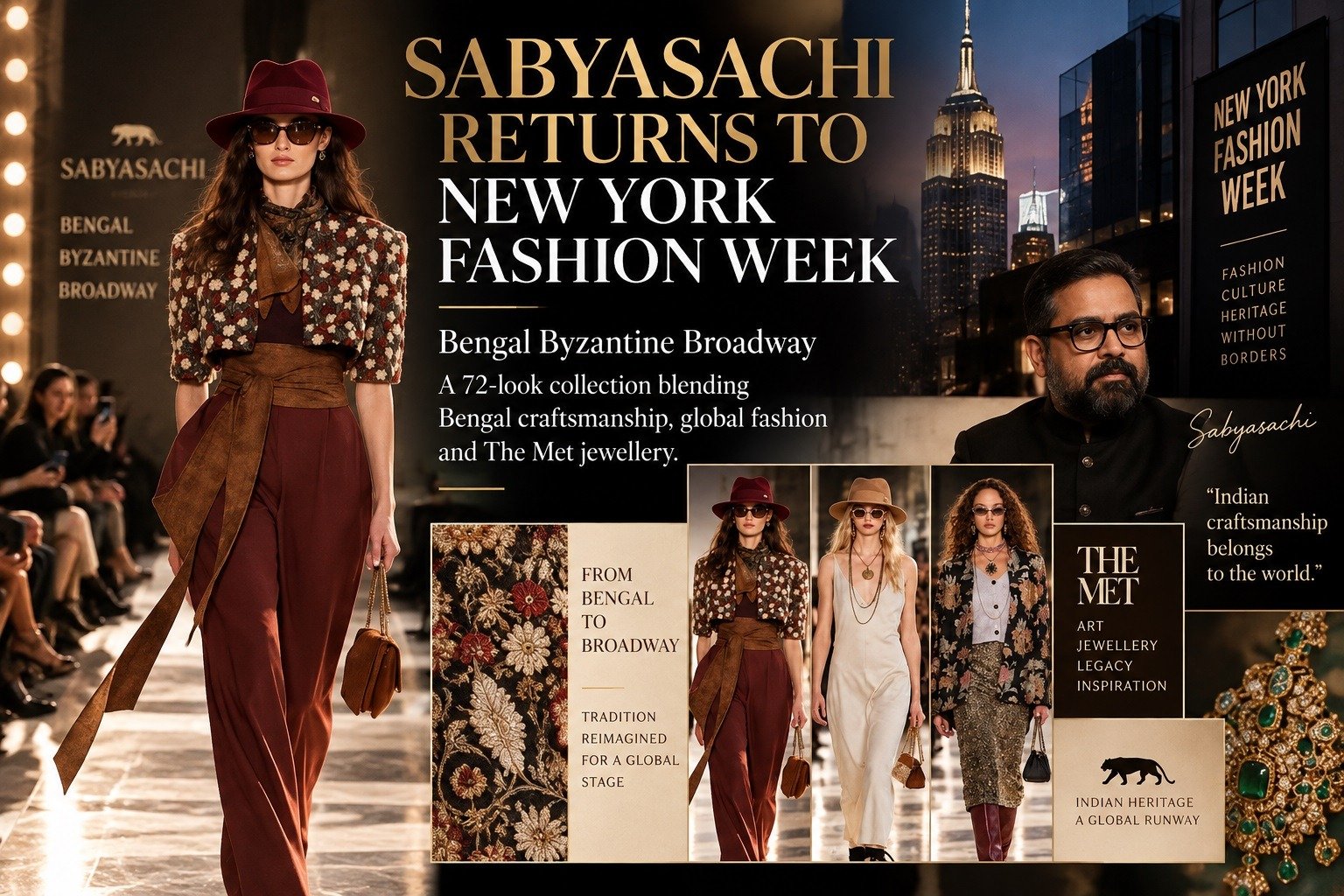
On September 15, Sabyasachi returned to the New York Fashion Week runway with “Bengal Byzantine Broadway,” a 72-look Spring/Summer 2027 collection that brought together Bengal craftsmanship, Byzantine artistic references and New York’s metropolitan energy. His previous NYFW runway appearance was in 2009.
The result was less a presentation of “Indian fashion abroad” and more an argument about what Indian fashion can look like when it no longer feels obliged to explain itself.
The first look said almost everything
Christy Turlington opened the show wearing layered denim.
That choice was significant because denim is about as far from the conventional image of Sabyasachi occasionwear as one can get.
Yet the clothes were not simply American basics. Denim, plaid shirts, tailoring, cashmere, mohair, velvet and relaxed silhouettes were combined with embroidery, brocade, hand-painted silk and elaborate jewellery. Vogue described the collection as Western clothing seen through an Indian lens.
There were also cowboy hats, Western workwear references and pieces that played with the visual language of the American West.
The message was fairly clear:
Indian craftsmanship does not have to arrive in New York wearing a sherwani.
Sometimes it can arrive in jeans.
Why “Bengal Byzantine Broadway”?
The title sounds almost like three very different cities accidentally booked the same taxi.
But there is a design logic behind it.
Bengal represents Sabyasachi’s cultural and craft vocabulary — particularly the visual richness associated with Calcutta and the designer’s longstanding engagement with Indian craftsmanship.
Byzantine enters principally through the jewellery and historical references associated with the new collaboration with The Metropolitan Museum of Art.
And Broadway brings theatricality, New York energy and spectacle into the equation.
Sabyasachi’s own presentation describes the collection as a journey from Calcutta to New York, moving between Bengal craftsmanship, Byzantine magnificence and Broadway’s theatrical power.
The combination is deliberately cosmopolitan.
It also reflects something important about Indian fashion today: globalisation does not necessarily mean abandoning local identity. It can mean putting that identity into conversation with other cultural traditions.
The Met collaboration changes the scale of the story
The fashion show also marked the beginning of a multi-year collaboration between Sabyasachi and The Metropolitan Museum of Art.
The first chapter focuses on high jewellery inspired by the Met’s collections and Byzantine art. Reporting on the collaboration describes pieces drawing on historical forms, including Byzantine revival cuffs and Etruscan-inspired pendants, with gold and coloured gemstones playing a central role.
Sabyasachi’s own collection material similarly places the jewellery within a broader conversation between historical art and contemporary craftsmanship. One featured Bengal Tiger necklace, for example, combines sculpted gold tiger motifs with a large Zambian emerald and an old-mine-cut diamond.
This matters beyond jewellery.
The Metropolitan Museum of Art is not simply another luxury retailer. It is one of the world’s major cultural institutions.
A collaboration of this nature puts Indian craftsmanship into a different institutional context: not merely as something beautiful to buy, but as part of a conversation about art, history, collecting and cultural exchange.
That is a much larger proposition.
Rani Mukerji brought the saree — but the runway did too
Among the notable guests was actress Rani Mukerji, who attended in a minimalist black saree.
Her appearance became one of the most recognisable Indian images from the event, but interestingly, the saree was not restricted to the audience.
The show’s closing look also returned to the garment.
Model Avanti Nagrath closed the presentation in a black saree, styled with a Sabyasachi tiger belt and statement cuffs.
That framing is worth noticing.
The saree was neither hidden to make the collection appear “global” nor used as a tokenistic opening statement.
It appeared at the end — almost like a signature.
The collection spent much of its journey speaking the language of global ready-to-wear before reminding the audience where its design vocabulary ultimately came from.
This was also a commercial experiment
There is another side to the glamour.
A global fashion presentation is not simply about applause.
It is about whether a designer can create products and an aesthetic that work across markets.
Sabyasachi’s New York presentation deliberately moved away from garments that require special occasions and towards pieces that could exist within an international wardrobe.
Denim, shirts, tailoring, jackets and other familiar staples are easier to understand across markets than highly specialised couture.
That does not make them less Indian.
It potentially makes Indian craftsmanship more portable.
And that could be one of the most commercially interesting aspects of this collection.
The Indian luxury industry is entering a different conversation
For years, Indian fashion’s international story was often told through weddings, Bollywood, embroidery, lehengas and spectacular couture.
Those remain important.
But India’s luxury proposition is becoming broader.
Indian designers increasingly have to compete not simply on cultural authenticity but on design language, craftsmanship, brand consistency, retail experience and international relevance.
Sabyasachi’s New York strategy appears to recognise that distinction.
The collection does not ask a Western customer to completely change their wardrobe.
It asks them to look at familiar clothes differently.
A denim jacket can carry Indian craft.
A Western shirt can coexist with historical jewellery.
A saree can close a New York runway without functioning as a museum exhibit.
That is a more sophisticated form of cultural exchange.
There is a risk too
The internationalisation of Indian luxury is not automatically a success story.
There is always a danger that heritage becomes packaging — that centuries of craft traditions are reduced to decorative motifs for global consumption.
There is also a commercial tension between exclusivity and accessibility.
The more a luxury house expands internationally, the harder it becomes to maintain the sense of rarity and cultural specificity that created its appeal in the first place.
Sabyasachi’s challenge now is therefore bigger than staging a memorable New York show.
The question is whether the brand can turn this global visibility into a durable international business while preserving the craftsmanship and cultural depth behind the name.
That will take more than a spectacular runway.
DOONITED Editorial Perspective: India doesn’t need to look Western to look global
Perhaps the most interesting lesson from Sabyasachi’s return is not the jewellery, the celebrities or even the New York location.
It is the confidence of the design proposition.
For a long time, internationalisation was sometimes interpreted as making Indian products more familiar to Western consumers.
This collection reverses that equation.
It takes globally familiar clothing — denim, tailoring, shirts and outerwear — and allows Indian craftsmanship to change the character of those clothes.
That is a subtle but meaningful shift.
The designer is not saying: “Here is an Indian version of Western fashion.”
The proposition is closer to: “Here is global fashion, interpreted through an Indian design intelligence.”
There is a difference.
And that difference may ultimately be more important than any single runway look.
The bigger takeaway
Sabyasachi’s New York return demonstrates that cultural influence does not always require cultural uniformity.
Bengal can meet Byzantium.
Calcutta can meet New York.
A saree can share the same runway as denim.
And an Indian luxury house can enter a global conversation without leaving its historical vocabulary at the airport.
The fashion industry will ultimately decide how commercially durable this new chapter becomes.
But as a cultural statement, “Bengal Byzantine Broadway” makes one thing clear: Indian fashion is increasingly moving from being presented to the world to participating in the conversation on its own terms.
And that may be the most interesting thing Sabyasachi brought back from New York.
Not just fashion.
Confidence.


World Beyond the News
Why Elephants Stay Close to Their Herd
Elephants live in highly social family groups and use calls, touch and body movements to maintain strong bonds.
Most of the Deep Ocean Remains Difficult to Explore
Extreme pressure, darkness and distance make deep-ocean exploration one of Earth’s greatest scientific challenges.
Spacecraft Can Travel Without Traditional Roads
Spacecraft use carefully calculated trajectories and gravity assists to travel enormous distances through space.
Why Movie Trailers Are Released in Stages
Major films often use teaser trailers, full trailers and final promotional spots to build awareness over time.