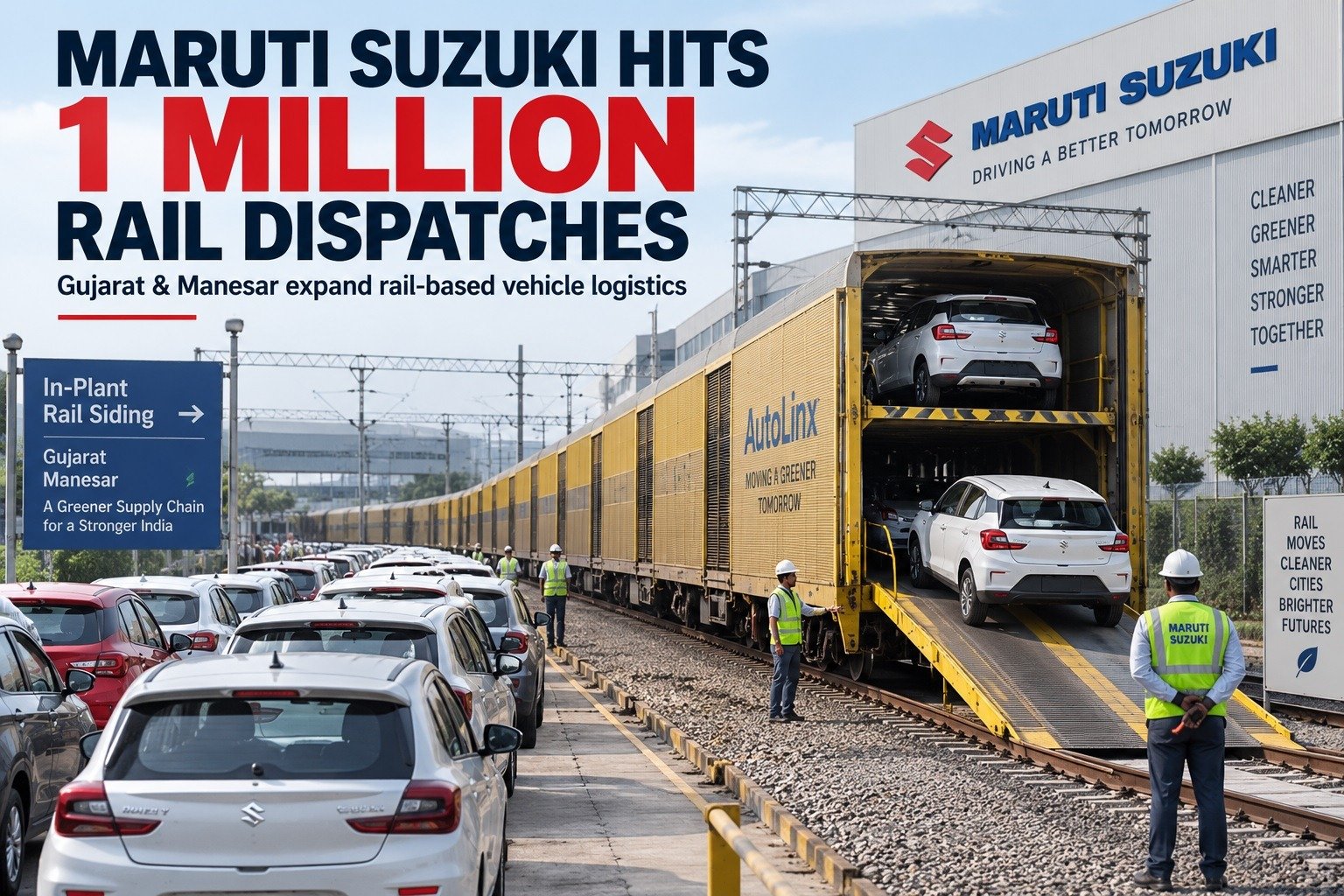
One Million Cars by Rail: How Maruti Is Changing India’s Auto Logistics
When a new car leaves an automobile factory, the most interesting part of its journey may not be the engine, battery or dashboard.
It may be what happens underneath it.
Railway tracks.
Maruti Suzuki has now dispatched one million vehicles through the in-plant railway sidings at its Hansalpur facility in Gujarat and Manesar facility in Haryana. Approximately 7.9 lakh vehicles were moved through Hansalpur and 2.1 lakh through Manesar. The milestone was reached in three years and five months after the Gujarat siding began operations in March 2023 and the Manesar facility followed in June 2025.
It sounds like an infrastructure statistic.
It is actually a story about how India’s automobile industry is trying to rethink the last few hundred kilometres between factory and customer.
And, perhaps more importantly, it is a story about whether India’s roads really need to carry every car that India’s factories produce.
The railway line begins inside the factory
The important word in Maruti’s announcement is “in-plant.”
This is not simply about loading cars onto trains somewhere after they have already travelled by road.
An in-plant railway siding is a dedicated rail terminal built within the manufacturing facility. Finished vehicles can be moved directly from the factory to railway rakes without first being transported by trucks to an external railway loading point.
That seemingly small change can eliminate an entire road leg from the logistics chain.
Factory.
Railway siding.
Train.
Distribution hub.
Dealer or customer.
It is a much cleaner sequence than:
Factory.
Truck.
Railway terminal.
Handling.
Train.
Another truck.
And then, eventually, the customer wondering why the car has accumulated more kilometres before delivery than his neighbour’s first road trip.
Hansalpur started the experiment
Maruti’s Gujarat siding at Hansalpur began operations in March 2023.
It was developed under the PM GatiShakti National Master Plan and was India’s first automobile in-plant railway siding, according to Maruti. The facility was formally inaugurated in March 2024.
The Gujarat facility has since become the larger contributor to the million-vehicle milestone.
Of the 10 lakh vehicles dispatched through the two in-plant sidings, roughly 79% came through Hansalpur.
That is not surprising given the earlier start date.
But it also shows how quickly a dedicated industrial rail connection can become part of a manufacturer’s logistics architecture when the infrastructure is integrated into the plant rather than added as an afterthought.
Then came Manesar
The second major piece arrived in Haryana.
Maruti’s Manesar in-plant railway siding began operations in June 2025 and is described by the company as India’s largest automobile in-plant railway siding, with a full-capacity annual dispatch capability of 450,000 vehicles.
The facility crossed 100,000 vehicle dispatches within nine months of beginning operations. Maruti estimated that those dispatches avoided about 16,800 tonnes of CO₂e compared with the relevant road-transport baseline used in its calculation.
By September 2026, Manesar had contributed approximately 2.1 lakh vehicles to the combined one-million milestone.
That is a remarkably fast ramp-up for a piece of infrastructure that most car buyers will never see.
This is bigger than one million cars
The headline number is impressive.
But the more revealing statistic is the trajectory.
Maruti says its share of rail-based vehicle dispatches increased from just 5% in FY2014-15 to 26.5% in FY2025-26. It has set a medium-term target of increasing that share to 35% by FY2030-31.
In the current financial year through August 31, Maruti’s rail-based dispatches had already crossed 300,000 vehicles, with the Hansalpur and Manesar in-plant sidings together accounting for about 70% of those rail dispatches.
That means rail is no longer an occasional alternative within Maruti’s distribution system.
It is becoming part of the company’s core logistics planning.
Why rail makes sense for cars
A passenger vehicle is an unusually awkward piece of freight.
It is valuable.
It cannot simply be stacked like boxes.
It takes considerable space.
And transporting thousands of cars by individual road carriers requires a large fleet of trucks, drivers, fuel and road capacity.
Rail offers a different model.
One train can move a large number of vehicles in a single movement, while reducing the number of individual road journeys required for long-distance distribution.
Maruti says the shift has helped reduce truck usage, fuel consumption and road congestion, while avoiding greenhouse-gas emissions.
The environmental benefit should still be understood carefully.
Rail is not automatically emissions-free.
Its actual environmental advantage depends on the rail system, locomotive energy mix, distance, loading efficiency and the road journey that rail replaces.
But when rail substitutes for large numbers of long-distance truck movements, there is a strong logistical case for using it more extensively.
The hub-and-spoke idea
The railway strategy also depends on what happens after the train arrives.
Maruti says the two in-plant sidings operate as part of a hub-and-spoke distribution model, with the company’s rail logistics network servicing more than 600 cities from 22 hubs. The railway network also connects with export gateways including Mundra and Pipavav ports.
That is where logistics becomes an engineering problem rather than simply a transport choice.
The objective is not merely:
“Put cars on trains.”
It is:
“Design the entire distribution network so that rail becomes the efficient backbone.”
That involves scheduling, loading infrastructure, hub locations, inventory planning, dealer distribution and the final road leg.
The railway is therefore one component of a much larger logistics system.
India’s auto industry is growing — and logistics must grow with it
Maruti’s rail push is arriving as its manufacturing footprint expands.
Its Hansalpur complex reached one million units of annual production capacity in July 2026 following the start of operations at a fourth plant, including production of the e VITARA.
More production inevitably means more vehicles have to leave factories.
If those additional vehicles were transported primarily by road, the logistics burden would rise accordingly.
Rail provides a way to increase outbound capacity without simply adding more trucks to already busy highways.
That is particularly relevant for an India whose automobile production is spread across increasingly large manufacturing clusters.
The next siding is already part of the plan
Maruti’s target of 35% rail-based dispatches by FY2030-31 will require additional infrastructure.
The company has said that an in-plant siding at its Kharkhoda facility in Haryana will support the expansion.
This is important because the million-vehicle milestone is not being presented as the conclusion of the strategy.
It is a benchmark.
The real objective is to make rail a substantially larger part of vehicle distribution over the next several years.
There are limitations
Rail cannot replace road transport completely.
Cars eventually have to reach dealers, customers and regional distribution points that may not have direct railway access.
That means the final-mile road journey remains essential.
There are also capacity constraints.
Railway paths have to be scheduled alongside passenger and freight traffic. New sidings require substantial investment. Loading and unloading infrastructure has to operate reliably. A delay at one point can affect an entire trainload of vehicles.
And the economics have to remain competitive.
A green logistics system that is too expensive or unreliable will struggle to scale regardless of how attractive its environmental credentials appear.
So the objective should not be rail at any cost.
It should be the right mode for the right distance and volume.
A quiet transformation in India’s automobile supply chain
There is something interesting about this story precisely because consumers rarely see it.
People notice a new car.
They notice a new factory.
They notice a new model launch.
They rarely notice the logistics architecture that moves hundreds of thousands of vehicles across the country.
Yet logistics can determine whether manufacturing growth remains efficient.
If India wants to become a larger automobile manufacturing and export hub, moving finished vehicles efficiently will be just as important as producing them.
DOONITED Editorial Perspective: India’s next logistics revolution may be less visible than the last one
India’s infrastructure story is often told through spectacular projects — expressways, airports, ports, metro systems and high-speed rail.
But industrial competitiveness is also built through less glamorous infrastructure.
A railway siding inside an automobile plant does not make for a dramatic inauguration photograph.
Its value is measured differently.
How many trucks did it replace?
How much fuel was avoided?
How efficiently can a factory distribute its output?
How many cities can the network serve?
How reliably can a car reach a customer?
That is the sort of infrastructure that rarely becomes a household conversation — until it stops working.
Maruti’s one-million milestone therefore offers a useful lesson.
Green logistics is not simply about buying cleaner trucks.
Sometimes it is about redesigning the route entirely.
Instead of asking how to make thousands of road journeys slightly more efficient, the better question may be whether thousands of those journeys need to happen on roads in the first place.
The bigger takeaway
Maruti Suzuki has now moved more than one million vehicles through just two in-plant railway sidings, while its overall rail-based vehicle dispatches since FY2014-15 have exceeded 3.3 million.
The company’s rail share has risen more than fivefold from its FY2014-15 level of 5%.
Its next target is 35%.
That may sound like a corporate logistics target.
It is also part of a much larger Indian story.
As factories become larger, production becomes more geographically distributed and automobile exports grow, the transport system connecting factories to markets becomes part of industrial competitiveness itself.
India’s automobile revolution therefore isn’t happening only on factory floors.
Some of it is happening on railway tracks.
And perhaps the most efficient car journey is the one where the car spends most of its time being moved by a train — rather than sitting in a truck, wondering why the highway has not moved for 40 minutes.
DOONITED Reader Insight
When you think about sustainable mobility, it is easy to focus only on the vehicle — petrol, hybrid or electric.
But sustainability also depends on how the vehicle reaches you.
Moving large volumes of finished cars by rail can reduce dependence on road transport and potentially improve fuel and logistics efficiency.
The broader lesson is simple:
A cleaner automobile industry needs cleaner manufacturing and smarter movement of the automobiles themselves.


World Beyond the News
Octopuses Can Change Their Appearance
Octopuses can rapidly alter their skin colour and texture to communicate, camouflage themselves and respond to danger.
Some Cities Exist Across Two Continents
A small number of cities are geographically associated with two continents, creating unusual cultural and geographic identities.
Earth’s Climate Is Measured in Many Ways
Scientists track temperature, atmospheric gases, sea level, ice cover and other indicators rather than relying on a single climate number.
Streaming Changed How Audiences Discover Shows
Recommendation systems and global streaming releases allow audiences to discover programmes far beyond their original markets.