Kolkata Durga Puja 2026: When the City Turns Its Streets Into a Giant Art Gallery
Every autumn, Kolkata performs a remarkable transformation.
Ordinary neighbourhoods acquire temporary gateways.
Empty plots become architectural installations.
Roadside workshops turn into studios.
Clay becomes sculpture.
Bamboo becomes structure.
Fabric becomes walls.
And an ordinary evening walk can suddenly feel like an open-air art biennale — except this one comes with dhak beats, crowds, food stalls and several million people who have very strong opinions about which pandal you absolutely must see.
This is Durga Puja in Kolkata.
In 2026, the city’s preparations are already well underway, with major committees working on elaborate themes, structures and installations ahead of the festival.
The official West Bengal Puja calendar lists Mahalaya on October 10, followed by Maha Shashthi on October 17, Saptami on October 18, Ashtami on October 19, Navami on October 20 and Vijaya Dashami on October 21.
But the story of Kolkata’s Puja begins long before the first drumbeat.
A festival that starts months before the festival
For the visitor, Durga Puja may appear to begin when the lights come on.
For the people who make it happen, it begins much earlier.
Artists, idol makers, bamboo workers, electricians, carpenters, painters, fabricators, decorators and numerous specialist craftspeople work for months on temporary structures that may stand for only a few days.
UNESCO recognised Durga Puja in Kolkata as Intangible Cultural Heritage in 2021, specifically noting the festival’s combination of large-scale installations, traditional Bengali drumming, ritual, public participation and the collaborative work of artists and designers.
That description captures something important.
Kolkata’s Puja is not simply a religious event with decoration around it.
The art is part of the event.
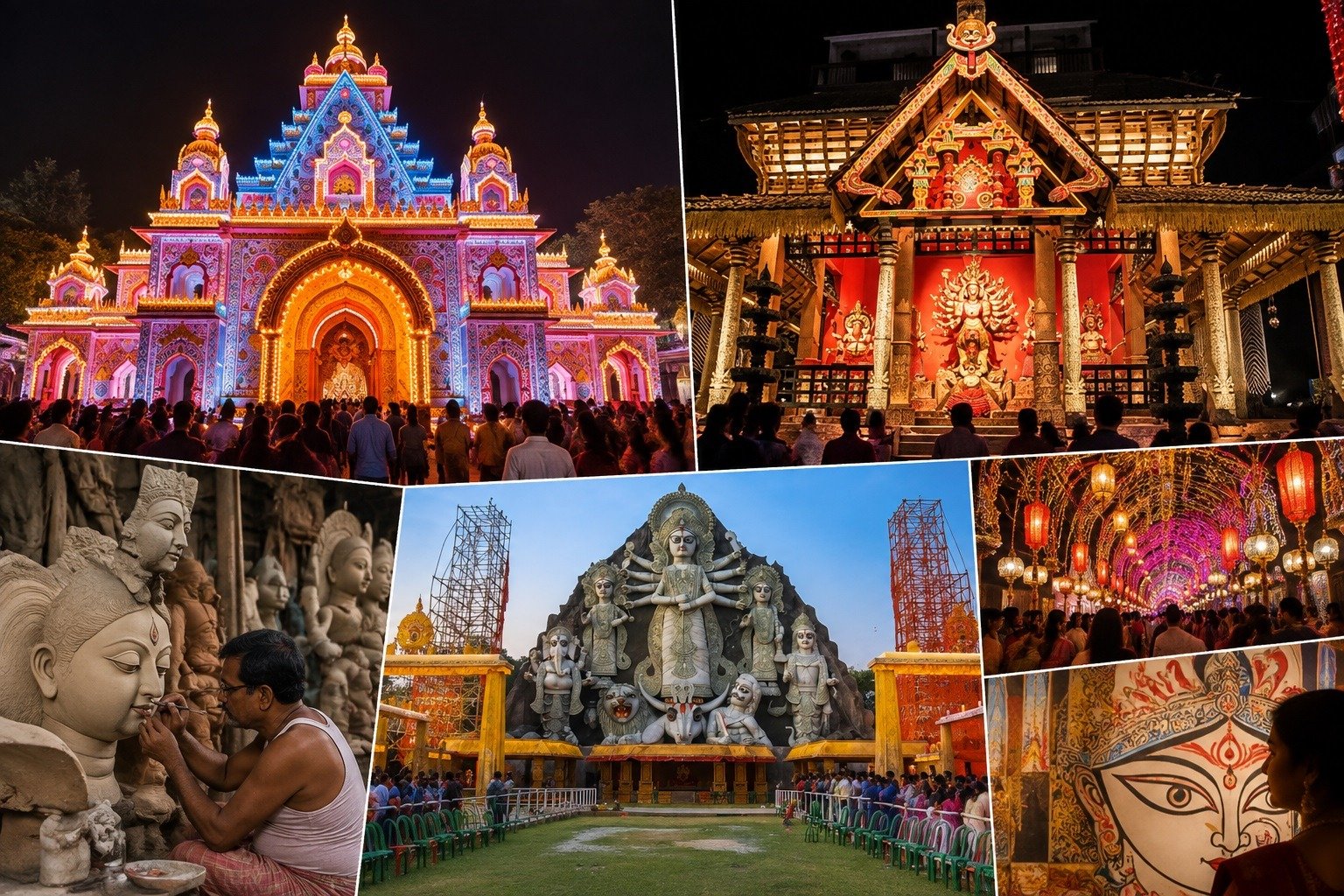
The pandal has become the medium
Kolkata’s famous theme pujas have developed an unusual creative language.
A pandal can recreate an architectural landmark.
It can tell a historical story.
It can explore an artist’s work.
It can interpret a social issue.
It can transform traditional materials into contemporary installations.
And it has to do all of this while still functioning as a sacred space.
The 2026 themes demonstrate how broad that creative vocabulary has become.
Santosh Mitra Square in central Kolkata is presenting “Sanatani Chetanay Vande Mataram,” linked to the 150th anniversary of Bankim Chandra Chattopadhyay’s famous song. The concept is being developed through large-scale visual and immersive elements.
At Samaj Sebi Sangha, the theme “Mahapujoy Mahanayak” pays tribute to Bengali cinema icon Uttam Kumar on the occasion of his birth centenary, with a concept built around posters from his films.
Elsewhere, Alipore Sarbojanin is exploring the Ramayana, Jagat Mukherjee Park is turning towards the world of manuscripts, and Dum Dum Park Tarun Sangha is using the idea of commerce and enterprise as its thematic subject.
The result is almost extraordinary.
You can walk through Kolkata and encounter religion, cinema, literature, history, architecture and craft within a few kilometres.
Kumartuli remains at the heart of it
Before the spectacular pandal comes the idol.
And for that, one of Kolkata’s most important places is Kumartuli.
The city’s traditional idol-making neighbourhood has become synonymous with clay images of Durga and her family. UNESCO notes that the months preceding the festival involve small artisanal workshops sculpting the images from unfired clay, traditionally associated with the Ganga.
This is where the scale of the festival becomes easier to understand.
Behind a finished Durga idol is a chain of skills:
bamboo framework,
straw modelling,
clay application,
sculpting,
drying,
painting,
ornamentation,
and finally the eyes that transform the finished image into the goddess for the ritual.
The visitor sees the final idol.
The artisan sees months of work.
Tradition is not disappearing — it is negotiating with modernity
One of the fascinating aspects of Kolkata’s Puja is that traditional and contemporary approaches coexist.
Some committees maintain heritage-style worship and relatively restrained decoration.
Others construct spectacular contemporary installations.
Some use historical architecture as inspiration.
Others use film, technology or contemporary art.
This creates a productive tension.
How modern can a pandal become while remaining recognisably Durga Puja?
There is no single answer.
And perhaps that is why the tradition remains so creatively alive.
The 2026 themes range from traditional Bengal and spiritual subjects to cinema, literature, history and wider Indian cultural traditions.
Kolkata’s Puja does not seem particularly interested in choosing between the past and the present.
It keeps putting them in the same pandal.
The economics hidden behind the spectacle
The pandal is temporary.
The economic activity surrounding it is not.
Thousands of people are involved in the seasonal ecosystem — from artisans and decorators to transport workers, food sellers, printers, electricians, security personnel and small retailers.
The festival also creates demand for clothing, jewellery, food, flowers, gifts and travel.
And then there is the visitor economy.
Hotels fill.
Restaurants become busy.
Transport demand rises.
Local shopping districts experience a seasonal surge.
For artisans, the festival can provide a significant annual market.
This is one reason Durga Puja should be understood not only as cultural heritage but also as part of Kolkata’s creative economy.
The temporary nature of the installations makes the model even more unusual.
Imagine constructing a building that everyone knows will disappear within days.
That is essentially the economic absurdity — and artistic brilliance — of the pandal.
The city itself becomes the exhibition
Perhaps the most interesting feature of Kolkata’s Puja is that the visitor does not need a museum ticket.
The exhibition is the city.
South Kolkata has its well-known clusters around areas such as Gariahat, Ballygunge, Hindustan Park and surrounding neighbourhoods.
Central Kolkata offers major installations such as Santosh Mitra Square.
North Kolkata brings together older community traditions, neighbourhood pujas and the wider Kumartuli–Shobhabazar cultural landscape.
The geography itself becomes part of the experience.
People don’t simply “visit Durga Puja.”
They pandal-hop.
And pandal-hopping has become its own form of urban tourism.
But spectacle has a cost
There is another side to this transformation.
A city hosting enormous crowds needs extraordinary logistical planning.
Kolkata Police is already preparing for 2026, including traffic and crowd-management arrangements around locations where pujas are expected to expand or new large celebrations are being introduced.
More visitors mean more traffic.
More temporary structures mean more material use.
More lighting means more energy consumption.
More food stalls mean more waste.
And more popularity means greater pressure on neighbourhoods that were never designed to accommodate enormous pedestrian flows.
The challenge is therefore not to make Kolkata’s Puja smaller.
It is to make its growth better managed.
Sustainability cannot be only a theme
Eco-friendly materials are increasingly discussed in connection with pandal construction, including bamboo, cloth and jute.
But genuine sustainability requires more than replacing one material.
It involves the complete lifecycle of a pandal:
Where did the material come from?
Can it be reused?
Where does it go after the festival?
How much waste is generated?
What happens to electrical equipment?
How are immersion-related materials handled?
A temporary structure that looks “green” on opening night but produces mountains of unrecoverable waste afterward has solved the visual problem, not the environmental one.
The next stage of Kolkata’s Puja should therefore be measurably sustainable, not simply decorated with sustainability language.
A festival that belongs beyond Kolkata
Durga Puja is now celebrated across India and by Bengali communities around the world. UNESCO itself describes the festival as extending beyond Kolkata to other parts of India and the Bengali diaspora.
But Kolkata retains a special role.
Here, the festival becomes almost a city-wide creative laboratory.
A sculptor, a lighting designer, an architect, a painter, a musician, a carpenter and a neighbourhood committee can collaborate on something that exists for a few days and then disappears.
That impermanence is part of its magic.
A museum preserves art by keeping it.
Kolkata’s Puja creates art knowing that it will eventually come down.
That may be one of the most Indian things about the entire phenomenon.
The DOONITED View
Kolkata Durga Puja should not be judged only by which pandal is the biggest, most expensive or most photographed.
The more interesting question is:
What is the city creating this year?
In 2026, the answer is already remarkably varied.
History.
Cinema.
Literature.
Architecture.
Mythology.
Craft.
Bengal’s own heritage.
And contemporary interpretations of Indian identity.
That variety is the real strength of the festival.
The pandal is temporary, but the skills behind it are not.
The lights disappear.
The bamboo is dismantled.
The clay returns to the elements.
But the artisan’s knowledge, the designer’s idea and the community’s ability to build something extraordinary together remain.
That is why Kolkata’s Durga Puja is more than a festival.
It is a living creative economy that happens to have a goddess at its centre.
The Learning Point
Kolkata’s greatest Durga Puja achievement may not be building spectacular pandals. It is creating a system in which religion, art, craft, community and urban culture meet in the same public space.
The real challenge for 2026 and beyond is to preserve that creative freedom while making the festival more sustainable, accessible and manageable.
Because when the lights finally go out, Kolkata should be left with more than memories.
It should be left with skills, livelihoods, cultural confidence and a cleaner city ready to begin again.


World Beyond the News
Why Elephants Stay Close to Their Herd
Elephants live in highly social family groups and use calls, touch and body movements to maintain strong bonds.
Most of the Deep Ocean Remains Difficult to Explore
Extreme pressure, darkness and distance make deep-ocean exploration one of Earth’s greatest scientific challenges.
Spacecraft Can Travel Without Traditional Roads
Spacecraft use carefully calculated trajectories and gravity assists to travel enormous distances through space.
Why Movie Trailers Are Released in Stages
Major films often use teaser trailers, full trailers and final promotional spots to build awareness over time.