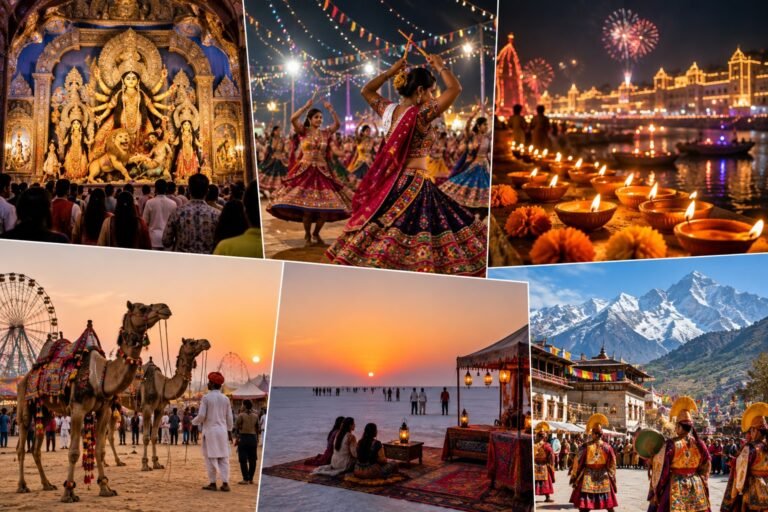
A festival where the landscape is part of the story
There are cultural festivals where the surroundings are a backdrop.
Tawang is different.
Here, the mountains are part of the experience. Prayer flags move in the high-altitude wind. Monasteries rise above the valley. Roads climb through dramatic Himalayan passes. Local markets carry handwoven products and regional foods. And the cultural traditions of the Monpa community remain closely connected to the landscape in which they developed.
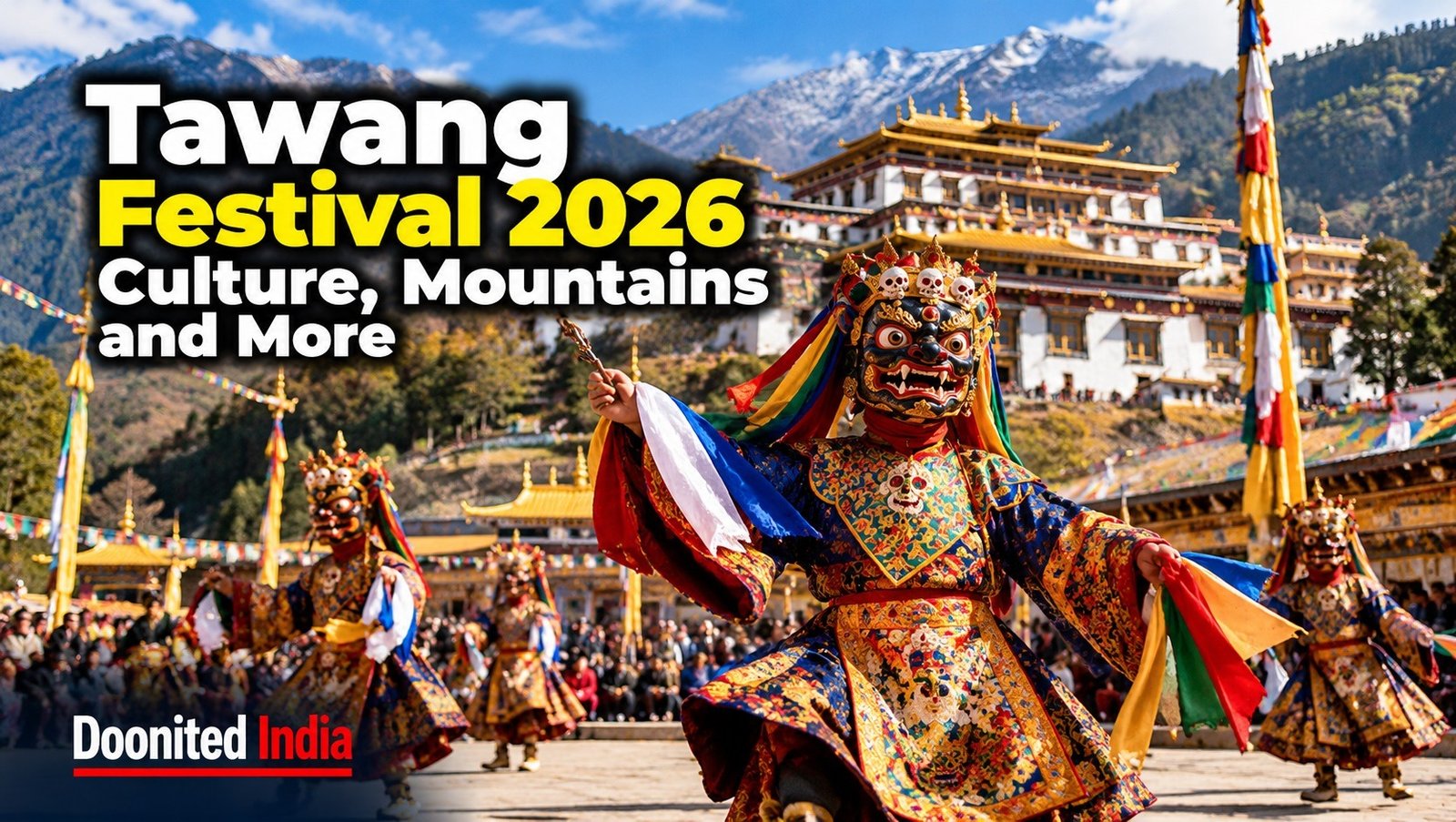
Against this setting, Tawang Festival 2026 is scheduled for October 27–31 in Tawang, Arunachal Pradesh. The official Incredible India calendar confirms the dates and identifies the event as a celebration of the cultural treasures of the region. The festival is organised by the Tourism Department of Arunachal Pradesh and showcases the traditions and customs of the Monpa people.
For visitors, it may look like a five-day cultural event.
For Tawang, it represents something deeper: an opportunity to present a living culture on its own terms.
The Monpa world
Tawang is widely associated with the Monpa community, one of the major ethnic communities of Arunachal Pradesh.
The Monpa cultural landscape is closely connected with Tibetan Buddhist traditions, monasteries, ritual practices, local crafts, music and mountain agriculture. Incredible India describes Tawang as the land of the Monpas and identifies its monastery as a major social, cultural and spiritual focal point.
That makes the festival more meaningful than a conventional tourism programme.
Traditional performances are not simply entertainment imported into the mountains for visitors. They emerge from a society in which religion, community and seasonal life have historically been interconnected.
The festival’s official description places particular emphasis on customs and traditions passed through generations, as well as the region’s connection with the land and the pre-harvest season.
The best way to understand the festival, therefore, is not to separate “culture” from “tourism”.
In Tawang, the two increasingly meet—but they should not become indistinguishable.
Tawang Monastery: the spiritual centre of the journey
Any visit built around Tawang’s culture inevitably leads to Tawang Monastery.
Perched at more than 10,000 feet, the monastery is one of India’s most important Buddhist institutions and is described by Incredible India as the largest monastery in India. It was founded in the late 17th century by Merak Lama Lodre Gyatso, following the wishes of the Fifth Dalai Lama.
The monastery’s physical scale is striking. Its complex includes a three-storey assembly structure, a long compound wall, residential buildings and a library containing important Buddhist scriptures.
But its importance is not architectural alone.
The monastery remains part of the spiritual and cultural life of the region.
That is why festival visitors should resist the temptation to treat it as merely another item on a sightseeing checklist.
A monastery is not a monument in the same sense as an abandoned palace. It is a living religious institution.
Visitors therefore need to approach it with the same respect they would show any active place of worship.
Sacred dance, music and living traditions
The Tawang Festival brings traditional performance into public view, including cultural presentations associated with Arunachal Pradesh and the Monpa heritage of the region.
Masked and monastic dances are particularly evocative because they combine movement, costume, music and religious symbolism. Similar traditions elsewhere in the Himalayan Buddhist world can easily be reduced to colourful spectacles for tourists.
That would miss the point.
The significance lies in the cultural meaning behind the performance.
In Tawang and surrounding monasteries, Buddhist ritual traditions remain part of community life. Incredible India’s material on Khinmey Monastery, for example, describes the preservation of Monpa language, traditions and cultural artefacts alongside its religious role.
The festival can therefore introduce outsiders to traditions they may never encounter otherwise.
But exposure should not become extraction.
A visitor’s photograph is not the same thing as understanding.
Food tells another story
Culture is often easiest to remember through food.
Tawang’s food traditions reflect its Himalayan environment and the ingredients available in a high-altitude region. Local markets and eateries provide visitors with an opportunity to experience dishes and ingredients that differ considerably from mainstream Indian cuisine.
The experience extends beyond the plate.
Food reveals climate, agriculture, preservation techniques, trade routes and household habits.
For an outside visitor, a regional dish may be an interesting meal.
For a community, it can be a record of how people have adapted to their environment.
That is why food deserves to be treated as part of the festival’s cultural story rather than simply another tourist attraction.
Craft that carries the mountains home
Tawang’s cultural economy also includes handicrafts and traditional textiles.
Incredible India highlights local handwoven tapestries and other craft products available through the region’s markets and craft centres. Its Tawang material specifically points visitors towards locally produced handicrafts that reflect centuries of tribal skill.
Craft creates an important bridge between tourism and livelihoods.
A visitor buying a locally made textile, woven item or traditional souvenir is potentially supporting a producer much closer to the source of the craft than a conventional mass-market purchase would.
But there is a larger challenge.
As tourism grows, handmade products can become vulnerable to imitation and mass-produced substitutes. The more successful Tawang becomes as a destination, the more important it becomes to distinguish authentic local craft from generic products carrying a Himalayan label.
For tourists, asking where something was made and who made it is not an unnecessary question.
It is part of responsible shopping.
The journey to Tawang is part of the experience
Tawang is not a destination that can be reached casually from the plains.
The journey itself is an important part of the experience.
The official tourism information points to road access from Tezpur or Guwahati, with the route climbing through the high-altitude Sela Pass, which rises to approximately 4,176 metres. Visitors also require an Inner Line Permit to enter Arunachal Pradesh.
That has practical consequences for anyone considering the October festival.
A high-altitude journey requires preparation.
Weather can change rapidly. Road conditions can affect travel times. Visitors should not plan the route as if Tawang were a conventional weekend destination accessible from a nearby metropolitan city.
The reward, however, is a journey through landscapes that progressively change as the road climbs into the Eastern Himalayas.
Sela Pass is not simply a transit point.
It is part of the geography that makes Tawang what it is.
Beyond the monastery: a landscape of memory
Tawang’s cultural significance also intersects with India’s modern history.
The Tawang War Memorial commemorates Indian soldiers who died during the 1962 Sino-Indian War. It sits within a region where geography and national security have long been closely connected.
The result is a destination where several forms of memory coexist.
There is religious memory in the monasteries.
Community memory in songs, food and craft.
Environmental memory in the landscape.
And national memory in the war memorial.
A thoughtful visitor can encounter all four within the same journey.
That is one reason Tawang resists being reduced to a scenic Himalayan holiday.
The tourism opportunity—and the warning
The Tawang Festival creates a valuable opportunity for the local economy.
Visitors need accommodation, transport, food and guides. They purchase local products and experience regional services. Cultural performers and producers gain visibility.
But tourism can also put pressure on precisely the culture that attracts visitors.
More vehicles mean greater pressure on mountain roads. More visitors can produce waste and strain local infrastructure. Popular cultural sites can become crowded. Demand for souvenirs can encourage cheap replicas.
The solution is not to keep visitors away.
It is to develop tourism carefully.
Tawang needs visitors who spend locally, respect religious spaces, avoid unnecessary waste and understand that the landscape is not an amusement park.
The festival’s success should therefore be measured not only by visitor numbers.
A more useful question is whether tourism strengthens the communities whose culture makes the destination distinctive.
Why Tawang matters beyond Arunachal Pradesh
For international readers, Tawang offers an important reminder that India’s cultural geography extends far beyond the better-known heritage circuits of Rajasthan, Delhi, Mumbai and Kerala.
The Eastern Himalayas contain their own histories, artistic traditions, religious institutions and indigenous communities.
Tawang also demonstrates how cultural identity can survive in a rapidly changing world without being frozen in time.
A tradition does not necessarily disappear because modern roads arrive.
Nor does it remain authentic simply because tourists photograph it.
Its survival depends on whether younger generations continue to practise it, whether communities retain meaningful ownership of their cultural knowledge and whether economic opportunities make that continuation possible.
That is the real challenge facing cultural tourism everywhere.
Five days—but a much longer story
The Tawang Festival will run for five days, but its significance cannot be contained within a festival calendar.
The event provides an introduction.
The monastery provides the historical depth.
The Monpa community provides the cultural context.
Food and craft provide everyday expressions of that culture.
And the mountains provide the setting that ties everything together.
For visitors arriving in late October, the most rewarding experience may therefore be to slow down.
Watch a performance without immediately reaching for the camera.
Enter a monastery respectfully.
Talk to a local craft seller.
Taste something unfamiliar.
Learn why a tradition exists rather than simply photographing what it looks like.
And allow the journey through the mountains to become part of the destination.
Tawang does not need to invent an exotic identity for visitors.
Its identity is already there.
The responsibility of tourism is to make sure that the world can experience it without consuming the very culture it came to see.


World Beyond the News
Octopuses Can Change Their Appearance
Octopuses can rapidly alter their skin colour and texture to communicate, camouflage themselves and respond to danger.
Some Cities Exist Across Two Continents
A small number of cities are geographically associated with two continents, creating unusual cultural and geographic identities.
Earth’s Climate Is Measured in Many Ways
Scientists track temperature, atmospheric gases, sea level, ice cover and other indicators rather than relying on a single climate number.
Streaming Changed How Audiences Discover Shows
Recommendation systems and global streaming releases allow audiences to discover programmes far beyond their original markets.