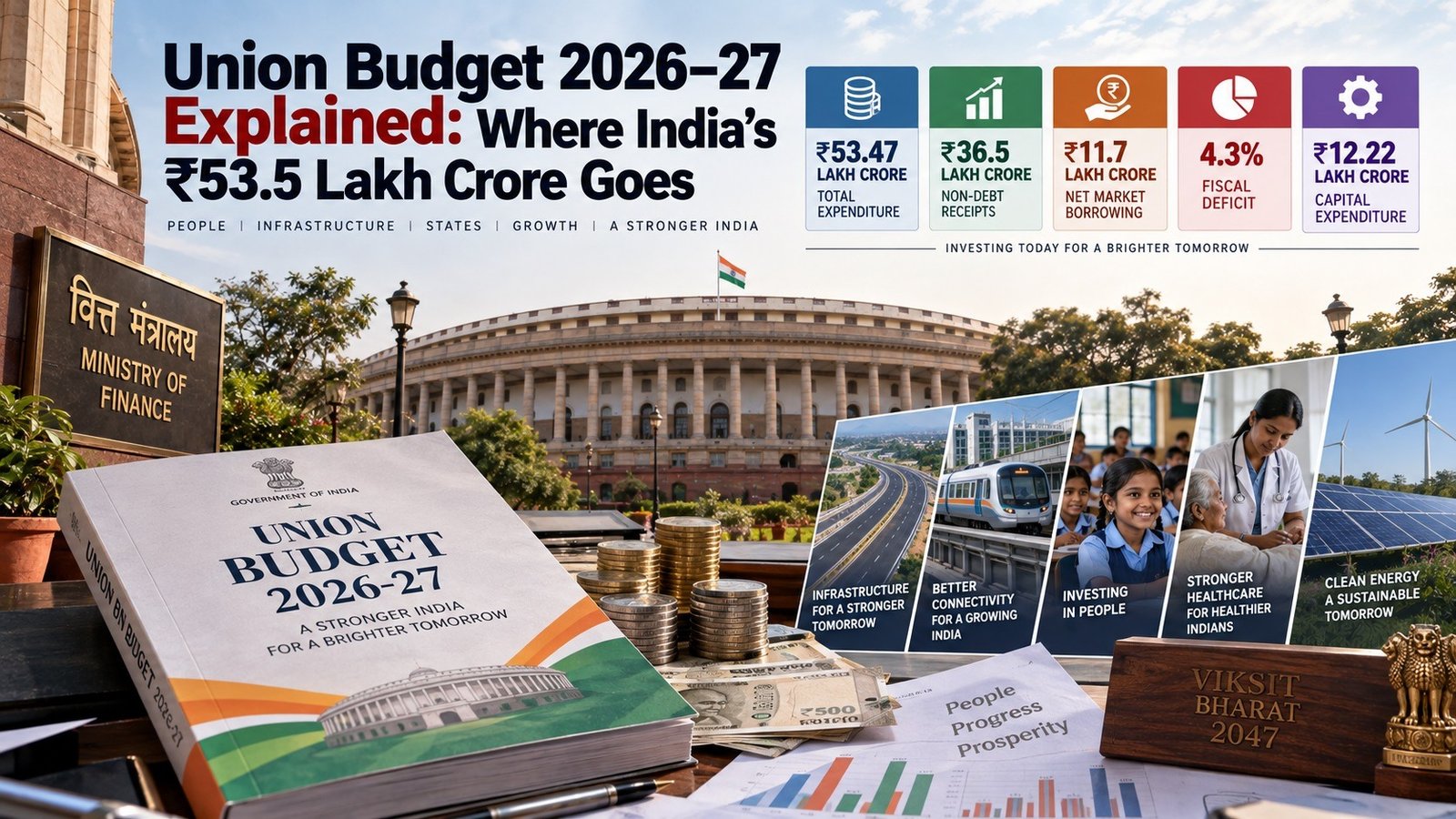
Follow the Money – Where India’s ₹53.5 Lakh Crore Actually Goes
Every year, the Union Budget arrives carrying numbers large enough to make a household calculator quietly give up.
₹53.47 lakh crore.
₹28.67 lakh crore.
₹12.22 lakh crore.
₹14.04 lakh crore.
For most Indians, these figures can feel like they belong to another planet.
They don’t.
The Union Budget is ultimately about a very familiar question:
Where does the government’s money come from — and where does it go?
The Union Budget 2026–27 estimates total expenditure at ₹53.47 lakh crore, against non-debt receipts of ₹36.5 lakh crore. The difference is financed through borrowing and other financing sources. The government’s net tax receipts are estimated at ₹28.67 lakh crore.
Understanding that chain makes the Budget much less mysterious.
Step One: Where Does the Money Come From?
The government has several sources of receipts.
The largest is taxation.
For 2026–27, gross tax revenue is estimated at ₹44.04 lakh crore. Direct taxes account for ₹26.97 lakh crore and indirect taxes ₹17.07 lakh crore. After the states’ share and other adjustments, the Centre’s net tax revenue is projected at approximately ₹28.67 lakh crore.
In simple terms, the government collects money through mechanisms that most Indians encounter regularly:
Income tax.
Corporate tax.
GST.
Customs duties.
Excise and other taxes.
There are also non-tax receipts — including dividends, interest receipts, fees and other government income.
The Budget estimates central government revenue receipts at ₹35.33 lakh crore, while non-debt capital receipts are estimated at ₹1.18 lakh crore.
And then comes the part every household understands particularly well:
When income is not enough to cover expenditure, you borrow.
The government does the same thing — on a considerably larger spreadsheet.
Step Two: The Borrowing Gap
The government’s total expenditure is estimated at ₹53.47 lakh crore.
Non-debt receipts are ₹36.5 lakh crore.
That leaves a substantial financing requirement.
The Budget estimates gross market borrowings of ₹17.2 lakh crore for 2026–27. Net market borrowing from dated government securities is estimated at ₹11.7 lakh crore, with the balance financing expected from small savings and other sources.
This is where the phrase fiscal deficit enters the conversation.
The fiscal deficit is estimated at 4.3% of GDP in 2026–27, compared with a revised estimate of 4.4% for 2025–26.
The deficit is not simply “government waste” and it is not automatically a sign of financial distress.
It represents the government’s borrowing requirement after accounting for its receipts, excluding debt capital receipts.
The important question is therefore:
What is the borrowed money being used for?
That brings us to the spending side.
Step Three: Not All Government Spending Is the Same
The government’s projected revenue expenditure is ₹41.25 lakh crore, while capital expenditure is ₹12.22 lakh crore.
The distinction matters.
Revenue expenditure broadly covers ongoing obligations — salaries, subsidies, pensions, interest payments and the operation of government programmes.
Capital expenditure creates or acquires assets and productive capacity.
A new railway line is different from paying interest on an old borrowing.
A bridge is different from a recurring administrative expense.
Both may be necessary.
But their economic effects can be very different.
₹12.22 Lakh Crore for Capital Expenditure
The government’s capital-expenditure allocation for 2026–27 is ₹12.22 lakh crore, equivalent to about 3.1% of GDP. This includes ₹2 lakh crore of capital support to states through Special Assistance as Loans for Capital Expenditure (SASCI).
But there is another figure worth understanding.
When grants for creation of capital assets are included, effective capital expenditure rises to about ₹17.15 lakh crore, or 4.4% of GDP.
This distinction is easy to miss.
The headline capex number is therefore not the entire picture of government-supported asset creation.
Roads, railways, urban infrastructure, energy systems and other capital projects can potentially improve productivity and connectivity over many years.
That is why capital expenditure has become such an important part of India’s fiscal strategy.
The Big Number That Nobody Celebrates: Interest Payments
There is another expenditure item that deserves much more attention.
Interest payments are estimated at ₹14.04 lakh crore in 2026–27.
That is larger than the entire capital-expenditure allocation.
It is also a reminder that borrowing today creates obligations tomorrow.
Government debt is not like a credit-card bill that suddenly arrives at the end of the month. It is a long-term financial commitment, with interest costs that have to be serviced.
The Budget’s medium-term fiscal strategy estimates central government debt at 55.6% of GDP in 2026–27, compared with 56.1% in the 2025–26 revised estimate. The government has stated a goal of moving central debt towards 50±1% of GDP by 2030.
This is why fiscal consolidation matters.
The government wants to continue spending on growth while gradually reducing the debt burden relative to the size of the economy.
It is a balancing act rather than a magic trick.
And Then the States Get Their Share
The Union Budget is not money that stays entirely with New Delhi.
The Sixteenth Finance Commission has recommended retaining the states’ share at 41% of the divisible pool of central taxes, and the government has accepted that recommendation. The Budget also provides ₹1.4 lakh crore in Finance Commission grants to states for FY2026–27, including grants for rural and urban local bodies and disaster management.
This matters because many services people encounter every day are delivered through state and local governments.
Schools.
Hospitals.
Roads.
Water systems.
Urban services.
Local infrastructure.
So the Budget’s money chain does not stop at the Union government’s accounts.
A significant portion moves through the federal system.
What About Defence, Health and Education?
The Budget also directs resources towards major national priorities.
Defence remains a major component of Union expenditure, while health and education receive substantial allocations through the relevant ministries and programmes.
But readers should be careful with simple “percentage of the Budget” charts circulating online.
Different Budget documents classify expenditure differently — by ministry, function, scheme, revenue/capital character, transfers and other accounting categories.
That means adding a few large-looking categories and calling them “the entire Budget” can produce misleading comparisons.
The official Budget at a Glance is therefore a better starting point for understanding the structure of expenditure.
The Budget Is Also About What India Wants to Build
The 2026–27 Budget places significant emphasis on manufacturing, infrastructure, energy security, MSMEs and emerging technologies.
Among the announced measures are India Semiconductor Mission 2.0, an increased allocation of ₹40,000 crore for the Electronics Components Manufacturing Scheme, a ₹10,000 crore SME Growth Fund and a ₹10,000 crore five-year programme for container manufacturing.
The government has also proposed Biopharma SHAKTI with an outlay of ₹10,000 crore over five years, alongside measures for textiles, rare-earth corridors, chemical parks, capital goods and industrial clusters.
This is where the Budget moves beyond accounting.
It becomes an economic strategy.
The question is whether these allocations eventually create productive capacity, jobs, exports, technology and higher incomes.
A budget announcement is an input.
The economic outcome comes later.
So What Does This Mean for an Ordinary Indian?
The Budget does not send ₹53.47 lakh crore directly into citizens’ bank accounts.
Its effects are more complicated.
You contribute through taxes.
The government collects revenue.
Some money is transferred to states.
Some pays for existing obligations.
Some services are funded.
Some money is invested in infrastructure.
Some is borrowed.
And the interest on earlier borrowing becomes a future expenditure.
That creates a giant national financial loop.
Citizen and business activity → taxes and other receipts → government expenditure → infrastructure/services/transfers → economic activity → future tax base.
When the system works well, public expenditure can help expand the economy that ultimately generates future revenue.
When expenditure produces weak outcomes, the fiscal burden can remain while the expected economic return fails to materialise.
That is why simply asking “How big is the Budget?” is not enough.
The DOONITED View
The most useful way to read Union Budget 2026–27 is not as a political speech or a giant collection of announcements.
Read it as a national balance-sheet story.
India expects to spend ₹53.47 lakh crore.
It expects ₹36.5 lakh crore in non-debt receipts.
It plans ₹12.22 lakh crore of capital expenditure.
It expects ₹14.04 lakh crore of interest payments.
And it estimates a fiscal deficit of 4.3% of GDP.
Those numbers tell a much richer story than a single “Budget allocation” headline.
The intelligent question is not merely:
“How much money has been announced?”
It is:
“What economic capacity will that money create, what obligations will it leave behind, and how effectively will the money travel from the Union government to the citizen?”
That is where Budget mathematics becomes economic reality.
The Learning Point
The next time you hear that the Union Budget is ₹53 lakh crore, don’t imagine one enormous government bank account.
Think of a chain.
Taxes and other receipts bring money in.
Borrowing fills the financing gap.
Revenue spending keeps the government functioning.
Capital spending builds assets.
Transfers move resources to states and other institutions.
Interest payments service earlier borrowing.
And ultimately, the entire system depends on India’s economy continuing to generate enough income, investment and productivity to sustain it.
The Budget is therefore not simply about where today’s money goes.
It is also about what kind of economic capacity India hopes that money will create for tomorrow.


World Beyond the News
Octopuses Can Change Their Appearance
Octopuses can rapidly alter their skin colour and texture to communicate, camouflage themselves and respond to danger.
Some Cities Exist Across Two Continents
A small number of cities are geographically associated with two continents, creating unusual cultural and geographic identities.
Earth’s Climate Is Measured in Many Ways
Scientists track temperature, atmospheric gases, sea level, ice cover and other indicators rather than relying on a single climate number.
Streaming Changed How Audiences Discover Shows
Recommendation systems and global streaming releases allow audiences to discover programmes far beyond their original markets.