Dr. Sanghamitra Machhua: Decoding Complex Immune Diseases and Building India’s Next Generation of Women Scientists
At PGIMER Chandigarh, the immunology researcher is investigating the molecular mechanisms behind complex immune disorders. Her selection for the India RISE Fellowship also highlights a wider question: how can India help more women scientists turn specialist research into sustained leadership and better patient care?
Some diseases announce themselves through obvious symptoms. Others present a more difficult puzzle: the immune system behaves abnormally, symptoms vary between patients, and the biological processes driving the condition remain only partly understood.
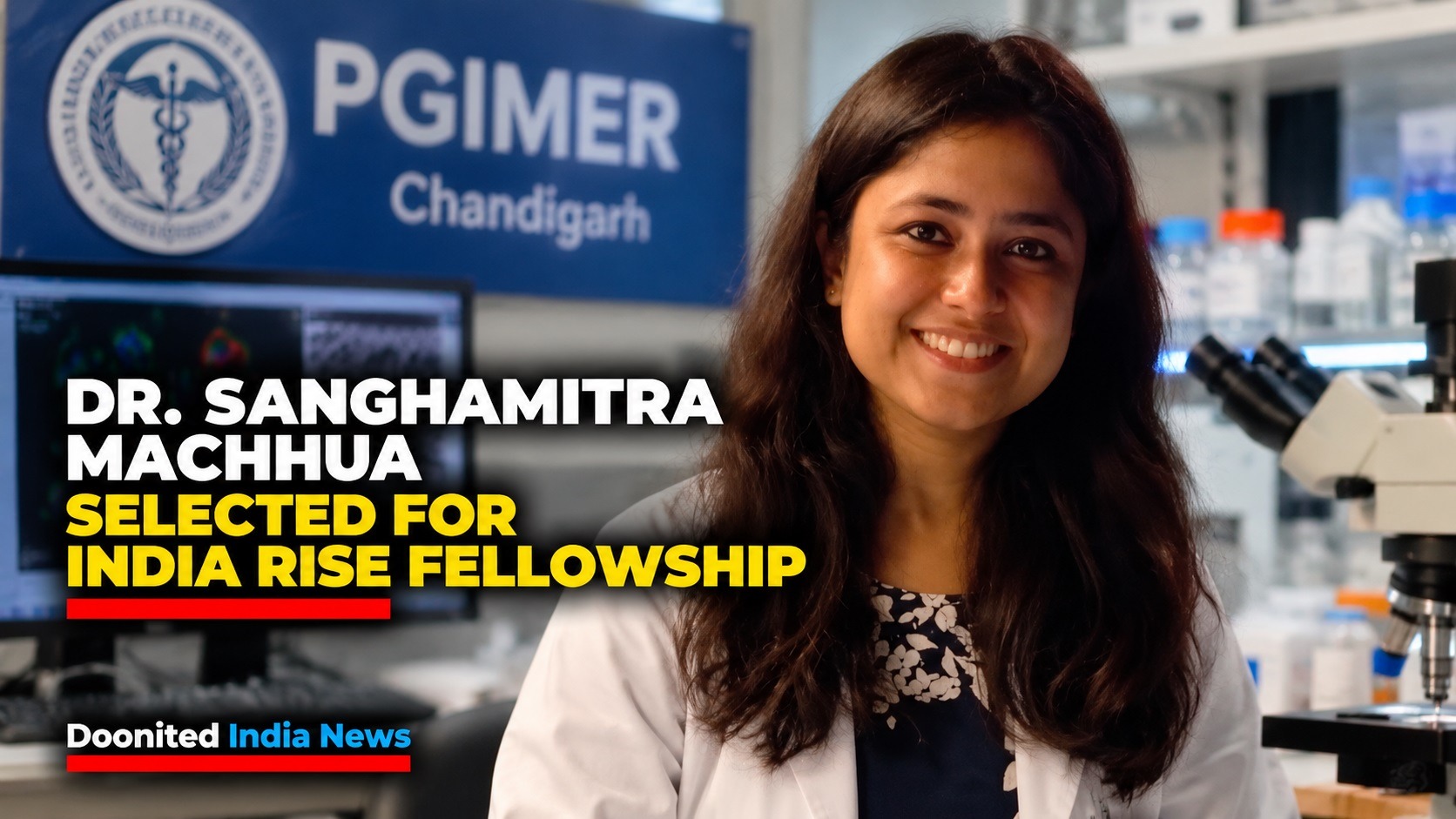
Solving such puzzles requires more than identifying a single gene or measuring one biological marker. Researchers may need to examine genetic variation, patterns of gene activity, immune responses and other molecular signals together. This is the kind of work pursued by Dr. Sanghamitra Machhua, a Young Scientist at the Postgraduate Institute of Medical Education and Research (PGIMER), Chandigarh.
Machhua’s research focuses on systemic sclerosis and primary immunodeficiencies, including hereditary angioedema. She uses multi-omics approaches—combining information from different layers of biology—to investigate the mechanisms underlying these conditions.
In 2026, she was selected for the inaugural India RISE Fellowship, a programme supporting early-career Indian women researchers in science, technology, engineering, mathematics and medicine (STEMM). The fellowship, led by the Gupta-Klinsky India Institute at Johns Hopkins University, combines research training, leadership development and mentorship while allowing participants to remain in their existing institutional roles.
Her story brings together two important themes: the scientific challenge of understanding complex immune diseases and the need to build stronger pathways for women to progress from research expertise into scientific leadership.
Investigating the immune system’s complex signals
Systemic sclerosis, also known as scleroderma, is an uncommon autoimmune disease that can affect the skin and internal organs. It involves changes in connective tissue, blood vessels and immune-system activity. Its clinical presentation and severity can differ considerably between patients, making accurate assessment and management challenging.
Primary immunodeficiencies are a different group of conditions. They arise from defects in the immune system, often linked to inherited genetic changes. Hereditary angioedema, for example, can cause recurrent episodes of swelling involving the skin, gastrointestinal tract or airway. Some attacks can become medical emergencies.
These disorders are not interchangeable, but both demonstrate why understanding the underlying biology matters. A clinical symptom alone may not explain the molecular process responsible for it, and patients with apparently similar presentations may have different biological profiles.
Machhua’s published work includes research on antinuclear antibody patterns and autoantibody profiles in systemic sclerosis patients at a North Indian tertiary-care centre. Other publications examine genetic and immunological questions relevant to systemic sclerosis and hereditary angioedema.
The value of this research lies in building a more detailed picture of disease mechanisms. Such knowledge can help researchers identify associations, refine diagnostic approaches and develop hypotheses for future studies. It does not, by itself, establish a new diagnostic test or prove that a particular treatment will work.
That distinction is essential when discussing translational research: the journey from a laboratory finding to a reliable improvement in patient care involves several stages of validation.
What multi-omics can reveal
The term multi-omics describes the integration of different kinds of biological data. Each layer offers a different perspective on how cells and biological systems function.
Genomics examines DNA, including genetic variants that may influence susceptibility to disease.
Transcriptomics studies RNA molecules and helps researchers understand which genes are active and how their activity changes.
Epigenetics investigates molecular mechanisms that influence gene activity without changing the underlying DNA sequence.
Immunological profiling can examine antibodies and other features of immune responses.
Combining these data types may help scientists move beyond isolated observations. A genetic variant, for example, might be more informative when examined alongside gene-expression patterns, immune markers and clinical features.
But more data do not automatically produce better answers. Multi-omics studies can be technically demanding, and researchers must account for differences in patient populations, sample sizes, laboratory methods and statistical uncertainty. An association observed in one patient cohort may not apply equally to other populations.
For India, research involving local patient cohorts can contribute evidence about disease patterns in the populations being studied. Wider application, however, requires replication and validation across additional groups and clinical settings.
The long-term ambition is to improve the connection between biological discovery and clinical decision-making. Machhua’s research contributes to that scientific process; claims about specific clinical benefits must remain proportionate to the evidence available.
Why the India RISE Fellowship matters
Scientific expertise is only one part of a research career. Researchers who want to lead programmes must also learn to design projects, secure funding, manage teams, communicate findings and build collaborations.
These responsibilities can become particularly demanding during the years after a doctorate, when early-career scientists are expected to establish an independent research direction while continuing to publish and compete for limited resources.
The India RISE Fellowship was designed to support women at this stage. Its 2026 inaugural cohort includes 41 women scientists from 16 states and union territories, representing 30 research and academic institutions.
The 12-month programme includes structured research training, leadership development, personalised mentorship and individual development plans. Participants can remain in their existing institutional roles rather than leaving their research positions to take part.
The programme also offers access to a network of professional resources and the opportunity to compete for a US$50,000 research grant challenge. This is a competitive opportunity, not a guaranteed award for every fellow.
For a researcher working in a specialised area such as immunology, structured mentorship and wider professional networks can be valuable complements to laboratory experience. They may help researchers sharpen proposals, identify collaborators and develop the skills required to lead future projects.
The fellowship does not replace institutional funding, laboratory infrastructure or long-term career opportunities. Its significance lies in addressing some of the professional and leadership barriers that can limit researchers even when their scientific training is strong.
The gap between studying science and leading it
India has made substantial progress in women’s participation in STEM education. According to the All India Survey on Higher Education for 2021–22, women accounted for 43% of enrolment in STEM disciplines at the higher-education level.
However, the Department of Science and Technology’s Research and Development Statistics Report 2023 recorded women as 18.6% of the workforce engaged as STEM professionals in R&D activities. The figures refer to different populations and years, but together they illustrate an important imbalance: representation in education does not automatically translate into equivalent participation in research careers.
The gap becomes especially important when considering career progression. Scientific leadership requires access to resources, opportunities to establish independent research programmes, recognition for contributions and the ability to sustain research through changing personal and professional circumstances.
Women scientists may also encounter practical barriers involving care responsibilities, access to mentorship and the demands of building a research record while competing for grants and permanent positions. These challenges differ between institutions and individuals, so they should not be treated as a single universal experience.
The policy question is whether support programmes can help address these barriers—and whether institutions provide the conditions needed for researchers to remain and advance.
Fellowships can create useful networks and strengthen leadership skills. Their broader impact depends on what follows: access to research funding, fair recruitment and promotion, supportive workplaces, adequate facilities and opportunities to lead independent work.
From recognition to measurable scientific progress
Machhua’s selection for India RISE provides recognition of her research trajectory, but the more meaningful test will be what she and other fellows are able to accomplish over time.
For scientific research, useful indicators include stronger research proposals, productive collaborations, high-quality publications, validated findings and the development of independent research programmes. Where appropriate, progress may eventually include improved diagnostic methods or evidence that informs patient management.
For the fellowship itself, the longer-term questions are whether participants remain active in research, advance into leadership positions and secure resources to pursue their work. Such outcomes require evaluation beyond the announcement of a cohort or the completion of a training programme.
There is also a wider lesson for research institutions. Supporting talented scientists should not be reduced to awarding recognition or providing short-term training. Researchers need an environment in which they can continue asking difficult questions, build teams and translate promising findings into the next stage of scientific investigation.
That is especially relevant in biomedical research, where progress is often incremental and the distance between an initial discovery and a clinical application can be considerable.
Why this story matters beyond one researcher
India’s health-research capacity depends not only on sophisticated equipment or large institutions, but also on the people who can frame meaningful questions, interpret complex evidence and sustain investigations over many years.
Researchers such as Machhua work in areas where better understanding of disease biology could contribute to future advances in diagnosis and care. Their work also illustrates the importance of building scientific careers that allow expertise to mature into independent leadership.
The international dimension matters too. Biomedical research increasingly depends on collaboration across institutions, disciplines and countries. Programmes connecting Indian researchers with international expertise can broaden professional networks, although scientific value ultimately rests on rigorous methods and reproducible findings.
Machhua’s profile therefore represents two connected ambitions: advancing research into complex immune disorders and strengthening the opportunities available to women scientists in India.
The real measure of success will not be the fellowship title alone. It will be whether researchers receive the time, resources and institutional support to turn scientific questions into reliable evidence—and, where the evidence allows, into better outcomes for patients.


World Beyond the News
Why Elephants Stay Close to Their Herd
Elephants live in highly social family groups and use calls, touch and body movements to maintain strong bonds.
Most of the Deep Ocean Remains Difficult to Explore
Extreme pressure, darkness and distance make deep-ocean exploration one of Earth’s greatest scientific challenges.
Spacecraft Can Travel Without Traditional Roads
Spacecraft use carefully calculated trajectories and gravity assists to travel enormous distances through space.
Why Movie Trailers Are Released in Stages
Major films often use teaser trailers, full trailers and final promotional spots to build awareness over time.