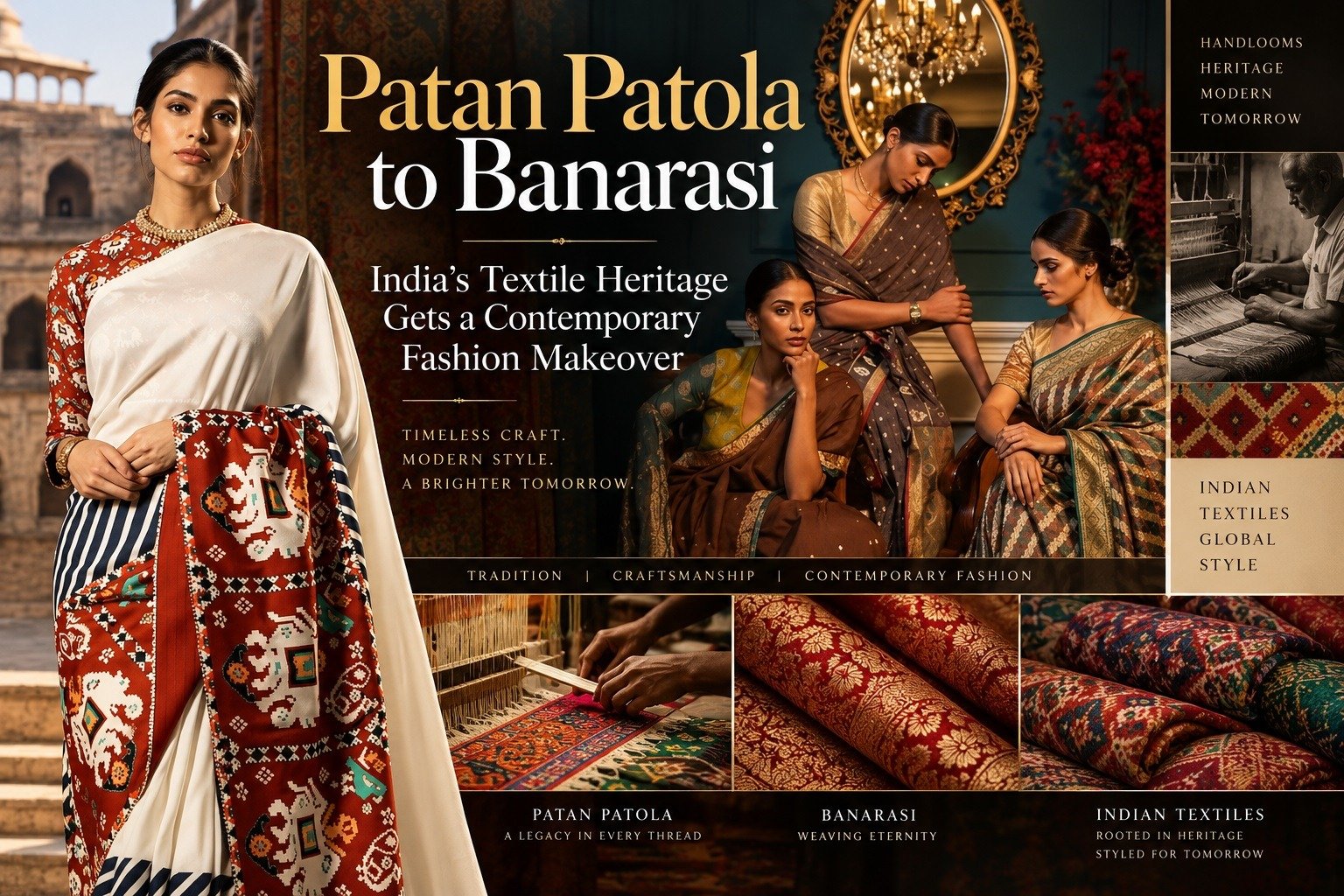
Patan Patola to Banarasi: India’s Textile Heritage Gets a Contemporary Fashion Makeover
India’s traditional textiles have survived wars, changing fashions, industrialisation and, occasionally, the rather dangerous human habit of deciding that something is “old-fashioned.”
Now some of India’s most celebrated weaves are getting a very different treatment.
Patan Patola, Bandhani, Banarasi brocade, Kanchipuram silk, Pochampally ikat and Kalamkari are being brought into a contemporary fashion vocabulary through a new collaboration between designer Mayyur Girotra and Swadesh, the craft initiative under Reliance Foundation.
Reported by Vogue India on September 17, the collaboration takes heritage textiles out of their conventional settings and reshapes them into modern garments, including ankle-length coats and kimono-style jackets.
It is an interesting experiment because the challenge with heritage textiles is not merely preserving them.
It is keeping them relevant without reducing them to decoration.
When the textile becomes the starting point
The collection does not treat India’s textiles as a single category.
That matters.
A Patan Patola is not simply another colourful fabric. Bandhani has its own resist-dyeing vocabulary. Banarasi brocade carries a long weaving tradition from Varanasi. Pochampally is associated with ikat, while Kanchipuram is known for its silk weaving tradition.
Girotra brings several of these traditions into the same design conversation.
According to Vogue India, the collection places Kanchipuram silk alongside Pochampally weave, Banarasi brocade alongside Bandhani and introduces ikat into an unusual basket-mesh construction. Even the inner details receive attention, with shibori-dyed linings appearing beneath silk layers.
In other words, the craft is not being used merely as a colourful surface.
The construction itself becomes part of the story.
From sari cupboard to modern wardrobe
This may be the most commercially significant part of the exercise.
Traditional textiles are often strongly associated with particular garments.
Banarasi becomes a sari.
Patola becomes a sari or dupatta.
Bandhani becomes festive Indianwear.
That association is culturally understandable, but it can also restrict the market for the textile.
Girotra’s approach attempts to break that pattern.
Ankle-length coats, kimono-inspired sleeves, jackets and contemporary silhouettes give heritage fabrics a different context.
Suddenly, the question is no longer:
“When would I wear this traditional textile?”
It becomes:
“How can this textile become part of a modern wardrobe?”
That is a considerably more useful question for craft preservation.
The difficult business behind the beautiful fabric
Fashion photography has a convenient habit of hiding the complicated part.
We see the finished jacket.
We rarely see the loom.
We see the pattern.
We don’t see the hours required to make it.
We admire the sari.
We don’t necessarily meet the person who wove it.
Girotra has been unusually direct about this issue. In his conversation with Vogue India, he describes artisans as artists rather than anonymous suppliers and speaks about the economic pressures that have made younger generations reluctant to continue traditional crafts. He says fair payment and transparency with the artisans were important elements of the Swadesh collaboration.
That is where the fashion story becomes a livelihood story.
A textile tradition cannot survive indefinitely as a museum object if the people capable of producing it cannot make a viable living from the craft.
Swadesh’s role is therefore important
The collaboration also fits into Swadesh’s broader effort around India’s artisan communities.
The project gives designers access to craft clusters while creating opportunities to translate traditional skills into contemporary products.
Girotra says that during visits to Swadesh’s clusters, including Varanasi, he saw investments such as additional looms being provided to artisans. He also worked with clusters connected with textiles including Banarasi, Kanchipuram, Bandhani, Pochampally and Patan Patola.
That creates an important bridge:
artisan → designer → contemporary product → consumer.
The bridge is not automatically successful.
But without such connections, traditional skills can remain trapped between heritage promotion and declining commercial demand.
Why Patan Patola matters
Among the textiles highlighted in this collaboration, Patan Patola is particularly striking.
Patola is associated with Gujarat’s Patan region and is traditionally made using the demanding double-ikat technique, in which both warp and weft threads are resist-dyed before weaving so that the pattern emerges through their precise alignment.
Historical Patola textiles have travelled far beyond India. Wikimedia Commons records examples made in Patan for markets including Indonesia, demonstrating that Indian textiles have long participated in international cultural and commercial exchange.
That history makes the contemporary fashion experiment especially interesting.
Taking Patola into modern fashion is not necessarily a departure from its history.
In some ways, it continues it.
Patola has already crossed borders.
The new question is whether it can cross wardrobe categories as successfully.
Banarasi gets another life
Banarasi brocade presents a similar opportunity.
Its association with weddings and ceremonial dressing gives it enormous cultural recognition, but also risks narrowing how consumers imagine it.
A contemporary jacket or coat can alter that perception.
The textile does not become less Banarasi because it is used differently.
The surrounding design language changes.
This is precisely where contemporary designers can become useful to traditional craft: not by replacing the technique, but by finding new reasons for people to want it.
And, ultimately, people tend to preserve what they continue to value.
The craft-versus-fashion dilemma
There is, however, an uncomfortable question.
Whenever traditional crafts enter luxury fashion, who receives the greatest economic benefit?
The designer?
The luxury retailer?
The brand?
Or the artisan?
A beautiful campaign cannot answer that question.
Transparent sourcing, fair remuneration, long-term orders, skills transmission and meaningful artisan participation matter far more.
Girotra’s stated emphasis on fair payment and direct communication with the craftspeople is therefore encouraging, but the larger test will always be what happens beyond one collection.
If demand grows but artisans remain economically vulnerable, preservation becomes little more than branding.
If demand creates sustainable livelihoods, however, fashion can become an important part of the preservation ecosystem.
That distinction deserves more attention than the usual “heritage meets modernity” headline.
India’s textile story is becoming a global opportunity
The timing is also significant.
Earlier this month, the Bharat Tex Trade Federation and Première Vision signed a multi-year agreement intended to strengthen India’s participation in the international textile and fashion ecosystem, with a particular emphasis on premium fashion and global opportunities for Indian textiles.
The Girotra-Swadesh collaboration is not the same initiative, but it sits within the same larger movement: India’s textile heritage increasingly being positioned not merely as cultural inheritance, but as part of contemporary design and international fashion.
That is potentially valuable for India.
But the opportunity should not be measured only in exports or luxury prices.
It should also be measured in whether a young person in a weaving community sees a future in learning the family craft.
That is the real economic test.
DOONITED Editorial Perspective: Heritage cannot survive on nostalgia
There is a comforting phrase frequently used around Indian handicrafts:
“We must preserve our heritage.”
Of course.
But heritage cannot survive simply because we admire it.
A craft survives when somebody learns it, somebody commissions it, somebody buys it and somebody can earn enough from it to teach the next generation.
That is why contemporary reinterpretation matters.
A Patola sari displayed behind glass is valuable as history.
A Patola textile that becomes a desirable contemporary garment can become living history.
The difference is substantial.
At the same time, the fashion industry should resist turning every traditional technique into a luxury marketing story while leaving the artisan invisible. The people who understand the loom, dye, motif and technique should be recognised as creators, not merely as the production department.
Girotra’s statement that his “school” was sitting with weavers is particularly revealing.
Perhaps Indian fashion’s next big lesson is not that designers need more inspiration.
It is that they need to spend more time listening to the people who have been making the inspiration for centuries.
The bigger takeaway
The Mayyur Girotra-Swadesh collaboration is ultimately about more than coats, jackets or beautiful textiles.
It asks whether India’s traditional crafts can participate in contemporary life without losing their identity.
Patan Patola does not need to stop being Patola to become modern.
Banarasi does not need to stop being Banarasi to enter a new wardrobe.
Bandhani does not need to abandon its technique to speak to a younger consumer.
The real innovation may simply be finding new contexts for old knowledge.
And there is a lesson here for India’s broader creative economy.
India possesses extraordinary cultural assets, but cultural inheritance alone does not create sustainable industries. The bridge between heritage and the future has to be built through design, fair economics, market access and respect for the people who carry the knowledge.
Fashion can help build that bridge.
But the loom still has to be running at the other end.
DOONITED Reader Insight
The next time you see a Patola, Banarasi or Bandhani garment, look beyond the finished product. Ask where the textile came from, who made it, how long it took and whether the people behind it are benefiting from its growing popularity.
The strongest form of heritage preservation is not keeping tradition frozen. It is giving tradition a future.

World Beyond the News
Bees Communicate Where Food Is
Honeybees use movement patterns known as waggle dances to communicate information about food locations.
Street Food Reflects Local History
Many famous street foods developed from migration, trade, local ingredients and the everyday needs of working communities.
A Day on Venus Is Extremely Long
Venus rotates so slowly that one rotation relative to distant stars takes longer than its trip around the Sun.
Human Achievement Continues to Push Limits
Athletes, engineers, scientists and explorers regularly establish new benchmarks in speed, endurance, scale and precision.