80 Lakh HPV Vaccinations: Why India’s Cervical Cancer Prevention Story Starts Before Adulthood
It begins much earlier — with an adolescent girl receiving a vaccine. India’s most important cancer-prevention story this year may not begin in a cancer hospital
More than 80 lakh doses of the Human Papillomavirus (HPV) vaccine have now been administered under India’s National HPV Vaccination Campaign, according to the Union Ministry of Health and Family Welfare. The milestone was announced on 11 September 2026, roughly six months after the nationwide campaign began.
The programme is aimed at preventing HPV infection and, ultimately, reducing India’s substantial cervical-cancer burden.
It represents something bigger than a vaccination number.
It is an example of healthcare moving from treating disease after it appears to preventing a major cancer risk years before it can become a clinical problem.
Why Vaccinate at 14?
The question naturally arises: why vaccinate children against a virus associated with a disease that generally develops much later?
The answer is timing.
HPV vaccines work best when administered before exposure to HPV. WHO identifies girls aged 9–14 years as the primary target group for HPV vaccination, before sexual activity begins. WHO recommends either a one- or two-dose schedule for this age group, depending on the programme and vaccine circumstances.
India’s national programme has chosen a specific age-based strategy.
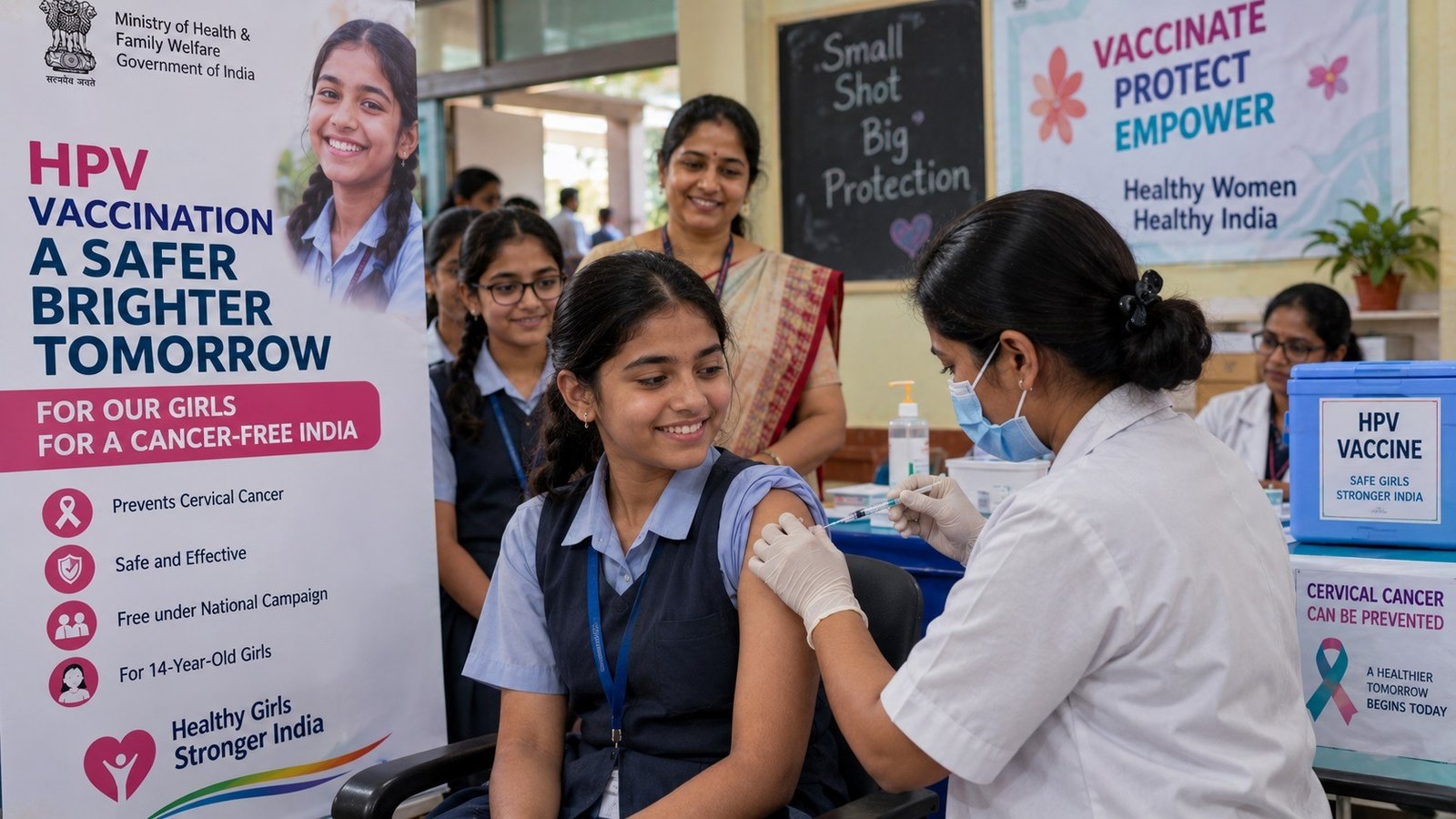
Girls aged 14 are eligible for the free campaign, with those turning 15 within 90 days of its launch also covered during the initial intensive phase. The programme is voluntary and requires parental consent.
This is therefore not about treating an existing disease.
It is about creating protection before the risk becomes relevant.
That is preventive medicine at its most straightforward.
The Virus Behind the Cancer
HPV is not one single virus but a group of related viruses.
Most HPV infections do not become cancer.
However, persistent infection with high-risk HPV types is responsible for almost all cervical cancers. WHO says more than 95% of cervical cancers are caused by HPV.
Certain HPV types are particularly important.
India’s national programme is using Gardasil-4, a quadrivalent vaccine that protects against HPV types 6, 11, 16 and 18. Types 16 and 18 are among the high-risk types responsible for a large proportion of cervical cancers.
The vaccine is therefore not a general “cancer vaccine”.
It is a vaccine against HPV types that can cause HPV-related disease, including cervical cancer.
That distinction matters because good health communication should explain what a vaccine does — and what it does not do.
India’s Cervical Cancer Burden Makes Prevention Particularly Important
According to the government’s February 2026 backgrounder, India recorded more than 120,000 new cervical-cancer cases and nearly 80,000 deaths annually, based on GLOBOCAN 2022 data cited by the government. Cervical cancer is the second most common cancer among women in India in that dataset.
These figures put the vaccination programme into perspective.
Cancer prevention is often discussed as though it begins with sophisticated hospitals, PET scans and advanced oncology treatment.
But the most efficient intervention can happen much earlier.
If an infection that can contribute to cancer can be prevented in the first place, the health system does not have to wait decades and then spend enormous resources treating its consequences.
The best cancer treatment, in some cases, is the cancer that never develops.
80 Lakh Is a Coverage Story — Not the Finish Line
The 80-lakh figure is impressive, but it needs to be interpreted correctly.
The government’s initial campaign target was approximately 1.15 crore girls aged 14, so 80 lakh doses represent substantial progress but not complete national coverage of the originally identified cohort. The Health Ministry said the focus was on reaching the remaining eligible beneficiaries as the campaign moved towards its final phase.
The geographical distribution also provides an interesting picture.
The Ministry reported that Gujarat, Uttar Pradesh, Madhya Pradesh and Mizoram had reached 100% coverage of their identified targets. Bihar, Andhra Pradesh and Assam had crossed 90%, while Karnataka had crossed 85%. Uttar Pradesh had administered more than 22 lakh vaccinations, the highest absolute number among states.
This highlights a basic truth about public-health campaigns:
A national programme is only as strong as its last mile.
The vaccine has to reach the eligible girl.
Her family has to understand it.
The health facility has to have supply.
The session has to be properly managed.
And the information has to travel far enough to overcome hesitation or simple lack of awareness.
The Government Health System Is Doing the Delivery
One important feature of the programme is that vaccination is being delivered through the public-health network.
The government says eligible girls can receive the vaccine at facilities including Ayushman Arogya Mandirs, primary health centres, community health centres, sub-district and district hospitals and government medical colleges.
The campaign also uses the U-WIN digital platform for registration and vaccination records, while vaccine stocks and logistics are monitored through eVIN. The government says vaccination sessions are conducted under medical supervision, with arrangements for managing adverse events following immunisation.
This is significant because a preventive programme cannot become a premium service available only to families who can afford private vaccination.
The public system has to carry it.
One Dose Does Not Mean “No More Prevention”
There is an important misconception worth avoiding.
The current Indian campaign uses a single-dose Gardasil-4 schedule.
WHO’s guidance allows a one-dose schedule for the primary 9–14 age group, while also recognising two-dose schedules depending on circumstances. Immunocompromised individuals require different recommendations.
But vaccination is only one part of cervical-cancer prevention.
Screening still matters.
WHO recommends cervical screening because HPV vaccination does not eliminate every cancer-causing HPV type. Screening can identify precancerous changes that can be treated before they progress to cancer.
So the long-term prevention equation is not:
Vaccine = no cancer risk.
It is closer to:
Vaccination + appropriate screening + timely treatment = stronger cervical-cancer prevention.
That distinction will become increasingly important as today’s vaccinated adolescents become tomorrow’s adult women.
The Global Context
India’s programme also places the country within a much wider global effort.
WHO’s cervical-cancer elimination strategy calls for vaccination, screening and treatment to work together. Its 90–70–90 framework aims for high vaccination coverage among girls, high-performance screening among women and appropriate treatment for women identified with disease or precancer.
The Indian government says the country has now joined more than 160 countries that have introduced HPV vaccination into national immunisation schedules.
That makes India’s scale particularly important.
India is home to a very large population of adolescent girls.
Even modest improvements in vaccination coverage can therefore translate into enormous absolute numbers of women protected against HPV-related disease over the coming decades.
The Social Challenge Is Almost as Important as the Medical One
HPV can be an uncomfortable subject because it is sexually transmitted.
That can create stigma around a vaccine that is fundamentally about cancer prevention.
For parents, the conversation should therefore be framed accurately.
Giving an adolescent an HPV vaccine is not a statement about her behaviour.
It is a preventive-health decision made years before a potential disease.
That is precisely why vaccination is recommended at a young age.
Public-health programmes work best when families receive clear information rather than fear, shame or misinformation.
The DOONITED View
The most interesting aspect of India’s 80-lakh milestone is not the number itself.
It is the change in the timing of healthcare.
For generations, much of the health system has been organised around the patient who already has a problem.
Vaccination reverses that logic.
There is no tumour to treat.
No symptom to diagnose.
No hospital admission.
The intervention happens when the person is healthy.
That is why prevention can be so powerful — and also so difficult to appreciate.
Nobody celebrates the disease that didn’t happen.
There is no photograph of a woman who never developed cervical cancer because she was vaccinated as a teenager.
Yet that invisible outcome is precisely the point.
The Learning Point
India’s HPV campaign offers a simple lesson in modern public health:
The earlier a preventable disease risk can be addressed, the less healthcare has to depend on expensive treatment later.
The 80-lakh milestone is therefore a significant step, but the larger objective is much more ambitious.
Every eligible girl reached.
Every family given accurate information.
Every vaccine safely administered.
Every woman eventually receiving appropriate cervical screening.
And every cancer prevented before it becomes a diagnosis.
That is what turns a vaccination campaign from a number on a government dashboard into a long-term public-health investment.
The most successful cancer-prevention programme may ultimately be the one whose success is measured in patients who never become patients.


World Beyond the News
Dolphins Use Individual Signature Whistles
Bottlenose dolphins develop distinctive whistles that function somewhat like individual acoustic identifiers.
The Pacific Is Earth’s Largest Ocean
The Pacific Ocean covers more area than any other ocean basin and stretches between Asia, Australia and the Americas.
Artificial Intelligence Learns Statistical Patterns
Modern machine-learning systems identify patterns in large datasets and use those patterns to generate predictions or outputs.
Why Some Stories Spread So Quickly
Emotion, novelty, visual appeal and easy sharing can make a story travel rapidly across social platforms.