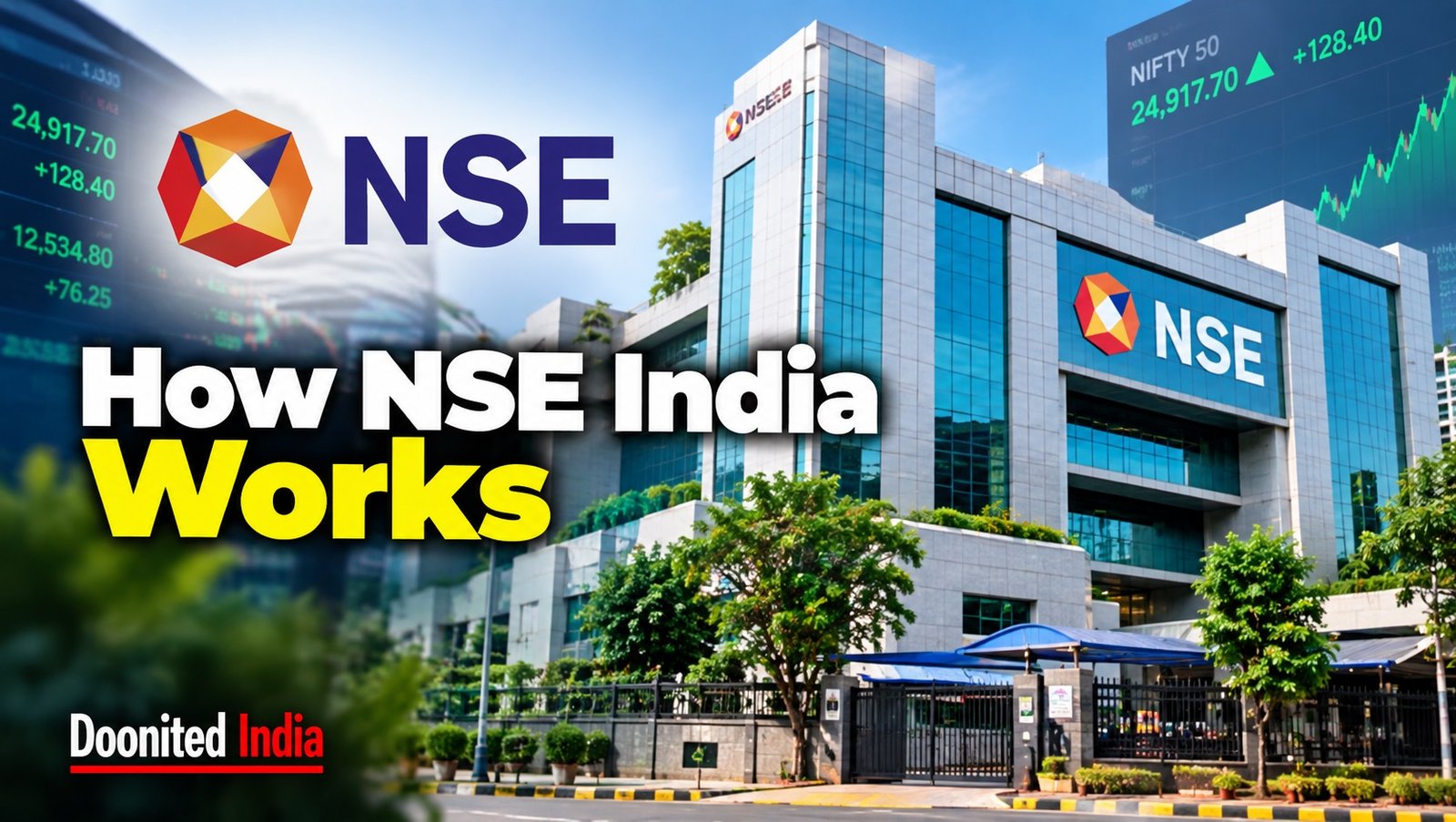
NSE India: How the National Stock Exchange Powers India’s Financial Markets
India’s stock market is often experienced through a broker’s app: a price flashes, an order is placed, and a portfolio changes. Behind that seemingly simple transaction sits a complex financial infrastructure connecting investors, companies, brokers, clearing institutions and regulators.
The National Stock Exchange of India (NSE) is a central part of that infrastructure. It introduced electronic, screen-based trading in India when it began operations in 1994, helping move securities trading towards a nationwide, technology-driven system. Today, its activities extend beyond matching buy and sell orders to include listings, market data, indices, technology services and investor education.
From trading floors to a nationwide electronic market
NSE was incorporated in 1992, received recognition as a stock exchange in April 1993, and began operations in 1994. Its equity market commenced trading on 3 November 1994. The exchange’s screen-based model enabled market participants across locations to access an electronic trading system rather than relying on a traditional physical trading floor.
That shift was significant for a geographically large country. Electronic access made it possible to connect participants through a common market system, while automated order matching helped bring greater consistency to the trading process.
Technology alone, however, does not make a market fair or risk-free. Market integrity also depends on rules, surveillance, reliable infrastructure, disclosures and regulatory oversight. The exchange operates within India’s securities-market framework, with the Securities and Exchange Board of India (SEBI) serving as the market regulator.
How the NSE’s trading system works
At its core, an exchange provides a marketplace where eligible buyers and sellers can submit orders. In an electronic order book, orders are matched according to the exchange’s rules, including price and time priority where applicable.
This process supports price discovery: the market price reflects the interaction of available buy and sell orders. A share’s price is not set by the exchange simply because a company is listed. It changes as participants respond to company information, economic conditions, expectations and the supply and demand for the security.
NSE operates markets across multiple segments, including equities and derivatives, alongside other products and services. The exact instruments available, trading hours, eligibility rules and risk controls depend on the relevant segment and exchange regulations.
For retail investors, the broker’s app is the visible interface. The exchange’s trading infrastructure is the system through which eligible orders reach the market.
Clearing and settlement: what happens after a trade?
A trade is not complete simply because a broker’s screen displays “executed”. The market must also determine what each participant owes and ensure that the relevant funds and securities are transferred.
NSE Clearing Limited, a wholly owned subsidiary of NSE, performs clearing and settlement functions for trades executed on the exchange. It calculates obligations, manages collateral and risk processes, and coordinates the movement of funds and securities through the market’s settlement infrastructure.
For the normal equity market, NSE Clearing follows a T+1 rolling settlement cycle: trades executed on a trading day are generally settled on the next working day. Weekends and applicable holidays affect the calendar.
An optional T+0 settlement mechanism has also been introduced for eligible securities and participating market members. Under this arrangement, settlement can occur on the same day, subject to the applicable rules and cut-off times. It is not a blanket replacement for T+1 across all securities and investors.
Faster settlement can reduce the time between a transaction and the transfer of funds or securities. It also requires careful coordination among exchanges, clearing corporations, brokers, banks and depositories. The operational details matter: settlement speed is meaningful only when the supporting systems and processes work reliably.
NIFTY 50: a market barometer, not the whole market
One of NSE’s most widely recognised contributions is the NIFTY 50, launched in April 1996. It tracks 50 large and liquid companies across sectors and is used as a benchmark for parts of the Indian equity market. The index is owned and maintained by NSE Indices, a group company.
The NIFTY 50 is useful because it provides a single reference point for observing the performance of a selected group of major listed companies. It is also used as the basis for financial products and as a benchmark against which investment performance may be assessed.
But the index is not a complete picture of every listed company or every investor’s portfolio. A rise in the NIFTY 50 does not mean that every stock is rising. Sector weights and the performance of larger constituents can influence the index substantially.
For readers following the market, the lesson is simple: an index is a measuring instrument. Like any measurement, it tells us something specific—not everything.
Helping companies raise capital
Stock exchanges also connect businesses seeking capital with investors willing to provide it. Companies can list securities and, subject to applicable rules and approvals, raise funds from the public through market offerings.
NSE’s role extends to listing-related services and platforms, including its SME-focused NSE Emerge platform. Its annual milestones report records the growth of this segment and the wider listing ecosystem.
A listing is not a certification that a company will succeed. Investors still need to examine the company’s disclosures, financial position, governance and the risks described in its offer documents.
Market access comes with responsibilities
Electronic trading has made market participation more accessible, but access should not be confused with guaranteed liquidity or protection from loss.
A stock may have limited trading activity. An order may execute at a different price than expected, particularly in a fast-moving market. Derivatives can involve leverage and complex risks. And even a liquid, widely followed security can fall sharply when expectations change.
NSE provides the marketplace and its operating framework; investors make the decisions about what to buy, sell or hold. Brokers provide access to the exchange, while clearing and settlement systems support the completion of trades. These are connected but distinct responsibilities.
Investors should also use official exchange and SEBI resources to check market notices, trading rules, disclosures and warnings about unauthorised platforms. A familiar logo or a professional-looking app is not, by itself, proof that a service is authorised.
DOONITED View: the market’s most important product is trust
The NSE’s evolution reflects a broader transformation in India’s financial system: markets have become increasingly electronic, interconnected and accessible. Trading infrastructure, clearing systems and market data may not be as visible as a rising share price, but they are essential to the functioning of the market.
The challenge is to ensure that technological access is matched by investor understanding. A market can process orders at extraordinary speed while a first-time investor still struggles to understand volatility, diversification or the difference between investing and speculation.
Technology can make participation easier. Trust requires more: transparent rules, resilient systems, credible disclosures, effective oversight and informed participants. The exchange is an important part of that structure, but no institution can remove the uncertainty inherent in investing.
Learning Point
The National Stock Exchange is more than a place where shares change hands. It provides electronic trading infrastructure, supports price discovery, works with clearing and settlement systems, operates market segments and offers indices and listing platforms.
For investors, understanding this structure helps separate the role of the exchange from that of a broker, a listed company or a market regulator. It also reinforces a central principle: efficient market infrastructure can support trading, but it cannot guarantee investment returns.


World Beyond the News
Octopuses Can Change Their Appearance
Octopuses can rapidly alter their skin colour and texture to communicate, camouflage themselves and respond to danger.
Some Cities Exist Across Two Continents
A small number of cities are geographically associated with two continents, creating unusual cultural and geographic identities.
Earth’s Climate Is Measured in Many Ways
Scientists track temperature, atmospheric gases, sea level, ice cover and other indicators rather than relying on a single climate number.
Streaming Changed How Audiences Discover Shows
Recommendation systems and global streaming releases allow audiences to discover programmes far beyond their original markets.