Triumph Bonneville 350: Can a Smaller Engine Bring the Classic Within Reach?
Triumph’s upcoming Bonneville 350 could bring the British marque’s classic roadster styling to a more accessible price point in India. But its expected October 2026 launch and ₹3.15 lakh price listing need context: the 350cc tax strategy is real, while the Bonneville’s final specifications and price remain unconfirmed.
The appeal of a classic motorcycle is rarely measured in horsepower alone. A teardrop tank, upright riding posture, round instruments and the gentle rhythm of a single-cylinder engine can matter as much as outright speed. The Triumph Bonneville 350 is expected to bring that familiar retro recipe into a lower-displacement class—one where the Royal Enfield Classic 350 has a strong presence.
The motorcycle has reportedly been spotted testing in India, and listings on major automotive portals now point to an October 2026 arrival. ZigWheels and BikeDekho show an estimated price of around ₹3.15 lakh ex-showroom. That is a portal estimate, not an official Triumph announcement.
There is also a larger story behind the motorcycle: Triumph and its Indian manufacturing partner, Bajaj Auto, have already moved several models from roughly 400cc to a 349cc engine to benefit from a lower GST rate. The Bonneville 350 is expected to extend that strategy into the modern-classic segment.
The 350cc strategy: A tax change with product consequences
In April 2026, Triumph introduced 349cc versions of several India-market motorcycles while retaining familiar “400” names. The revised range includes the Speed T4, Speed 400, Scrambler 400 and Thruxton 400, among others. The change was designed to place the engines below the relevant 350cc threshold for the lower GST slab.
This is not simply a badge change. The 349cc engine is derived from the earlier 399cc single-cylinder unit, with a shorter stroke. Output varies by model, and the smaller engine produces less peak power than the previous 399cc version in several applications.
The tax advantage can help manufacturers lower prices or absorb some of the extra cost of equipment and production. But it does not guarantee a particular retail price. The final price still depends on manufacturing costs, equipment, positioning, distribution and the company’s commercial strategy.
That is why the Bonneville’s ₹3.15 lakh listing should be treated cautiously. It may be a placeholder estimate, and it is notably higher than the price band many buyers might expect from a tax-optimised 350cc motorcycle.
Bonneville design: Classic details, modern engineering
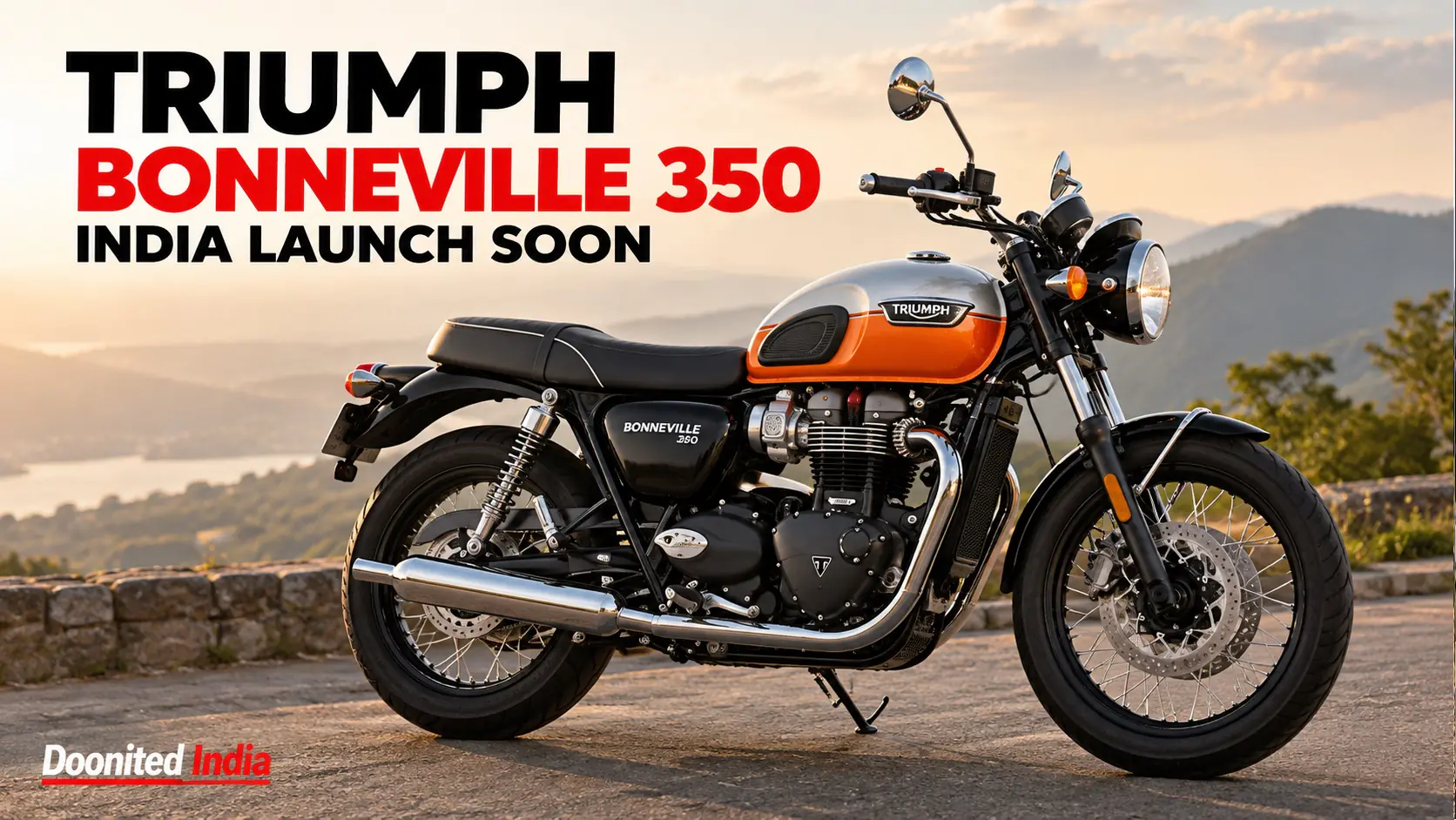
Spy photographs and reports suggest the new motorcycle will retain the Bonneville family’s familiar visual language: a teardrop-shaped tank, round retro-style instruments, a relatively clean body profile and twin peashooter-style exhausts. The test bike is also reported to use telescopic front forks.
That design direction is important. The Bonneville name carries a heritage that buyers associate with traditional British roadsters. The smaller engine may change the performance envelope, but it does not necessarily need to change the character of the motorcycle.
The expected 350cc engine is likely to be a single-cylinder, liquid-cooled unit derived from the downsized Triumph platform already used in India. Its final output, torque, gearing and tuning for the Bonneville have not been officially disclosed. Figures estimated for the Speed 400 or Scrambler 400 should not simply be transferred to this model.
The same caution applies to equipment. ABS, instrument design, wheel type, seat height and connectivity should be judged from the production specification—not inferred from spy shots or from other Triumph models.
Can it challenge the Royal Enfield Classic 350?
The Royal Enfield Classic 350 is the obvious reference point for a retro-styled motorcycle in this capacity class. The Triumph could offer an alternative for riders who want British styling and a different engine character, while the Classic benefits from an established customer base and a familiar ownership ecosystem.
The Bonneville’s eventual price will shape the comparison. At ₹3.15 lakh, it would sit well above the value-led expectation many buyers associate with a sub-350cc motorcycle. If Triumph manages to price it closer to the ₹2 lakh range, it could reach a different group of customers—but that lower price is speculation, not a confirmed company target.
A lower GST rate creates room for competitive pricing; it does not compel a manufacturer to pass every rupee of the tax difference to the customer. Equipment, brand positioning and production costs still matter.
Buyers should also compare the complete ownership proposition: service intervals, parts availability, warranty, resale prospects and the on-road price in their city. The most attractive showroom price is only one part of the calculation.
DOONITED View: The right size for the right purpose
The Bonneville 350 could be a useful expansion of Triumph’s India strategy. The 350cc platform demonstrates how manufacturers can adapt products to local tax structures while retaining recognisable global identities. A modern-classic version could appeal to riders who value design and relaxed road manners more than outright acceleration.
But the opportunity comes with a responsibility. The motorcycle should not be priced solely on the strength of its badge. If the aim is to make a premium brand more accessible, the final price, equipment and after-sales support must reflect that ambition.
The most interesting outcome would be a motorcycle that feels like a genuine Bonneville—not a stripped-down model whose main selling point is a tax threshold. The heritage should be in the riding experience, not just the shape of the tank.
Learning Point
For upcoming motorcycles, distinguish three things: confirmed product details, tax-driven possibilities and portal estimates. The Bonneville 350’s October 2026 timing and ₹3.15 lakh price are currently estimates. The broader Triumph 349cc strategy, by contrast, has already moved into production.
The official launch will determine whether the Bonneville becomes a genuinely more accessible modern classic—or a premium retro motorcycle with a smaller engine.


World Beyond the News
Octopuses Can Change Their Appearance
Octopuses can rapidly alter their skin colour and texture to communicate, camouflage themselves and respond to danger.
Some Cities Exist Across Two Continents
A small number of cities are geographically associated with two continents, creating unusual cultural and geographic identities.
Earth’s Climate Is Measured in Many Ways
Scientists track temperature, atmospheric gases, sea level, ice cover and other indicators rather than relying on a single climate number.
Streaming Changed How Audiences Discover Shows
Recommendation systems and global streaming releases allow audiences to discover programmes far beyond their original markets.