Hyundai’s Two-EV Strategy: Ioniq 6 Premium Ambition Meets an India-Made Compact Electric SUV
Hyundai’s electric-car plans for India could soon stretch from a premium, aerodynamic sedan to a locally manufactured compact SUV. But while the affordable EV programme is backed by company announcements, the Ioniq 6’s India launch remains unconfirmed.
India’s electric-car market is beginning to ask two very different questions. Can an electric vehicle offer the refinement, performance and long-distance ability expected of a premium car? And can an EV become affordable and practical enough for a much larger group of Indian households?
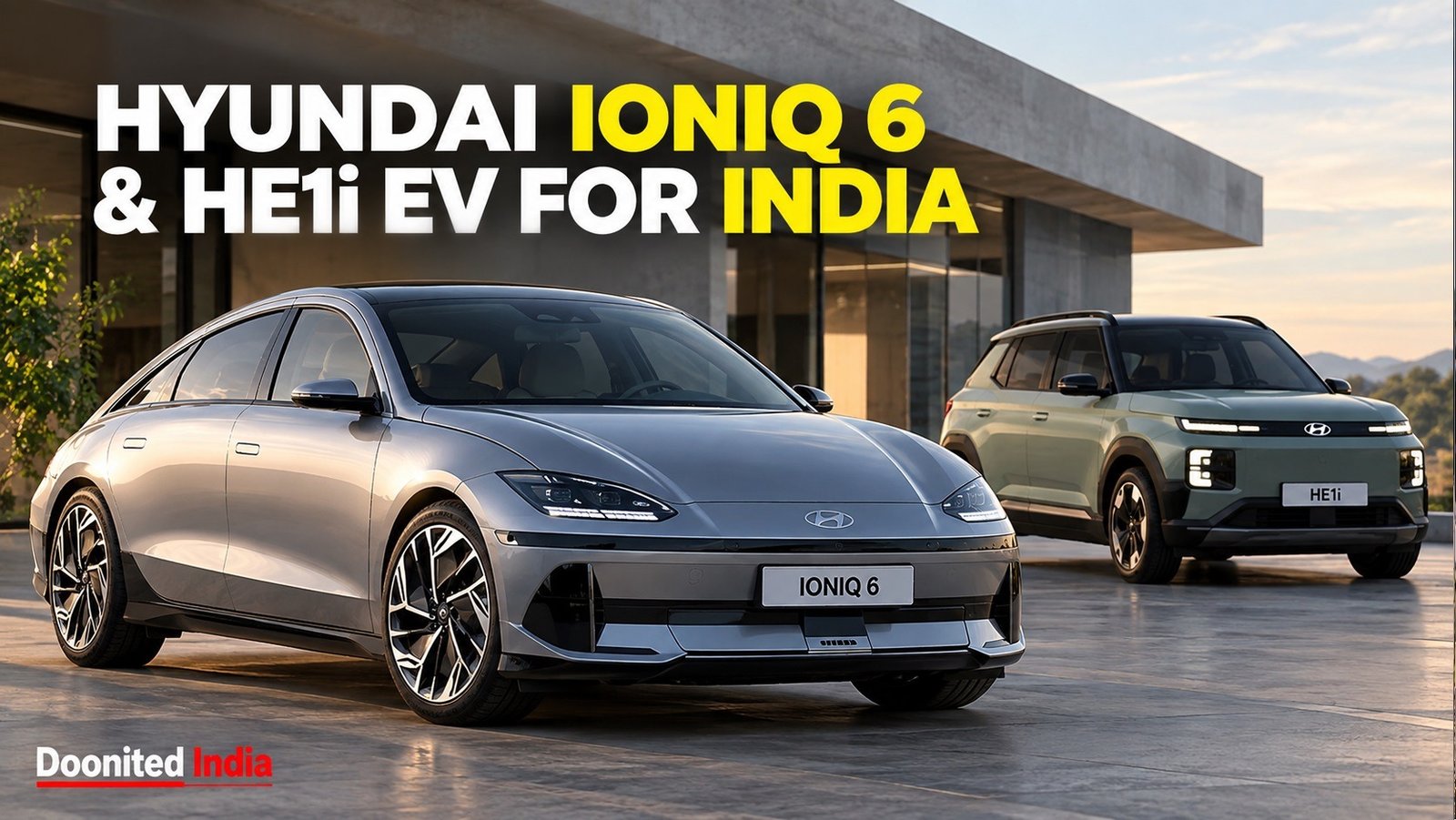
Hyundai’s two potential additions—the Ioniq 6 and the India-specific compact EV codenamed HE1i—sit at opposite ends of that conversation. One is a sleek global electric sedan that could expand Hyundai’s premium EV portfolio. The other is a locally developed product intended to bring electric mobility into a more accessible segment.
Their reported timelines overlap, but their status does not. The HE1i programme has been confirmed by Hyundai, with its debut expected by the end of 2026 and no later than March 2027. The Ioniq 6, by contrast, is still listed by automotive portals as an expected Indian launch, with no official launch confirmation found in Hyundai’s public India announcements.
That distinction matters. In the automotive world, “expected” can be a useful signal—but it is not a booking date.
Hyundai Ioniq 6: A premium electric sedan, if India gets it
The Hyundai Ioniq 6 is designed around a low, streamlined fastback silhouette. Its shape is not merely a styling exercise: aerodynamic efficiency is an important part of an electric car’s ability to use its battery energy effectively, particularly at higher road speeds.
The model has already been shown to Indian audiences, including at Auto Expo 2023. However, that appearance should not be mistaken for confirmation of a retail launch. Recent Indian automotive listings point towards a possible October–November 2026 window and an estimated ex-showroom price of around ₹60 lakh–₹65 lakh. These remain industry estimates, not Hyundai-announced dates or prices.
What about the 600km-plus range?
The Ioniq 6 has delivered long-range figures in international specifications. The previous long-range version was quoted at up to 614km under the WLTP test cycle. That figure is useful context, but it should not automatically be presented as the range of a prospective Indian model.
Hyundai has revealed a facelifted Ioniq 6 internationally, and the updated model’s final range figures have not been confirmed in the cited reporting. Battery size, wheel design, drivetrain, equipment and test cycle can all affect the published figure. India’s eventual specification—if the car is introduced—could differ from overseas versions.
For prospective buyers, the real questions will extend beyond the headline range: how quickly the car charges, how much range it retains on Indian motorways, and whether Hyundai offers a service and charging-support package suited to a low-volume premium EV.
A niche with a clear identity
At an estimated ₹60–65 lakh, the Ioniq 6 would occupy a specialised position. Its appeal would likely centre on distinctive design, electric performance and a premium sedan experience rather than the elevated seating position and perceived versatility that many Indian buyers seek from SUVs.
That makes the business case more demanding. A premium EV needs to offer more than an impressive specification sheet. Buyers at this price point will consider resale value, service access, charging convenience and the confidence that the manufacturer will support the product for years.
Hyundai HE1i: The more consequential electric-car programme
The HE1i is the more firmly established part of Hyundai’s near-term EV plan. Hyundai has confirmed a new compact electric SUV designed and localised for India. It will be built at the company’s Sriperumbudur facility in Tamil Nadu and is based on the E-GMP (K) platform, which also underpins the global Hyundai Inster.
Hyundai’s chief executive in India has indicated that the vehicle could debut by the end of 2026, earlier than the company’s broader target of March 2027. The programme is therefore more than a speculative model listing, although the final launch date, name, price and full specifications remain undisclosed.
Inster-inspired, not simply an imported Inster
The global Inster provides a useful reference point, but the HE1i should not be described as a locally assembled Inster without qualification. Hyundai has said the Indian vehicle will be designed and localised for the domestic market.
The company has confirmed two versions—standard range and long range—but has not yet published the Indian battery capacities, range figures or power outputs. The global Inster’s 42kWh and 49kWh battery options, and its overseas WLTP range figures, are therefore reference points rather than confirmed HE1i specifications.
Hyundai has also confirmed a next-generation infotainment system and Level 2 driver-assistance technology. These features could help the compact EV stand out, but their exact functions and availability across variants will matter more than the labels themselves.
The ₹10–15 lakh question
A price band of ₹10 lakh–₹15 lakh is being discussed in some reports and listings, but Hyundai has not officially confirmed this range. It should be treated as an estimate, not a launch price.
If Hyundai can deliver a well-equipped, locally manufactured EV around this level, it could bring a new competitor into the mainstream electric-car market. However, the HE1i’s rivals may include more than one body style or price bracket. The Tata Punch EV is an obvious point of comparison in the compact-EV conversation, while the latest reporting also identifies the Tata Nexon EV, Mahindra XUV 3XO EV and Kia Syros EV as relevant competitors.
The eventual comparison will depend on the HE1i’s dimensions, battery options, real-world range, charging speed, ground clearance, boot space and variant pricing. Until those details arrive, a precise “direct rival” label is premature.
Two cars, two different tests for Hyundai
The Ioniq 6 and HE1i would test two distinct capabilities.
The Ioniq 6 would test Hyundai’s ability to sell a premium electric sedan in a market where SUVs dominate much of the conversation. Its success would depend on product appeal, price positioning and the ownership experience—not simply the range printed in a brochure.
The HE1i would test Hyundai’s ability to localise an EV for a broader Indian audience. Local manufacturing can support cost control and supply-chain development, but affordability depends on the complete vehicle programme: battery costs, localisation, production scale, equipment and warranty commitments.
Battery sourcing is also a live issue. Recent reporting says the compact EV will initially use cells from Svolt, with a longer-term plan to source locally produced cells through Hyundai’s association with Exide. That transition is relevant because domestic battery manufacturing could help deepen the local EV ecosystem, but the timing and execution will need to be demonstrated.
There is a practical lesson here for buyers: local manufacturing does not automatically guarantee a low price, just as a large claimed range does not automatically guarantee convenient long-distance travel. The details behind those promises matter.
DOONITED View: The launch matters less than the ownership promise
India does not need electric cars that merely look futuristic in a showroom. It needs EVs that fit the realities of Indian driving: mixed road conditions, varied climates, uneven access to home charging and long distances between some charging points.
For the Ioniq 6, Hyundai would need to explain why a premium electric sedan deserves attention in an SUV-oriented market—and support that proposition with dependable seHyundai Ioniq 6 and HE1i: Upcoming EVs for India compelling price, useful real-world range, sensible charging performance and robust after-sales support could make the car relevant to families considering their first EV. A long equipment list will help, but not if the entry variant feels compromised or the price rises sharply for the battery and features buyers actually need.
Hyundai’s two-car strategy could therefore serve different purposes: the Ioniq 6 would showcase the brand’s premium electric ambitions, while the HE1i could build volume and strengthen local capability. The latter has the clearer announced path to India. The former remains a possibility that buyers should watch rather than assume.
Learning Point
When evaluating an upcoming EV, separate confirmed company announcements from industry estimates. Check whether a range figure uses WLTP, ARAI or another test cycle; compare the exact variant; and assess charging, warranty, service reach and total ownership cost alongside the sticker price.
A launch headline can create excitement. The specification sheet, final price and ownership support determine whether that excitement survives the first year.


World Beyond the News
Bees Communicate Where Food Is
Honeybees use movement patterns known as waggle dances to communicate information about food locations.
Street Food Reflects Local History
Many famous street foods developed from migration, trade, local ingredients and the everyday needs of working communities.
A Day on Venus Is Extremely Long
Venus rotates so slowly that one rotation relative to distant stars takes longer than its trip around the Sun.
Human Achievement Continues to Push Limits
Athletes, engineers, scientists and explorers regularly establish new benchmarks in speed, endurance, scale and precision.