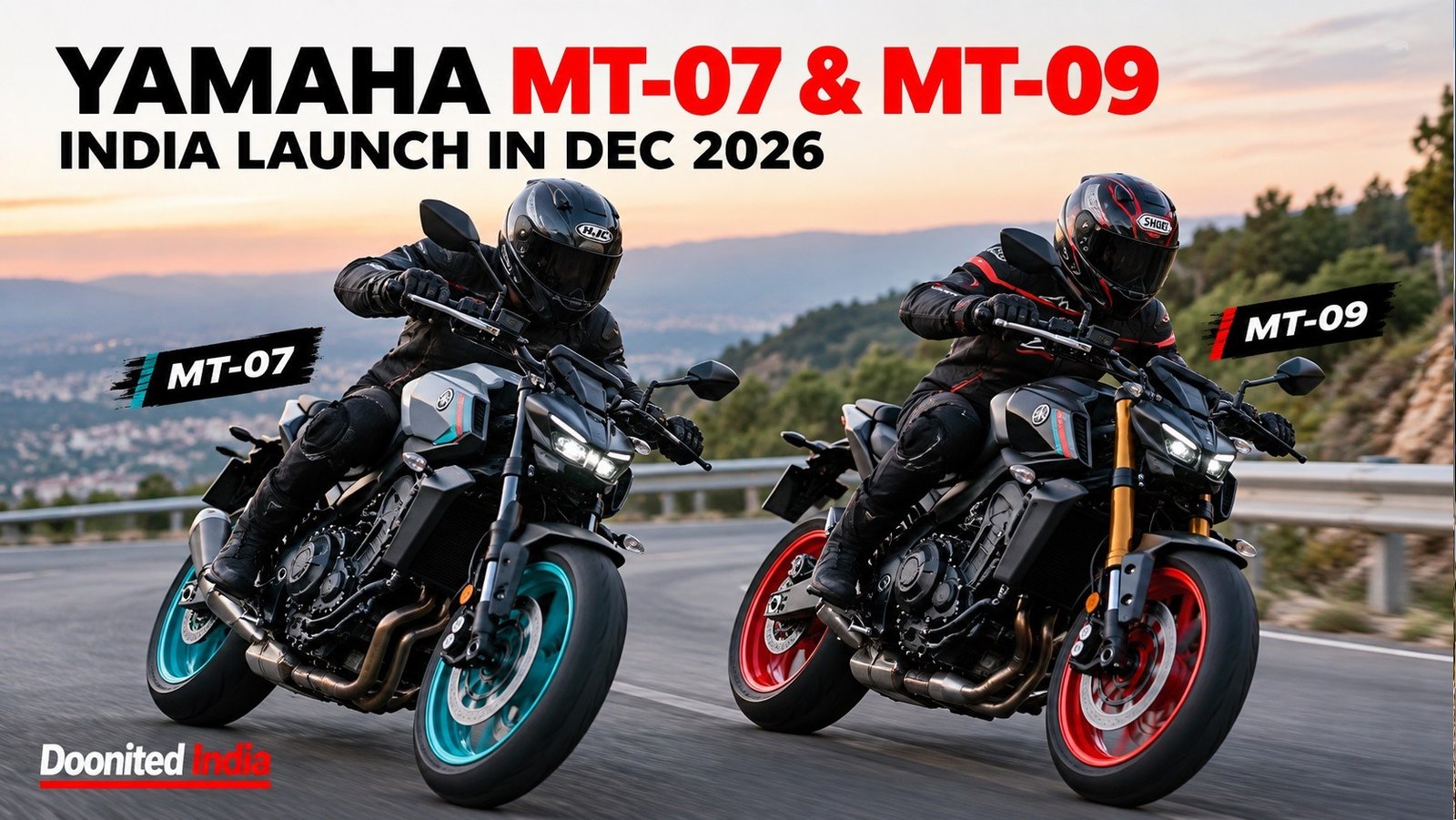
Yamaha MT-09 and MT-07: Two New Streetfighters Could Expand Yamaha’s Big-Bike Line-up in India
Yamaha’s MT family has built its identity around muscular styling, upright riding positions and engines designed to deliver strong, accessible performance. Now, two of its most recognisable middleweight naked motorcycles—the MT-07 and MT-09—are listed for an expected India launch in December 2026.
The estimated prices are approximately ₹7.50 lakh for the MT-07 and ₹12 lakh for the MT-09, ex-showroom. These are third-party estimates, not confirmed Yamaha India prices. The launch month is also tentative, and the motorcycles’ arrival depends on the company finalising the requirements for the Indian market.
The two motorcycles serve different purposes. The MT-07 is a middleweight twin-cylinder roadster aimed at riders seeking a balance of performance and everyday usability. The MT-09 sits higher in the range, with a more powerful 890cc inline-three engine and a sharper performance brief.
Their potential arrival matters because Yamaha has previously sold the MT-09 in India, but the current-generation models have yet to establish a regular presence in the market. If the new launches proceed, Yamaha could strengthen its premium motorcycle portfolio with two distinct options rather than a single flagship import.
Yamaha MT-07: The approachable middleweight

The MT-07 is powered by a 689cc liquid-cooled, parallel-twin engine producing approximately 73.4PS at 8,750rpm and 67Nm at 6,500rpm. It is paired with a six-speed gearbox. The international model is known for its compact proportions and an engine character designed to deliver useful torque without demanding high revs all the time.
That makes the MT-07 relevant to riders who want a substantial step up from a 300–400cc motorcycle, but do not necessarily need the outright performance of a larger triple-cylinder machine.
Its relatively upright riding position should also make it more practical than a fully faired supersport motorcycle for commuting, weekend rides and shorter touring trips. However, “everyday usability” is relative: a 689cc motorcycle at an estimated ₹7.5 lakh is a premium purchase, and its running costs will be higher than those of a typical commuter or entry-level motorcycle.
At the expected price, the MT-07 would enter a competitive segment. Buyers will likely compare it with the Kawasaki Z650 and other middleweight roadsters, weighing engine character, equipment, comfort, service access and total ownership cost.
The MT-07’s proposition is straightforward: a twin-cylinder engine, a relatively uncomplicated naked-bike format and enough performance for spirited road riding. Its success in India will depend on whether Yamaha can price it attractively against established alternatives.
Yamaha MT-09: The sharper, more powerful option
The MT-09 moves into a different performance category. Its 890cc liquid-cooled inline-three engine produces approximately 119PS at 10,000rpm and 93Nm at 7,000rpm. The engine is paired with a six-speed gearbox, and the international model offers a bi-directional quickshifter.
The MT-09’s electronics and rider aids are also part of its premium positioning. International specifications include riding modes and electronic assistance designed to help the rider manage its performance. Exact equipment for an India-spec model should be confirmed at launch; international specifications should not automatically be assumed to apply unchanged.
At an estimated ₹11.5–12 lakh, the MT-09 would be a significant purchase. Its appeal will depend not just on its power output but on how effectively Yamaha balances performance, comfort, equipment and price against competing premium naked motorcycles.
There is also a practical consideration: 119PS is more performance than many riders can use on public roads consistently. The value lies in the engine’s flexibility and the motorcycle’s overall dynamics—not in treating every traffic signal as the starting grid at a race circuit.
MT-07 vs MT-09: What separates them?
|
Specification |
Yamaha MT-07 |
Yamaha MT-09 |
|---|---|---|
|
Engine |
689cc parallel twin |
890cc inline triple |
|
Expected power |
73.4PS |
119PS |
|
Expected torque |
67Nm |
93Nm |
|
Expected price |
₹7.50–8 lakh |
₹11.50–12 lakh |
|
Expected launch |
December 2026 |
December 2026 |
Specifications and prices are based on international model data and third-party India estimates. Final Indian specifications and prices may differ.
The MT-07 is the more accessible proposition on paper, with a lower price and a twin-cylinder engine suited to a wide range of road use. The MT-09 offers substantially more power and a different engine character, but asks buyers to spend several lakh rupees more.
For a rider upgrading from a smaller motorcycle, the MT-07 may offer a more gradual move into the middleweight class. The MT-09 is aimed at those who specifically want stronger performance and are comfortable with the additional cost and capability.
Neither model is automatically the right choice for every buyer. Seat comfort, heat management, weight, throttle response and low-speed manners can matter more in daily use than the difference between two specification sheets.
The E20 question: why the launches have taken time
Yamaha’s India plans for its larger-capacity motorcycles have faced delays associated with E20 fuel compatibility and homologation. In July 2025, Autocar India reported that Yamaha had not abandoned its plans for the MT-07, MT-09 and other larger motorcycles, but that the E20 requirements had affected the timeline. The models were expected to arrive as completely built units (CBUs).
E20 is petrol blended with up to 20 per cent ethanol. For a vehicle to be certified for the relevant fuel, manufacturers must validate factors such as material compatibility, durability, drivability, emissions and fuel-system performance. The Indian government has stated that the E20 programme has been supported by technical studies and validation.
The important distinction is that a reported past delay does not establish the precise reason for any further change in the launch schedule. As of September 2026, the December date shown by motorcycle portals remains an estimate. Yamaha’s final announcement will determine whether both models arrive together, separately or on a revised timeline.
CBU imports can also influence pricing. Import duties, currency movements, logistics and variant-specific equipment can make an internationally available motorcycle considerably more expensive in India. A launch price will therefore reflect more than the motorcycle’s overseas retail price converted into rupees.
What the launch could mean for Indian riders
Yamaha has a recognised presence in India’s mass-market motorcycle segment, but its premium big-bike portfolio has been comparatively limited. Bringing the MT-07 and MT-09 would give customers two choices within the same naked-bike family, with distinct engine configurations and price points.
The opportunity is not simply to add more models to a catalogue. Premium buyers expect a complete ownership proposition: trained service staff, parts availability, transparent maintenance costs and a dealer experience that matches the price.
This will be especially important if the bikes arrive as CBUs. A premium import can attract attention in the showroom, but customers will judge it over years of ownership. Long waiting periods for parts or limited service access can undermine even a compelling product.
Yamaha will also need to communicate clearly which features and specifications are included in the Indian models. Buyers should not assume that every electronic aid, colour, suspension component or accessory offered overseas will be standard here.
DOONITED View
The MT-07 and MT-09 could give Yamaha India a more clearly differentiated premium naked-bike line-up. The MT-07 offers a middleweight twin-cylinder format, while the MT-09 brings the distinctive character and performance of an 890cc triple.
The main uncertainties are the same ones that matter most to buyers: confirmed launch dates, India-specific equipment, final pricing and the service network supporting the motorcycles. The December 2026 listings are useful indicators, but they are not a substitute for an official launch announcement.
If Yamaha can align pricing with the competition and make ownership straightforward, these motorcycles could broaden the company’s appeal among enthusiasts. If the final prices rise significantly above current estimates, buyers will have to weigh the Yamaha experience against alternatives offering different combinations of performance, features and support.
The real test will not be how quickly the MT-09 accelerates on an empty road. It will be whether Yamaha can make owning a premium motorcycle feel as rewarding as riding one.
Learning Point
When comparing premium naked motorcycles, assess the complete ownership proposition—not just engine size and peak power. Consider riding position, low-speed behaviour, service access, parts costs, warranty terms and the exact India-spec equipment. An informed decision begins with confirmed specifications, not a launch listing.


World Beyond the News
Why Elephants Stay Close to Their Herd
Elephants live in highly social family groups and use calls, touch and body movements to maintain strong bonds.
Most of the Deep Ocean Remains Difficult to Explore
Extreme pressure, darkness and distance make deep-ocean exploration one of Earth’s greatest scientific challenges.
Spacecraft Can Travel Without Traditional Roads
Spacecraft use carefully calculated trajectories and gravity assists to travel enormous distances through space.
Why Movie Trailers Are Released in Stages
Major films often use teaser trailers, full trailers and final promotional spots to build awareness over time.