Hyundai Bayon: Bookings Open at ₹11,000 Ahead of Festive-Season India Launch
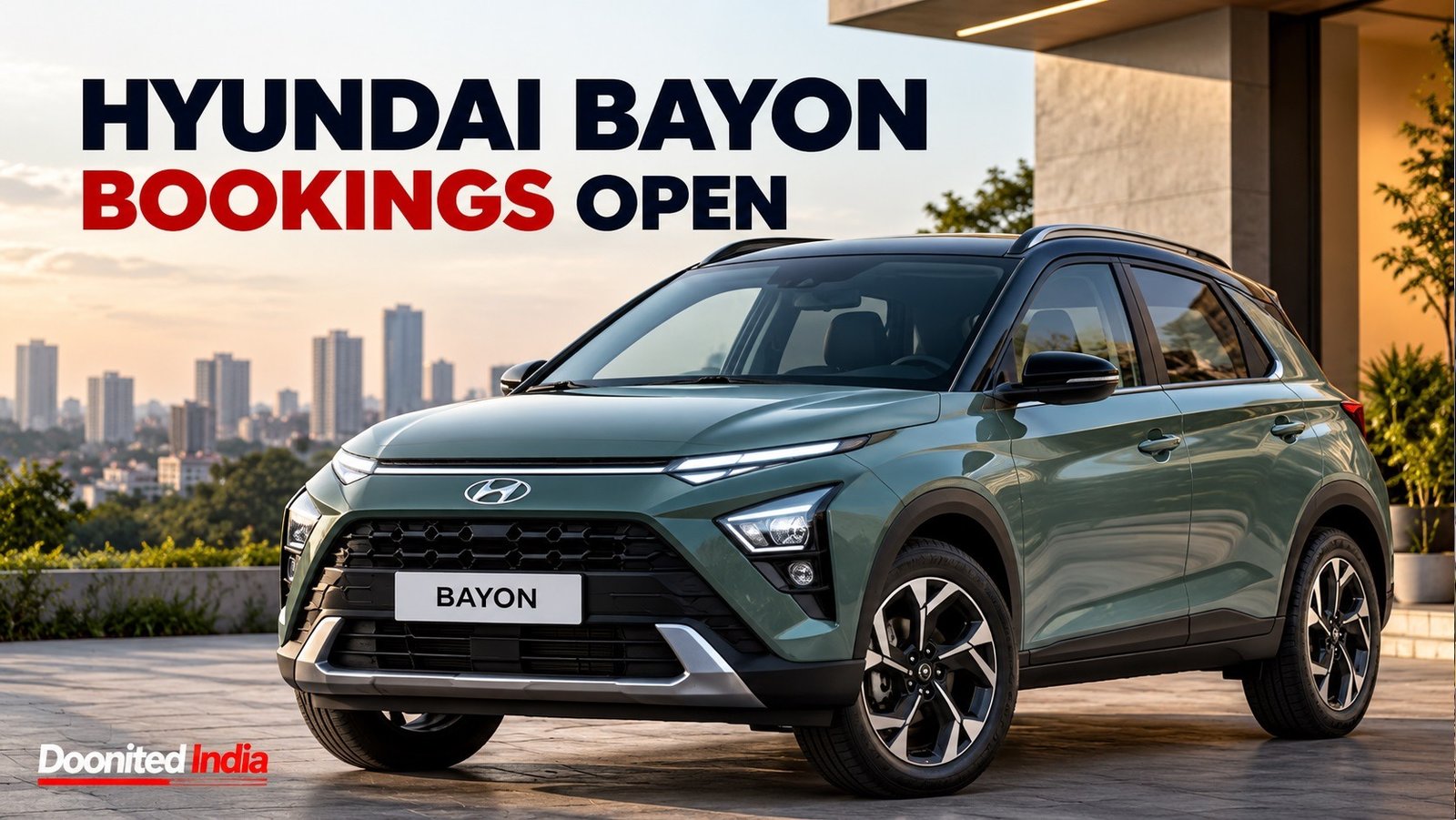
Hyundai Motor India Limited (HMIL) has opened bookings for the Hyundai Bayon, a new 4.2-metre SUV scheduled to arrive in India during the 2026 festive season. Customers can reserve the vehicle for ₹11,000 through Hyundai’s official website or authorised dealerships.
The company has confirmed several key details, including the Bayon’s approximate length, petrol powertrain with manual and IVT transmission options, an in-built generative AI voice assistant and the Global K Enhanced platform. However, the final price, detailed engine specifications, variant-wise equipment and exact launch date remain unannounced.
The Bayon will expand Hyundai’s Indian SUV portfolio with a vehicle positioned between the Venue and Creta in size. Its appeal could lie in offering a more substantial footprint and a technology-focused cabin without moving into a larger SUV.
Hyundai Bayon: What Has Been Officially Confirmed?
Hyundai announced the start of bookings on September 23, 2026. The manufacturer describes the Bayon as an “Intelligent Utility Vehicle”, highlighting technology, comfort, safety and contemporary styling.
The confirmed details include:
-
Length: Approximately 4.2 metres.
-
Platform: Global K Enhanced.
-
Powertrain: Hyundai petrol engine.
-
Transmission: Manual and Intelligent Variable Transmission (IVT).
-
Technology: In-built generative AI voice assistant.
-
Booking amount: ₹11,000.
-
Expected arrival: Festive season 2026.
Hyundai says the platform has been engineered for “5-star Indian safety standards”. This is the company’s description of its engineering approach, not an independently awarded crash-test rating. Buyers should look for an official crash-test result for the India-spec model before drawing conclusions about its tested safety performance.
The company has also highlighted advanced safety features, but the complete variant-wise equipment list has not yet been published.
A New SUV Between the Venue and Creta
The Bayon’s 4.2-metre length gives Hyundai an opportunity to address buyers who find the Venue too compact but do not necessarily want to move up to the Creta.
For urban families, a vehicle in this size range can offer a useful balance. It may provide a more substantial road presence and cabin than a sub-four-metre SUV while remaining easier to manoeuvre and park than a larger vehicle.
The Bayon’s actual practicality, however, will depend on more than its exterior length. Rear-seat space, boot capacity, visibility, turning radius and ride comfort will determine how well it fits everyday Indian use. These details should be assessed from the final specifications and a physical inspection.
The positioning also creates a challenge for Hyundai. If the Bayon’s price approaches the Creta too closely, buyers may prefer the larger model. If the price overlaps heavily with higher Venue variants, Hyundai will need to demonstrate why the Bayon deserves the step up.
The car’s success will therefore depend on where it fits financially as much as where it fits physically.
Design: Hyundai’s H-Edge Lighting and SUV Styling
Hyundai’s official design sketches show a sculpted bonnet, a distinctive front fascia and signature H-Edge LED daytime running lights. The styling also includes pronounced wheel arches, wrap-around door cladding and bridge-type roof rails.
The company says the Bayon follows its evolving “Art of Steel” design language, with defined surfaces and sharp character lines intended to give the SUV a confident appearance.
The design sketches offer an indication of the vehicle’s direction, but the production model’s complete appearance should be judged from official photographs and the showroom vehicle. Sketches can emphasise certain design elements that appear differently on the final car.
In a crowded SUV market, a distinctive design can help a new model stand out. But the Bayon will need to pair its styling with practical advantages that buyers can experience after the first impression fades.
Petrol Engine and Transmission: What Buyers Should Know
Hyundai has confirmed a petrol powertrain with manual and IVT transmission choices. It has not yet announced the engine displacement, power output, torque figures or fuel-efficiency certification in the booking announcement.
Some automotive reports have suggested a 1.5-litre naturally aspirated petrol engine. Until Hyundai releases the technical specification sheet, that detail should be treated as a report rather than a confirmed specification.
The IVT option could be particularly relevant for buyers who regularly navigate congested city traffic. An automatic transmission can reduce the effort of stop-and-go driving, although real-world smoothness, responsiveness and fuel consumption will depend on the final calibration and driving conditions.
A manual option will continue to serve buyers who prefer greater direct control over gear selection or want to compare the price difference between transmission variants.
What about a factory-fitted CNG version?
Reports have also discussed the possibility of a factory-fitted Hy-CNG option. However, Hyundai’s booking announcement confirms petrol power with manual and IVT options; it does not confirm CNG availability.
If a CNG version is introduced, it could interest high-mileage users looking to manage running costs. Buyers would need to consider the price premium, boot-space implications, fuel availability and the actual difference in operating costs. Until an official announcement, CNG should not be treated as part of the confirmed Bayon line-up.
Generative AI Voice Assistant: Useful Technology or a Gimmick?
One of the Bayon’s headline features is its in-built generative AI voice assistant. Hyundai says the system is designed to make interaction between driver and vehicle more natural and intuitive.
The practical value will depend on what the India-spec system can do. Useful functions could include accessing vehicle information, controlling supported features or retrieving information through voice commands. The final capabilities, language support, connectivity requirements and any subscription conditions remain to be detailed.
AI branding may make a car sound futuristic, but drivers will judge the feature on everyday performance. Does it understand commands reliably? Does it respond quickly? Can it reduce the need to look at a screen while driving?
A voice assistant that requires repeated instructions risks becoming less of a co-driver and more of an argument with the dashboard. The technology will matter most if it is dependable, easy to use and genuinely reduces distraction.
Safety and Equipment: Wait for the Full Specification
The Bayon’s official announcement highlights safety engineering and advanced features, but it does not provide a complete list of equipment by variant.
Claims circulating about Level 2 ADAS, specific screen sizes, camera systems or other premium features should not be treated as confirmed unless Hyundai includes them in its official India-specification list.
When the final details are released, buyers should check which safety systems are standard and which are restricted to higher trims. They should also distinguish between active driver-assistance systems, passive safety equipment and crash-test performance: these are related, but they measure different aspects of vehicle safety.
For a family SUV, the availability and operation of safety features can be more consequential than a long list of connected-car functions.
Expected Price: An Estimate, Not Hyundai’s Announcement
CarWale’s listing gives an expected price range of ₹9.79 lakh to ₹15.49 lakh (ex-showroom). This is a third-party estimate, not an official price announcement from Hyundai.
The final price will be central to the Bayon’s market position. Buyers should compare the eventual ex-showroom prices with the on-road cost, including registration, insurance and any optional packages.
Variant-wise pricing will also reveal whether the features that distinguish the Bayon are available at accessible price points or reserved for the most expensive versions.
DOONITED View: The Bayon Needs to Make Its Middle Ground Matter
The Hyundai Bayon enters the conversation with a clear proposition: a roughly 4.2-metre SUV, contemporary styling and a technology-led cabin. Hyundai has confirmed the broad outline, but the final price and full specifications will determine whether the package makes sense for Indian buyers.
Its opportunity is to offer a meaningful alternative between the Venue and Creta. Its risk is ending up in a price overlap where customers see little reason not to choose one of Hyundai’s existing models.
The generative AI assistant may attract attention, but everyday ownership will still be shaped by comfort, fuel costs, space, safety, service access and resale value. Smart technology is welcome; sensible pricing and dependable execution are essential.
For now, the Bayon is a confirmed upcoming Hyundai SUV with bookings open—not yet a fully disclosed product. Prospective buyers should use the booking period to understand the final variant line-up and avoid making decisions based on unconfirmed features.
Learning Point
An open booking window does not mean every specification is final or publicly available. Before placing a reservation, confirm the variant, engine, transmission, safety equipment, final price, cancellation terms and expected delivery date with an authorised Hyundai dealership.


World Beyond the News
Octopuses Can Change Their Appearance
Octopuses can rapidly alter their skin colour and texture to communicate, camouflage themselves and respond to danger.
Some Cities Exist Across Two Continents
A small number of cities are geographically associated with two continents, creating unusual cultural and geographic identities.
Earth’s Climate Is Measured in Many Ways
Scientists track temperature, atmospheric gases, sea level, ice cover and other indicators rather than relying on a single climate number.
Streaming Changed How Audiences Discover Shows
Recommendation systems and global streaming releases allow audiences to discover programmes far beyond their original markets.