Bank Strike 2026: Three Days of Disruption Loom as Unions Press for a Five-Day Workweek
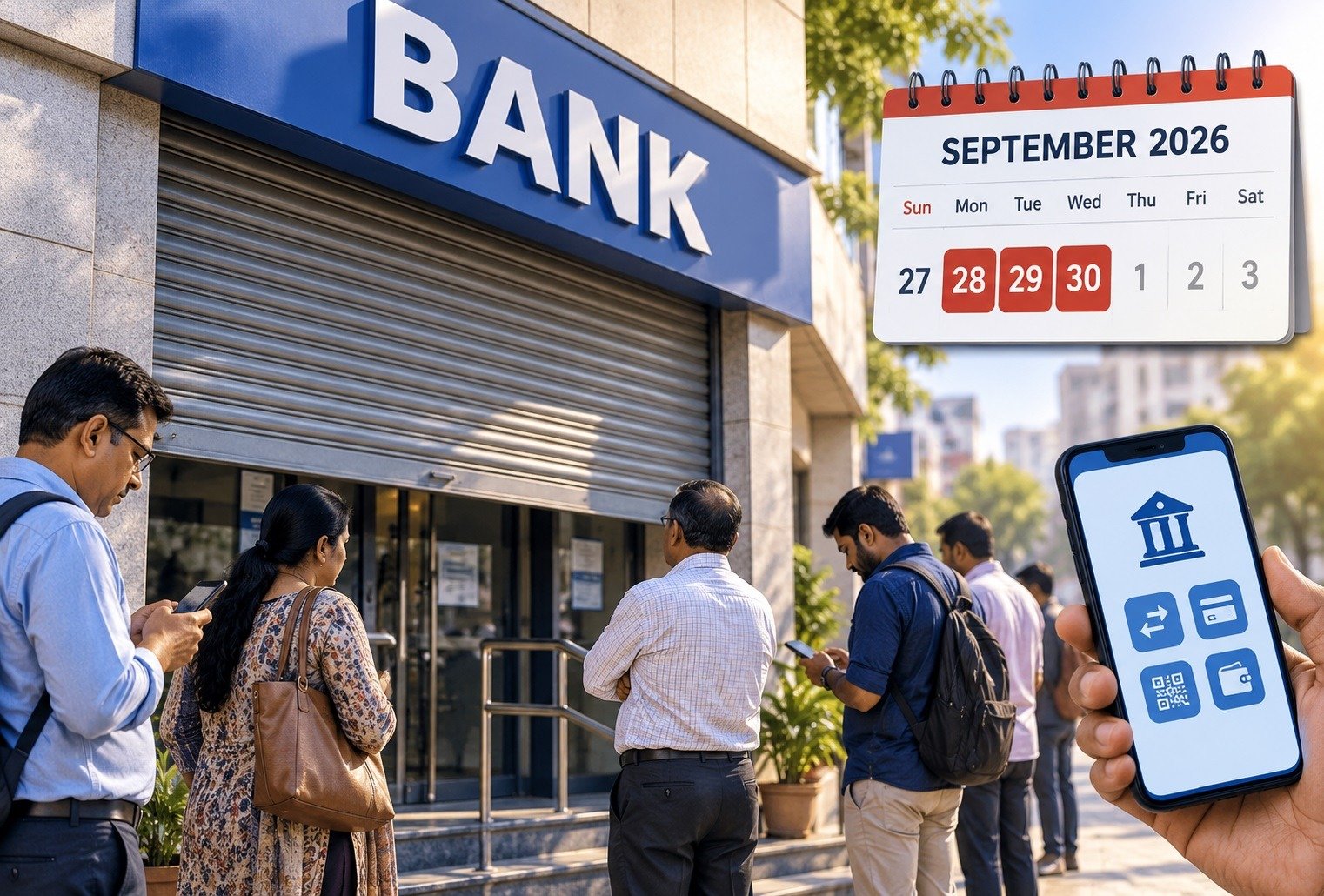
A nationwide bank strike is scheduled for September 28–30, but one important update changes the picture for customers: public sector banks and regional rural banks have been directed to open on Sunday, September 27, to help people complete urgent transactions. The strike could still disrupt branch services during the final three days of September, including at a particularly busy time for banks’ half-yearly closing.
The United Forum of Bank Unions (UFBU) has maintained its call for a three-day strike after conciliation talks failed to resolve its principal demand: implementation of a five-day banking week. The Finance Ministry has appealed to employees to reconsider, while bank managements have been asked to minimise inconvenience to customers.
For ordinary account holders, the immediate question is practical: which services may be affected, what can be done digitally, and how should households and businesses prepare for month-end?
The latest update: Sunday opening, strike still scheduled
September 26 is the fourth Saturday of the month? No—under the regular banking calendar, it is the fourth Saturday?
The calendar matters because bank branches were already scheduled to be closed on Saturday, September 26, and Sunday, September 27. The government has since announced that all public sector banks (PSBs) and regional rural banks (RRBs) will function normally on Sunday, September 27, with RBI approval for branches and specified banking facilities to remain operational. The Sunday opening is intended to give customers an additional opportunity to complete urgent work before the proposed strike.
This is a significant change from the earlier expectation of five consecutive days without normal branch access. It does not, however, mean that the strike has been called off. As of September 26, the three-day action remains scheduled for September 28, 29 and 30.
Why are bank unions striking?
The central demand is a five-day banking week. Bank branches currently close on the second and fourth Saturdays, in addition to Sundays and notified holidays. UFBU wants all Saturdays to become holidays, bringing banking into a five-day weekly schedule.
The issue has been under discussion for some time. The Indian Banks’ Association (IBA) had agreed to the proposal in 2024, but implementation requires the necessary government approval. The unions argue that the matter has remained unresolved despite negotiations.
The dispute is not limited to the working week. Union demands have also included pension-related improvements, a uniform dearness allowance formula for pensioners and an option for employees covered by the National Pension System to move to the Old Pension Scheme.
The government says it has engaged with the unions and that five-day banking is under consideration, but that other stakeholders’ views must also be taken into account. The Finance Ministry has urged employees to defer the strike and continue negotiations.
There has already been a one-day nationwide strike on September 11. The proposed September 28–30 action is therefore the next stage in an ongoing dispute, rather than an isolated protest.

What failed in the talks?
The latest conciliation meeting did not produce an agreement on the five-day week. According to the government’s account, discussions have addressed employee concerns, and the Performance Linked Incentive (PLI) scheme has been kept in abeyance. The government considers this a response to one of the unions’ principal demands.
UFBU, however, says the outstanding demand for five-day banking needs concrete progress. It has indicated that it would consider deferring the strike if there were a positive development on implementation.
That leaves a familiar gap between negotiation and resolution: one side points to steps already taken, while the other says the core issue remains unsettled. For customers, the consequence is uncertainty over branch-based services at the end of the month.
Which banking services could be affected?
The most direct impact is expected at public sector bank branches, where staff participation could interrupt in-person services. The precise disruption may vary by bank, branch and the extent of participation.
Customers who may need to visit a branch should consider completing time-sensitive work before the strike begins. This includes services that require staff intervention, physical documentation, verification or processing at a counter.
Digital banking channels—including mobile banking, internet banking and UPI—are expected to remain available. ATMs and business correspondent outlets may also provide access to some services. But customers should not assume every channel will function without interruption: cash replenishment, technical issues and transaction-specific limitations can still matter.
Private sector banks are expected to be less affected, although customers should check their own bank’s official communication rather than assume that every branch will operate normally.
A practical checklist for customers
-
Finish branch-dependent work early: Do not leave account updates, documentation, cheque-related queries or other staff-assisted work until the strike period.
-
Check cash requirements: Withdraw a reasonable amount in advance if you expect to need cash. Avoid unnecessary large withdrawals.
-
Use digital channels where suitable: Confirm that mobile and internet banking are active and that you can access your account.
-
Plan payments around the month-end: Businesses should review vendor payments, salary processing and other time-sensitive transactions.
-
Check directly with your bank: Follow official notices for branch operations, cheque clearing and any service-specific arrangements.
-
Use Sunday’s opening where available: Public sector banks and regional rural banks are scheduled to open on September 27, but confirm the relevant branch and service before travelling.
Why the timing is especially sensitive
September 30 is the half-yearly closing date for banks. The period involves reconciliation, provisioning and other accounting and operational processes. A strike at this point can add pressure to work that is already deadline-driven.
The impact may extend beyond a customer waiting at a counter. Businesses could face delays in payments or documentation, while transactions involving multiple institutions may take longer to settle. Government-related and international banking operations could also experience knock-on effects, depending on the service involved.
That does not mean every payment will stop. The distinction between branch operations, digital transactions and back-office processing is important. Customers should expect possible disruption—not assume that the entire banking system will be switched off.
The larger question: can banking modernise without disrupting customers?
The five-day-week debate raises legitimate questions about employee working conditions, service design and how banking has changed. Digital channels have made many routine transactions possible without visiting a branch. At the same time, cash-dependent customers, small businesses, senior citizens and people who need in-person assistance still rely heavily on physical access.
A modern banking system must account for both realities. Digital access can reduce the need for routine branch visits, but it is not a complete substitute for staffed services. Nor should customers bear the full cost of unresolved negotiations between employers and employees.
The Sunday opening is a practical attempt to reduce inconvenience. Yet it is also a reminder that calendar changes and contingency measures can only soften disruption; they cannot settle the underlying labour issue.
DOONITED View: The customer should not become the collateral
Bank employees’ demand for a five-day week deserves to be understood as a workplace and policy question, not dismissed simply because a strike is inconvenient. Equally, customers and businesses have a reasonable expectation that essential financial services will be planned and communicated reliably.
The responsible path is a negotiated settlement with a clear implementation timeline, transparent communication and safeguards for essential services. If a five-day week is adopted, banks will need to organise staffing, branch access and digital support so that the change does not simply shift inconvenience from employees to customers.
For now, the immediate advice is straightforward: use the Sunday opening if you need a branch, complete urgent work before September 28, and keep alternative payment methods available. A little planning can save a long queue—and a month-end headache.
Learning Point
A bank strike does not automatically mean every banking channel will stop. The likely disruption is concentrated in branch-based services, while digital channels may continue to operate. Customers should distinguish between a scheduled strike, a branch closure and a complete interruption of banking—and plan according to the service they actually need.


World Beyond the News
Octopuses Can Change Their Appearance
Octopuses can rapidly alter their skin colour and texture to communicate, camouflage themselves and respond to danger.
Some Cities Exist Across Two Continents
A small number of cities are geographically associated with two continents, creating unusual cultural and geographic identities.
Earth’s Climate Is Measured in Many Ways
Scientists track temperature, atmospheric gases, sea level, ice cover and other indicators rather than relying on a single climate number.
Streaming Changed How Audiences Discover Shows
Recommendation systems and global streaming releases allow audiences to discover programmes far beyond their original markets.