Angel One Research: Stock Recommendations, ARQ Prime and the Limits of Market Advice
Stock market research has become a familiar feature of Indian investing apps. Alongside price charts and order buttons, investors can now find company analysis, market commentary, stock recommendations and algorithm-driven tools—all within the same digital ecosystem.
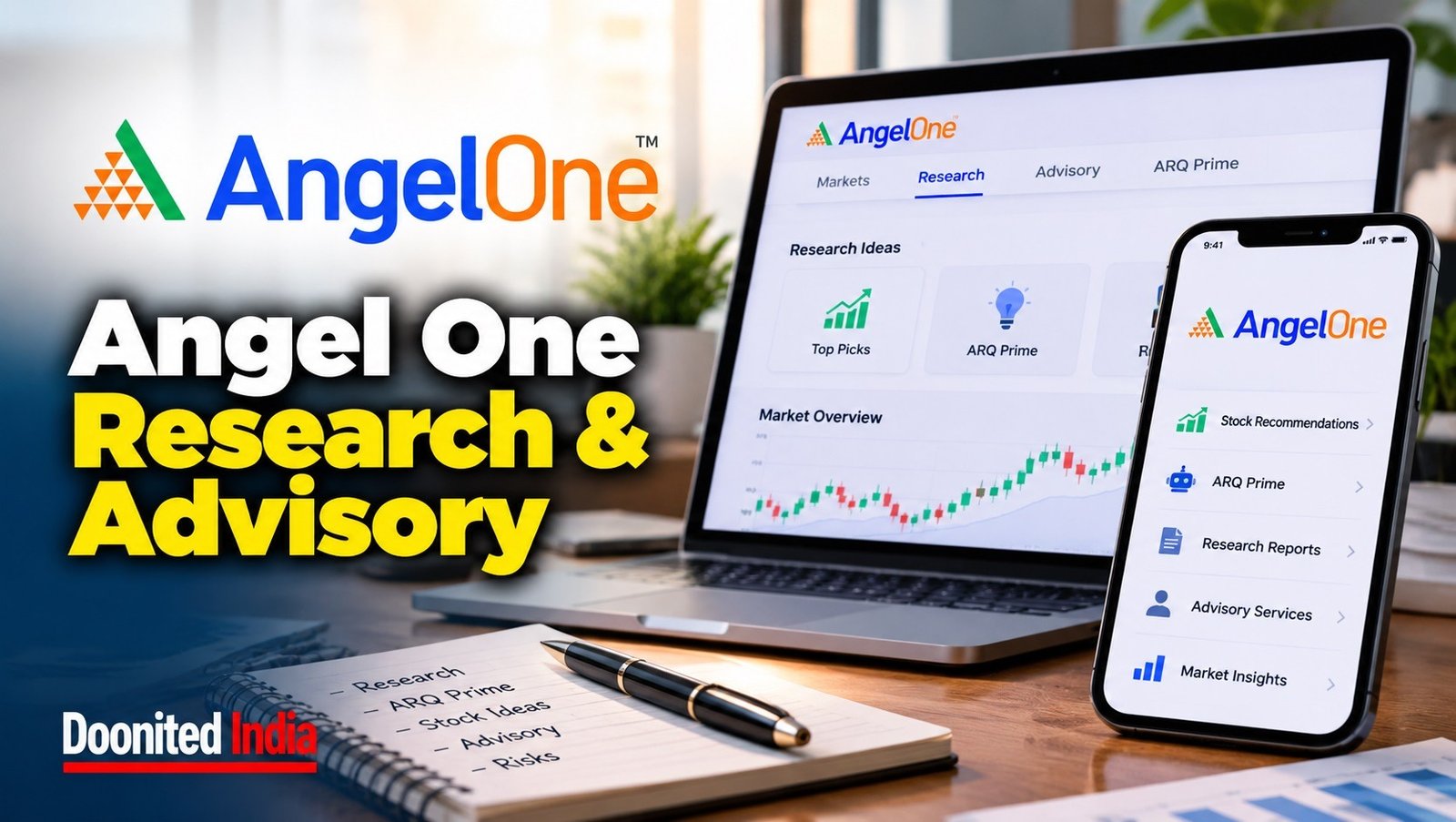
Angel One combines brokerage services with a research and advisory offering that includes fundamental and technical research, stock recommendations, ARQ Prime and paid advisory services such as Angel Platinum. Some recommendations are available to Angel One clients without a separate recommendation fee; other services may have their own charges and conditions.
The convenience is clear: research can be accessed close to the point where an investor makes a decision. The challenge is equally important. A stock recommendation is not a guarantee, an algorithm is not an oracle, and a “buy” button should never be mistaken for a complete investment plan.
What Angel One’s research offering includes
Angel One’s Knowledge Centre publishes educational material on market concepts, company fundamentals, technical analysis and investing. Its app also provides research and advisory features for clients, with offerings that vary by service and plan.
Fundamental research: Examines business performance, financial statements, industry conditions and other factors that may influence a company’s prospects.
Technical research: Studies price movements, charts, trends and indicators to identify possible trading setups.
Stock recommendations: Research-backed ideas for different holding periods and market segments, subject to the availability and terms of the relevant service.
Algorithm-driven tools: Systems that apply predefined rules to market data and generate investment ideas.
Paid advisory services: Products with their own eligibility, pricing, features and terms.
These categories serve different purposes. Fundamental analysis may help an investor understand a business; technical analysis may help a trader assess price behaviour. Neither eliminates uncertainty, and neither should be treated as a substitute for understanding the investment being considered.
ARQ Prime: a rule-based approach to stock selection
Angel One describes ARQ Prime as an algorithm-based, rule-driven investment advisory engine. Its published explanation says the system recommends stocks using predefined rules and can present a list of up to 15 stocks. The company describes the approach as operating without human intervention in the recommendation process.
A rules-based system has a practical appeal. It can apply the same selection criteria consistently and reduce the influence of momentary emotion in the process of generating a recommendation. That is different, however, from proving that the recommendation will be profitable.
What an algorithm can—and cannot—do
An algorithm operates within the data, assumptions and rules used to design it. Its output may be affected by the quality of the data, the suitability of its rules and changes in market conditions.
A strategy that performs well under one set of conditions may behave differently when interest rates shift, liquidity tightens, a sector faces a sudden shock or market participants respond to an event not reflected in historical data. No model can guarantee that the future will resemble its training data or its past test conditions.
Angel One’s own description of ARQ Prime should therefore be read as a description of how the product is designed, not as independent proof of future performance. Investors should examine the methodology and the relevant performance disclosures before relying on its recommendations.
Free recommendations and paid advisory: understand the distinction
Angel One says its clients can access certain stock and portfolio recommendations without paying a separate recommendation fee. Its support page also clarifies that ordinary trading charges still apply when a customer acts on a recommendation.
Its research explainer distinguishes between free client recommendations, ARQ Prime and Angel Platinum, which it describes as a paid advisory product for long-term investors. The article also refers to third-party services available through its platform, including Sensibull, smallcase and Streak. Availability and charges depend on the particular service and its terms.
Before subscribing to a paid product, investors should check:
The subscription fee and renewal conditions.
What research or advisory service is actually included.
Whether recommendations are general or tailored to the customer.
The performance methodology and reporting period.
The risks, limitations and relevant disclosures.
How to read a stock recommendation
Angel One’s published research explainer says its advisory section can display active recommendations, entry or buy prices, stop-loss levels, target prices and estimated gains or losses for a specified quantity. It also describes performance reporting for recommendations over a recent 90-day period.
Such information can help make a recommendation more structured. But investors should read it as a set of assumptions and conditions—not a promise that the target will be reached.
A target price is an estimate. A stop-loss is an instruction or risk-management level, not an assurance that the final execution price will match it. Market gaps, liquidity and volatility can affect execution.
Performance figures also need context. A record of past recommendations may not reflect brokerage, taxes, slippage or the investor’s actual execution. Results can differ depending on when a recommendation was received, when a trade was placed and how it was exited. A short reporting window may also capture a market environment that does not persist.
The useful questions are not simply “How many calls made money?” but also:
How were the recommendations selected?
Does the reported performance include all recommendations, including unsuccessful ones?
Are returns shown before or after costs?
What holding period and benchmark are used?
What risk or drawdown accompanied the reported returns?
If these details are unclear, the headline performance number tells only part of the story.
Research does not replace financial planning
A stock recommendation generally focuses on a security or trading opportunity. A person’s financial situation is much broader.
An investor may need to consider emergency savings, debt obligations, investment horizon, liquidity needs, tax circumstances and how much loss they can absorb. A stock that appears attractive in a research report may still be unsuitable for someone who needs the money soon or already has substantial exposure to the same sector.
Likewise, a list of recommended stocks is not automatically a diversified portfolio. Diversification depends on the underlying holdings and how they behave together—not simply on the number of stocks displayed.
Angel One’s educational and advisory tools can contribute to the research process, but they should not be assumed to provide comprehensive personal financial planning or individualized tax structuring.
Regulatory context and investor responsibility
Angel One’s website publishes disclaimers stating that its articles are intended for educational purposes and that securities-market investments are subject to market risks. The company also identifies different registrations and services across its business. Investors should check the relevant service’s regulatory status, terms and disclosures rather than assume every product has the same legal or regulatory character.
Before following a recommendation, read the applicable risk disclosures and understand who is providing the service. If a product’s methodology, charges or regulatory status is unclear, seek clarification before paying for it or acting on its output.
DOONITED View: research is a tool, not a decision-maker
The integration of research into a trading app can make market information more accessible. Angel One’s mix of educational articles, stock research, recommendations and algorithmic tools gives users several ways to investigate an investment idea.
But accessibility can create an illusion of certainty. A polished dashboard, a precise target price or a computer-generated stock list can look more definitive than the underlying evidence warrants. Markets remain uncertain even when the presentation is exceptionally neat.
The strongest use of research is not to outsource every decision. It is to challenge assumptions, identify risks and understand why an investment might succeed—or fail. Investors should be able to explain the basic reason for a trade without relying solely on the fact that an app has labelled it a recommendation.
Learning Point
Angel One’s research and advisory tools can help investors organise their market research, but recommendations are not guarantees of returns. Check the service’s charges, methodology, performance disclosures and risk conditions. Consider how an investment fits your own financial goals, time horizon and capacity for loss before acting.


World Beyond the News
Why Elephants Stay Close to Their Herd
Elephants live in highly social family groups and use calls, touch and body movements to maintain strong bonds.
Most of the Deep Ocean Remains Difficult to Explore
Extreme pressure, darkness and distance make deep-ocean exploration one of Earth’s greatest scientific challenges.
Spacecraft Can Travel Without Traditional Roads
Spacecraft use carefully calculated trajectories and gravity assists to travel enormous distances through space.
Why Movie Trailers Are Released in Stages
Major films often use teaser trailers, full trailers and final promotional spots to build awareness over time.