Zerodha Kite: Brokerage Charges, Trading Tools and the Real Cost of Investing
A key correction before publication: Zerodha’s current published rate for equity intraday and futures is ₹20 or 0.03% per executed order, whichever is lower—not 0.01%. Its standard non-BSDA demat account AMC is ₹300 a year plus GST, while the first-year AMC waiver applies to eligible resident individual accounts opened on or after 1 June 2026. The BSDA fee structure also has more than one holding-value slab.
The promise of zero brokerage—and what investors still pay
For Indian retail investors, the cost of trading is often presented through a single, attractive number: brokerage. Zerodha has built much of its appeal around a straightforward proposition—zero brokerage on equity delivery investments and a capped fee structure for intraday and derivatives trades.
But a low brokerage bill is not the same as a zero-cost transaction. Securities Transaction Tax (STT), exchange transaction charges, GST, stamp duty and, in some cases, depository participant (DP) charges can all affect the final amount. The practical question for an investor is therefore not merely, “How much does the broker charge?” It is, “What will the complete transaction cost me?”
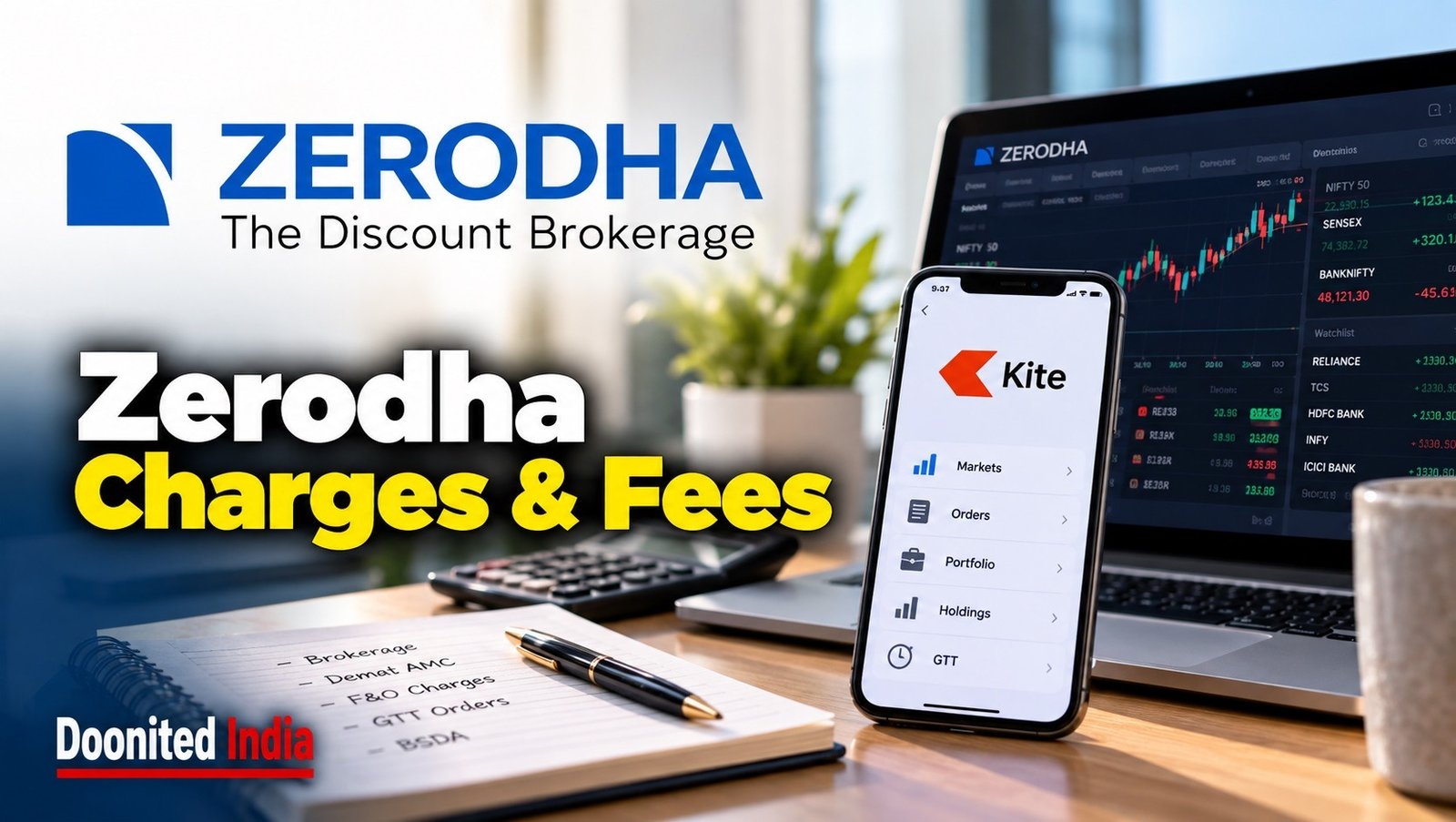
Zerodha’s Kite platform adds another part to the proposition: a trading interface with charting, alerts, Good Till Triggered (GTT) orders and basket orders. These features can make order management more convenient, but they do not remove market risk or guarantee that an order will execute at the price a trader wants.
Zerodha brokerage charges: the current structure
For resident individual accounts, Zerodha’s published brokerage schedule distinguishes between delivery investments, intraday trades, futures and options.
|
Transaction type |
Brokerage |
|---|---|
|
Equity delivery |
₹0 |
|
Equity intraday |
₹20 or 0.03% per executed order, whichever is lower |
|
Equity futures |
₹20 or 0.03% per executed order, whichever is lower |
|
Equity options |
Flat ₹20 per executed order |
These are brokerage charges, not the total cost of trading. Other statutory and exchange-related charges apply according to the transaction and instrument. The exact amount can also differ by segment and exchange.
What “zero brokerage” actually means
For eligible retail individual investors, equity delivery trades carry no brokerage at Zerodha. That can be relevant to people who buy shares with the intention of holding them rather than selling them within the same trading session.
However, delivery transactions can still attract costs. STT applies to equity delivery transactions on both the buy and sell sides, while stamp duty generally applies on the buy side. Exchange transaction charges, regulatory charges and GST may also be applicable. When shares are sold from a demat account, a DP charge may be levied.
The distinction matters because a broker can charge zero brokerage while a transaction still generates a payable amount. “Zero brokerage” describes one component of the bill—not every charge associated with investing.
Demat account AMC: free initially, then account-dependent
Zerodha’s charges page states that account opening is free for individual accounts and that eligible new resident individual accounts opened on or after 1 June 2026 receive a first-year AMC waiver. From the second year, the maintenance charge depends on whether the account is a standard demat account or qualifies as a Basic Services Demat Account (BSDA).
For resident individual accounts, the published AMC structure is:
|
Account type |
Annual maintenance charge |
|---|---|
|
Standard non-BSDA account |
₹300 + 18% GST |
|
BSDA: holdings up to ₹4 lakh |
₹0 |
|
BSDA: holdings above ₹4 lakh and up to ₹10 lakh |
₹25 per quarter + GST |
|
BSDA: holdings above ₹10 lakh |
₹75 per quarter + GST |
The BSDA classification is subject to eligibility conditions, including the number of demat accounts held under the same PAN. It should not be assumed that every account with holdings below ₹4 lakh automatically qualifies.
A useful detail for new customers is that the first-year waiver is not necessarily a permanent waiver. Investors should check the applicable AMC, the date from which it is charged and whether the account is classified as BSDA.
Kite: a trading interface built around order management
Kite is Zerodha’s web and mobile trading platform. Its feature set includes market search, advanced charts, alerts, GTT orders and baskets. These tools are designed to help users monitor instruments and manage orders from one interface.
GTT orders: useful, but not a guarantee
Good Till Triggered orders allow users to define a trigger price. When the specified condition is reached, Kite places an order according to the user’s selected instructions. Zerodha says GTT orders can remain active for up to 365 days and are free to place.
The important limitation is that a trigger is not the same as a completed trade. A triggered order may not execute if its price conditions are not met or if the order is otherwise not executed. A market gap can also mean that the price at which an order is placed differs from what the investor expected.
GTT is therefore an order-management facility—not a promise of a particular exit price or protection against losses.
Basket orders: several orders, one organised workflow
Kite’s basket feature allows users to group multiple orders, save baskets and execute them in sequence. Zerodha’s support documentation says a basket can contain up to 20 orders, with up to 50 baskets created. The broker says it does not charge an additional fee specifically for basket orders; the individual trades remain subject to their applicable charges.
This can be useful for investors who need to organise multiple trades. But a basket is not a guarantee that every order will be executed. Users should check each order’s status, available funds or margin, and any rejected or partially executed orders.
The wider Zerodha ecosystem
Kite sits within a broader collection of Zerodha products. The company lists Console for account reports and portfolio-related information, Coin for direct mutual fund investments, Varsity for educational material and Kite Connect APIs for developers.
Zerodha also offers integrations and third-party tools. However, availability, pricing and the features included in free or paid plans can change. Investors should check the relevant provider’s current terms rather than assume that every tool or premium feature is included at no additional cost.
For a new investor, educational resources may be as important as the trading interface. A platform can make it easier to place an order; it cannot replace understanding the instrument, the risk involved or the difference between investing and short-term trading.
The costs beyond brokerage
A realistic trading-cost calculation should consider more than the broker’s headline fee. Depending on the transaction, the bill may include:
-
STT or CTT: government levies that vary by instrument and transaction type.
-
Exchange transaction charges: charges based on the exchange and segment.
-
GST: applicable to specified service and transaction-related charges.
-
Stamp duty: generally linked to the buy-side transaction and applicable rates.
-
DP charges: potentially applicable when securities are debited from a demat account.
-
Other service charges: for example, charges for certain dealer-assisted orders or optional services.
The rates and rules are subject to change. Zerodha’s official charges page is the appropriate reference for checking the latest schedule before placing a trade.
DOONITED View: compare the complete bill, not the headline
Zero brokerage on delivery is easy to understand and can make the cost structure appear refreshingly simple. Yet the most useful comparison between trading platforms goes beyond a single fee.
Investors should examine the brokerage formula, statutory charges, demat maintenance, order-related fees, platform tools and the support information available when something goes wrong. They should also distinguish between a feature that improves convenience and one that changes the financial risk of a trade. GTT orders, baskets and charting tools can support a process; none can make an uncertain market predictable.
The same principle applies to derivatives. A flat brokerage fee may look modest beside the value of a position, but the potential loss on a leveraged or options trade can be much larger than the fee. A low-cost transaction is not automatically a low-risk transaction.
There is a small irony in the phrase “free trading”: the brokerage may be zero, but the decision still has a price if it is poorly researched.
Learning Point
Before choosing a broker or placing a trade, calculate the total transaction cost and understand the product being traded. Check the current official charges, confirm whether the account qualifies for a BSDA or AMC waiver, and remember that order tools do not guarantee execution or returns.
For most investors, the first question should not be how cheaply they can trade. It should be whether the trade fits their goals, knowledge and capacity to absorb risk.


World Beyond the News
Octopuses Can Change Their Appearance
Octopuses can rapidly alter their skin colour and texture to communicate, camouflage themselves and respond to danger.
Some Cities Exist Across Two Continents
A small number of cities are geographically associated with two continents, creating unusual cultural and geographic identities.
Earth’s Climate Is Measured in Many Ways
Scientists track temperature, atmospheric gases, sea level, ice cover and other indicators rather than relying on a single climate number.
Streaming Changed How Audiences Discover Shows
Recommendation systems and global streaming releases allow audiences to discover programmes far beyond their original markets.