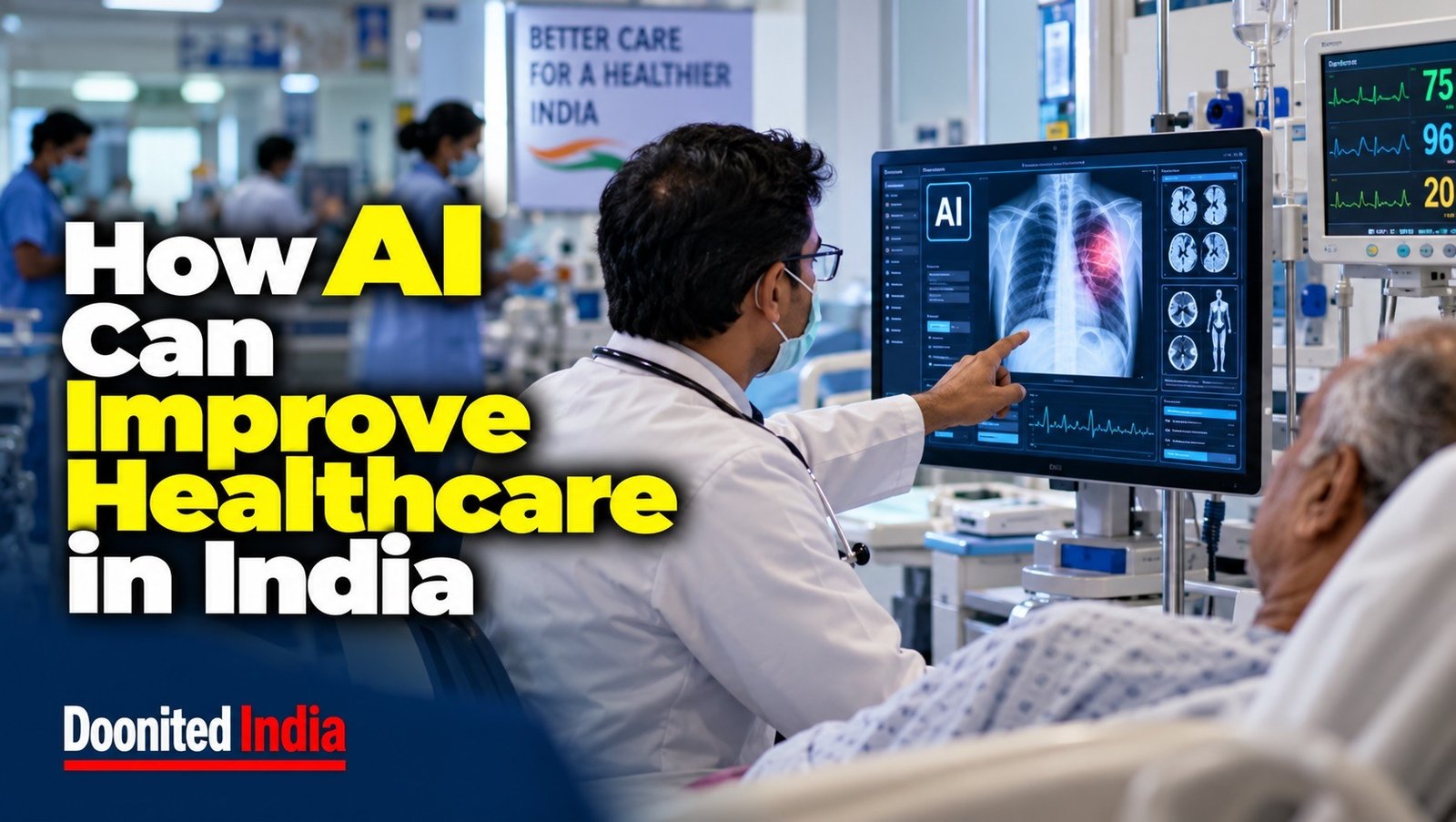
AI in Indian Healthcare: Can Technology Make Better Care Reach More People?
From reading medical scans to easing hospital bottlenecks, artificial intelligence could help India deliver faster, more consistent healthcare. But the real test is not whether an algorithm can impress in a demonstration—it is whether it works safely for diverse patients, supports clinicians and reaches people beyond major cities. As the AI in Healthcare Grand Summit 2.0 approaches, India’s challenge is turning technological promise into trustworthy care.
A medical scan may take only minutes to produce, but getting the right interpretation can depend on specialist availability, workload and the quality of the image itself. In a busy hospital, the gap between generating a report and acting on it can matter enormously.
Artificial intelligence (AI) is increasingly being developed to help with tasks like these: flagging suspicious findings, organising clinical information, supporting risk assessment and reducing repetitive administrative work. In principle, such tools could give healthcare professionals more time for patients and help hospitals use scarce resources more effectively.
For India, the opportunity is substantial—but so is the responsibility. A country with major differences in income, infrastructure, language and access to specialists cannot measure healthcare AI only by how well it performs in a sophisticated urban hospital. The technology must also be safe, affordable, useful in ordinary clinical settings and accountable when something goes wrong.
These questions are likely to feature prominently at the AI in Healthcare Grand Summit 2.0, scheduled for October 10–11, 2026, in Gurugram. The organiser lists the Gurgaon Convention Centre as the proposed venue, with the location still marked “to be confirmed,” and expects more than 500 delegates and 50 speakers. The event is organised by ICG and ICSPL. Those attendance figures and programme details are the organiser’s projections, rather than independently verified attendance.
From an impressive demo to a dependable clinical tool
AI can assist with several different kinds of healthcare work, but these should not be confused with one another.
In medical imaging, for example, a model may help flag an area that warrants a radiologist’s attention. In pathology, software may help analyse digitised slides. In cardiology, algorithms can support the interpretation of certain signals or identify patterns that deserve further review.
In each case, the tool’s value depends on the task, the quality of its training and validation, and the clinical setting in which it is used. An algorithm that performs well on one dataset may not perform equally well across hospitals, equipment, patient populations or disease patterns.
AI can also support hospital operations. Predicting patient volumes, assisting appointment scheduling, organising records and reducing repetitive documentation may help administrators make better use of beds, staff and diagnostic facilities. These applications may not attract the same attention as an AI system that detects disease, but operational improvements can affect how quickly patients move through the system.
The distinction is important: AI that supports a clinician is not the same as AI that independently makes a clinical decision. A tool can produce a useful alert, but a qualified professional must interpret it in context and decide what action is appropriate.
India’s emerging framework: SAHI and BODH
India has begun building a national framework around responsible health AI. In February 2026, the Ministry of Health and Family Welfare launched the Strategy for Artificial Intelligence in Healthcare for India (SAHI) and the Benchmarking Open Data Platform for Health AI (BODH).
SAHI is intended to guide the safe, ethical, evidence-based and inclusive adoption of AI across the healthcare system. It addresses the governance and practical foundations needed to introduce these tools responsibly, rather than treating technology adoption as an end in itself.
BODH, developed by IIT Kanpur in collaboration with the National Health Authority, is designed to help evaluate AI models using diverse, anonymized real-world health data while protecting the underlying datasets. Its purpose is to strengthen assessment of a model’s performance, robustness and suitability before broader deployment.
These initiatives address a central problem: healthcare AI needs to be tested against the realities of the population it will serve. A model should not be considered reliable simply because it performs well in a vendor presentation or a limited trial.
India’s regulatory framework also matters. The Central Drugs Standard Control Organisation has a pathway for regulating AI-enabled medical devices under the Medical Devices Rules, 2017, including requirements for technical documentation, risk analysis, verification and validation, and clinical evidence where applicable.
The existence of a framework does not guarantee that every tool in use is safe. Implementation, monitoring and enforcement remain essential. But national guidance and structured evaluation provide a foundation for moving from experimentation towards responsible deployment.
The patient is not a data point
Healthcare AI depends on data, and medical data is among the most sensitive information a person can share. Records may reveal diagnoses, medications, family history, reproductive health and other details that patients would not want exposed or used in ways they do not understand.
India’s Ayushman Bharat Digital Mission (ABDM) is intended to support interoperable digital health records and exchange. Its health-data framework emphasises privacy and security, while the ABHA system is designed to enable digital access and sharing of health records with informed consent.
For AI developers and healthcare institutions, the challenge is to use data in ways that are lawful, secure and clinically meaningful. Removing names from a dataset is not, by itself, a complete privacy strategy. Institutions must also consider access controls, cybersecurity, consent, data minimisation, retention and the possibility of re-identification.
Patients should not have to choose between receiving care and surrendering control over their personal information. Trust is not a decorative feature of digital health; it is part of the infrastructure.
The risk of an AI divide
India’s healthcare needs are not uniform. A large private hospital in a metropolitan centre may have digital records, specialist teams, reliable connectivity and the budget to integrate new systems. A smaller facility may face shortages of staff, equipment, stable internet access and technical support.
If AI tools are built primarily for well-resourced hospitals, they could deepen existing disparities. A system that requires expensive equipment, extensive digitisation or specialist oversight may be of limited use in the places where additional support is most needed.
The answer is not simply to make AI cheaper. It must be designed for local conditions: different languages, varied clinical workflows, uneven data quality and the practical realities of frontline healthcare. It must also be maintained. Software that is installed but not updated, monitored or integrated into daily work can become another underused hospital investment.
Public procurement and pilot programmes should therefore ask more than whether a tool works. They should ask who benefits, who is excluded, what it costs to operate, and whether outcomes improve in the settings where it is deployed.
Who is responsible when AI gets it wrong?
No AI system is error-free. A false alarm can trigger unnecessary tests and anxiety; a missed finding can delay further assessment. Bias in training data can also produce uneven performance across patient groups.
That makes clinical responsibility a practical issue, not an abstract debate. Hospitals need clear rules about when AI output should be reviewed, how disagreements between a clinician and a model are handled, and who is responsible for monitoring performance after deployment.
Clinicians should understand a tool’s intended use and limitations. Developers should provide meaningful evidence and disclose relevant risks. Healthcare institutions should ensure that systems are validated for their setting and that staff are trained to use them appropriately.
Patients, meanwhile, deserve understandable information when AI materially influences their care. The presence of a human professional should mean more than a signature at the end of an automated process.
What the summit should help answer
The October summit offers an opportunity to move the discussion beyond predictions about what AI might eventually do. The questions that matter now are specific:
Which applications have demonstrated meaningful clinical or operational benefits?
How are tools being validated across different Indian populations and healthcare settings?
What safeguards protect patient data?
Who monitors performance after a system is introduced?
How can smaller hospitals and rural facilities access useful technology without unsustainable costs?
The answers should be measured in evidence: better diagnostic performance, reduced delays, safer workflows, lower avoidable costs or improved access—not simply the number of AI products launched.
India has important assets for developing health AI, including a large and diverse population, a growing digital-health ecosystem and strong technical and medical expertise. Those advantages will matter only if data quality, validation, privacy and clinical accountability develop alongside innovation.
The most useful healthcare AI may not be the system that promises to replace the most human work. It may be the one that helps a doctor notice something earlier, gives a nurse more time with a patient, or helps a smaller hospital make better use of limited resources.
That is the standard India should set: not AI for its own sake, but technology that earns its place in healthcare by making care safer, more accessible and more dependable.


World Beyond the News
Dolphins Use Individual Signature Whistles
Bottlenose dolphins develop distinctive whistles that function somewhat like individual acoustic identifiers.
The Pacific Is Earth’s Largest Ocean
The Pacific Ocean covers more area than any other ocean basin and stretches between Asia, Australia and the Americas.
Artificial Intelligence Learns Statistical Patterns
Modern machine-learning systems identify patterns in large datasets and use those patterns to generate predictions or outputs.
Why Some Stories Spread So Quickly
Emotion, novelty, visual appeal and easy sharing can make a story travel rapidly across social platforms.