Amit Aggarwal and the New Indian Couture: When Waste Materials Become Luxury
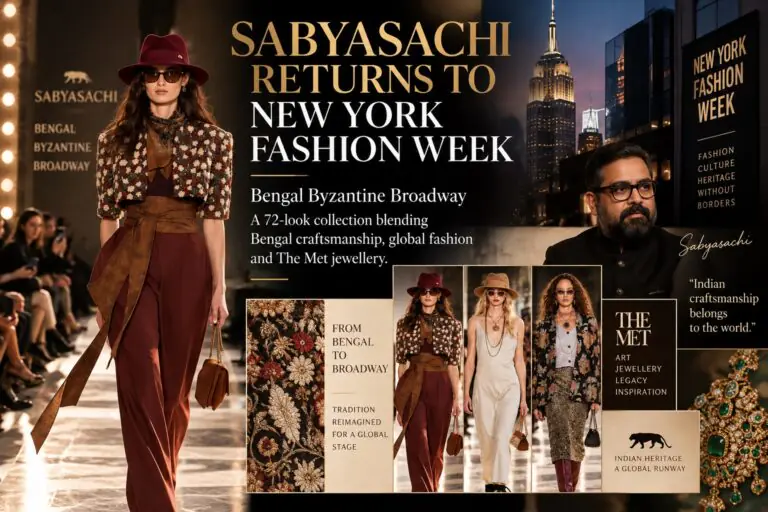
Amit Aggarwal’s AM.IT will close Lakmē Fashion Week x FDCI’s Delhi edition on October 18, bringing his experimental approach to materials into the spotlight. But his significance goes beyond one runway: he has spent years asking whether discarded materials can become part of a genuinely new Indian language of luxury.
What happens when something designed to be thrown away becomes something people want to keep?
In most industries, the answer would be a recycling story.
In the hands of Amit Aggarwal, it can become fashion.
Plastic sheets, discarded textile remnants, old Patola and Benarasi fabrics, bindi sheets, straws, rubber and other industrial or post-production materials have appeared in his design vocabulary over the years. Instead of concealing their origins, Aggarwal has often made their transformation part of the creative proposition.
That makes his upcoming appearance at Lakmē Fashion Week x FDCI in New Delhi particularly interesting.
On 18 October 2026, his prêt label AM.IT is scheduled to close the Delhi edition’s Grand Finale at the Taj Palace. The announced collection looks at everyday India through craft, urban landscapes, colour, utility and ornament, translating those references into contemporary silhouettes, textures and materials.
The timing is significant.
Fashion is under growing pressure to explain where its materials come from, how long garments last and what happens when consumers no longer want them.
Aggarwal has been asking versions of those questions for years.
The more difficult question now is whether his approach points towards the future of Indian luxury — or remains an exceptional example of what one unusually inventive designer can achieve.
The waste was never simply waste
Aggarwal’s relationship with unconventional materials is not a recent response to the sustainability conversation.
Vogue India has documented his use of recycled plastics and industrial materials across both his couture and AM.IT work, including recycled polymer sheets, plastic bags, bindi sheets, discarded discs, toy parts and vintage Indian textiles that were no longer usable as saris.
In an earlier interview, Aggarwal explained his interest in giving discarded raw material another identity and described upcycling as a way of moving everyday materials into fashion rather than treating them as disposable.
That distinction is important.
There is a temptation to describe recycled fashion as an aesthetic category: look, this dress was made from waste.
Aggarwal’s work is more ambitious.
The material itself becomes part of the design problem.
A plastic sheet does not automatically become fashionable because it has been reused. It has to be cut, structured, manipulated, combined, engineered and finished well enough to become desirable.
The transformation is therefore both environmental and aesthetic.
Why polymer became part of his signature
One of Aggarwal’s most distinctive techniques has been his use of polymer and other non-traditional materials to create structure.
Vogue India has described his practice as involving recycled polymer sheets that are cut, folded, moulded and transformed into architectural forms. His work has also combined these materials with Indian textiles such as Patola, Benarasi and Chanderi.
The result is far removed from the visual language normally associated with “eco-fashion”.
There are no obvious signals saying I am sustainable.
Instead, there are sculptural silhouettes, unusual surfaces and highly engineered forms.
That may be the most interesting part of Aggarwal’s approach.
He does not necessarily make sustainability look rustic.
He makes it look futuristic.
The Indian textile tradition is still inside the experiment
Calling Aggarwal’s work “recycled fashion” alone would also miss an important part of the story.
His material experimentation frequently exists alongside Indian textile traditions.
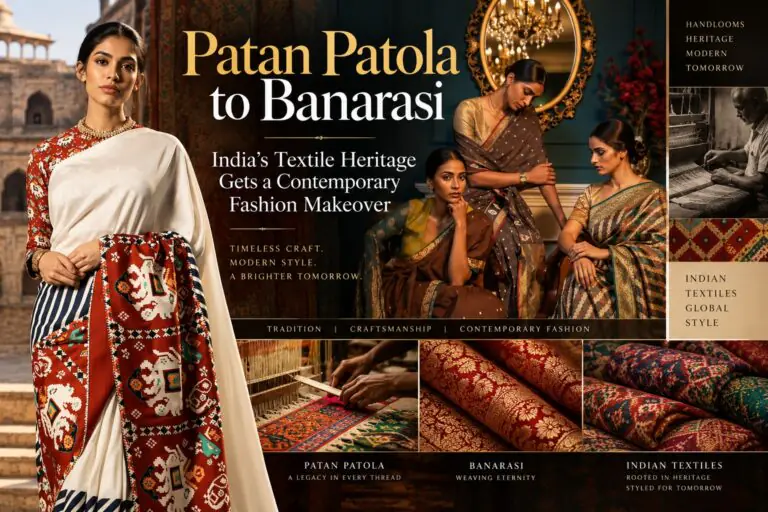
Vintage Patola and Benarasi textiles, Chanderi weaving, zari and traditional embroidery techniques have appeared alongside polymers and industrial materials. Vogue has documented his combination of recycled materials with heritage textiles, while his couture work has incorporated techniques such as aari and zardozi over unconventional bases.
This creates a productive contradiction.
The traditional and the industrial are not presented as opposites.
They are engineered into the same garment.
A historic textile can meet a synthetic polymer.
Hand embroidery can sit on an unconventional surface.
An old weaving tradition can become part of an aggressively modern silhouette.
That is arguably a more interesting model for Indian fashion than simply reproducing traditional clothing in contemporary colours.
It suggests that heritage does not have to mean preservation in amber.
It can mean reinvention.
AM.IT: making experimentation more wearable
Aggarwal’s prêt label AM.IT, launched in 2015, was conceived as a more accessible extension of his conceptual design language.
The objective was not to abandon experimentation but to move some of its ideas into everyday wardrobes.
Vogue’s coverage of the label’s early collections documented combinations including recycled plastic, straws, gamcha, bindi sheets and other unconventional materials.
That distinction becomes especially relevant for the October 2026 finale.
The show is not being positioned simply as a display of couture experimentation. It is an AM.IT presentation exploring the transition from professional life into evening dressing, with the collection drawing on everyday Indian visual contrasts — craft and concrete, function and ornament, practicality and colour.
That gives the finale a broader commercial question.
Can an experimental material language become part of clothing people actually want to live in?
Sustainability is harder than using recycled material
Here is where fashion’s sustainability conversation needs more honesty.
Using recycled or reclaimed material is not automatically equivalent to producing an environmentally sustainable garment.
A complete sustainability assessment would need to consider the material’s original production, collection, processing, energy use, chemical treatments, transport, durability, repairability and eventual end-of-life.
A synthetic material may be diverted from waste and given a longer useful life, which can be valuable.
But that does not make every garment made from plastic environmentally benign.
This distinction is crucial because the fashion industry has become increasingly skilled at turning sustainability into a marketing vocabulary.
Words such as conscious, eco, green, responsible and sustainable can sound reassuring while revealing very little about a product’s complete lifecycle.
Aggarwal’s work is more interesting when viewed as material innovation and upcycling, rather than automatically treating every unconventional material as proof of complete sustainability.
That is a higher — and more useful — standard.
The real innovation is changing what luxury means
Luxury has traditionally been associated with scarcity.
Rare textiles.
Precious materials.
Exceptional craftsmanship.
Long production times.
Aggarwal introduces another possibility:
Luxury can also be defined by transformation.
A material that has little perceived value can acquire value through extraordinary design and workmanship.
That is not entirely new. Haute couture has always been capable of transforming ordinary raw materials through skilled labour.
What is different is the deliberate use of materials whose previous identity was associated with waste or disposability.
This creates an intriguing reversal.
The old luxury equation was often:
rare material + skilled craftsmanship = high value.
The emerging equation can be:
unexpected material + intellectual design + skilled craftsmanship = new value.
That shift could become particularly important for Indian fashion.
Why this matters for Indian luxury
India has an enormous textile and craft heritage, but it also has a huge contemporary waste challenge.
The fashion sector sits at the intersection of both.
There are textile scraps, surplus fabrics, discarded garments, industrial remnants and enormous quantities of materials moving through manufacturing systems.
At the same time, India possesses highly skilled craftspeople capable of embroidery, weaving, surface development, hand manipulation and intricate finishing.
The opportunity lies in bringing these two worlds together.
Aggarwal’s practice demonstrates one version of that possibility.
Waste does not have to be treated merely as a disposal problem.
It can become a design resource.
But for the idea to scale, the fashion industry needs more than individual designers.
It needs better material traceability, collection systems, recycling infrastructure, responsible manufacturing, skilled labour, consumer education and transparent claims.
A couture runway can start the conversation.
It cannot solve the waste problem by itself.
The business challenge: can circularity scale?
There is another uncomfortable question.
Luxury fashion depends partly on desirability and newness.
Sustainability, meanwhile, asks consumers to buy less, use products longer and waste less.
Those two ideas can coexist, but not automatically.
The industry’s future may depend on moving from a model of constant replacement towards one based more heavily on durability, repair, reuse, resale and material recovery.
For designers, this creates an opportunity to redefine why a garment deserves to be expensive.
If a piece is beautifully made, materially innovative and designed to survive for years, its value becomes less dependent on seasonal novelty.
That is where Indian luxury could potentially develop a distinctive advantage.
India already possesses a deep cultural tradition of extending the life of clothing — through tailoring, alteration, hand-me-downs, reuse, embroidery and transformation.
The modern sustainability conversation may therefore have something to learn from practices that existed long before the word “circularity” became fashionable.
The October runway is bigger than a finale
When AM.IT closes Lakmē Fashion Week x FDCI on October 18, the immediate attraction will naturally be the clothes.
There will be the runway production, beauty direction, models, music, photography and social-media conversation.
But the more important question will be material.
What happens when a designer takes the visual language of India’s everyday environment — its craft, construction, colour, utility and urban contradictions — and turns it into luxury?
The organisers’ description of the AM.IT finale suggests precisely this movement between everyday life and fashion, with the collection designed around the changing rhythm of the modern woman’s day.
It is a useful direction for Indian fashion because luxury no longer has to mean distance from ordinary life.
Sometimes it can mean looking at ordinary things differently.
From “waste” to “worth”
Amit Aggarwal’s importance in the sustainability conversation is therefore not that he has somehow solved fashion’s environmental problems.
He has not — and no single designer can.
His importance is that he has challenged a deeply embedded assumption:
that the value of a material is determined by what it was originally made to be.
A plastic sheet can become structure.
A discarded textile can become surface.
An old sari can become a new form.
An industrial leftover can become part of an object of desire.
And traditional craftsmanship can provide the bridge between the discarded and the luxurious.
That is a powerful idea for Indian fashion.
The next stage, however, must go beyond clever transformation.
The industry needs to demonstrate durability, transparency, responsible sourcing and measurable environmental improvement.
If that happens, sustainability will cease to be a decorative adjective attached to luxury.
It could become part of luxury’s definition itself.
And perhaps that is the most interesting promise of Amit Aggarwal sustainable fashion.
Not that waste can be made beautiful.
But that design can make us question why we ever decided something was worthless in the first place.


World Beyond the News
Birds Can Navigate Using Earth’s Magnetic Field
Several bird species can sense Earth’s magnetic field, helping them navigate during long-distance migration.
Fermentation Is a Global Food Tradition
People across continents have used fermentation for centuries to preserve food and create distinctive flavours.
Modern Batteries Store Energy Chemically
Rechargeable batteries repeatedly move ions between electrodes, allowing electrical energy to be stored and released.
Why Songs Become Global Hits
Streaming platforms, short-form video, playlists and international collaborations can rapidly carry music across borders.