Kota Dussehra Mela: Why a 300-Year-Old Fair Still Matters to Modern India
Kota’s Dussehra is much larger than a single evening of Ravana Dahan. Tracing its documented history to 1723, the fair has evolved from a royal and religious observance into a sprawling public celebration where Ramleela, folk culture, commerce, entertainment and community life meet. In 2026, the Kota Dussehra Fair runs from 20 October to 6 November.
A Festival That Refused to Stay Small
On 20 October 2026, while millions across India mark Vijayadashami, Kota will begin another chapter of a tradition whose documented history reaches back more than three centuries.
The Kota Dussehra Fair, held at Dussehra Ground, is officially scheduled from 20 October to 6 November 2026. The Ministry of Tourism’s Incredible India portal describes it as one of Rajasthan’s major Dussehra celebrations and traces its origins to 1723, during the reign of Mahrao Durjanshal Singh Hada. Incredible India
That is what makes Kota interesting.
Dussehra itself is ancient and celebrated throughout India. But Kota developed a distinctive local institution around it: a religious occasion that gradually became a large public fair.
The result is not simply a ceremony.
It is a temporary city within the city.
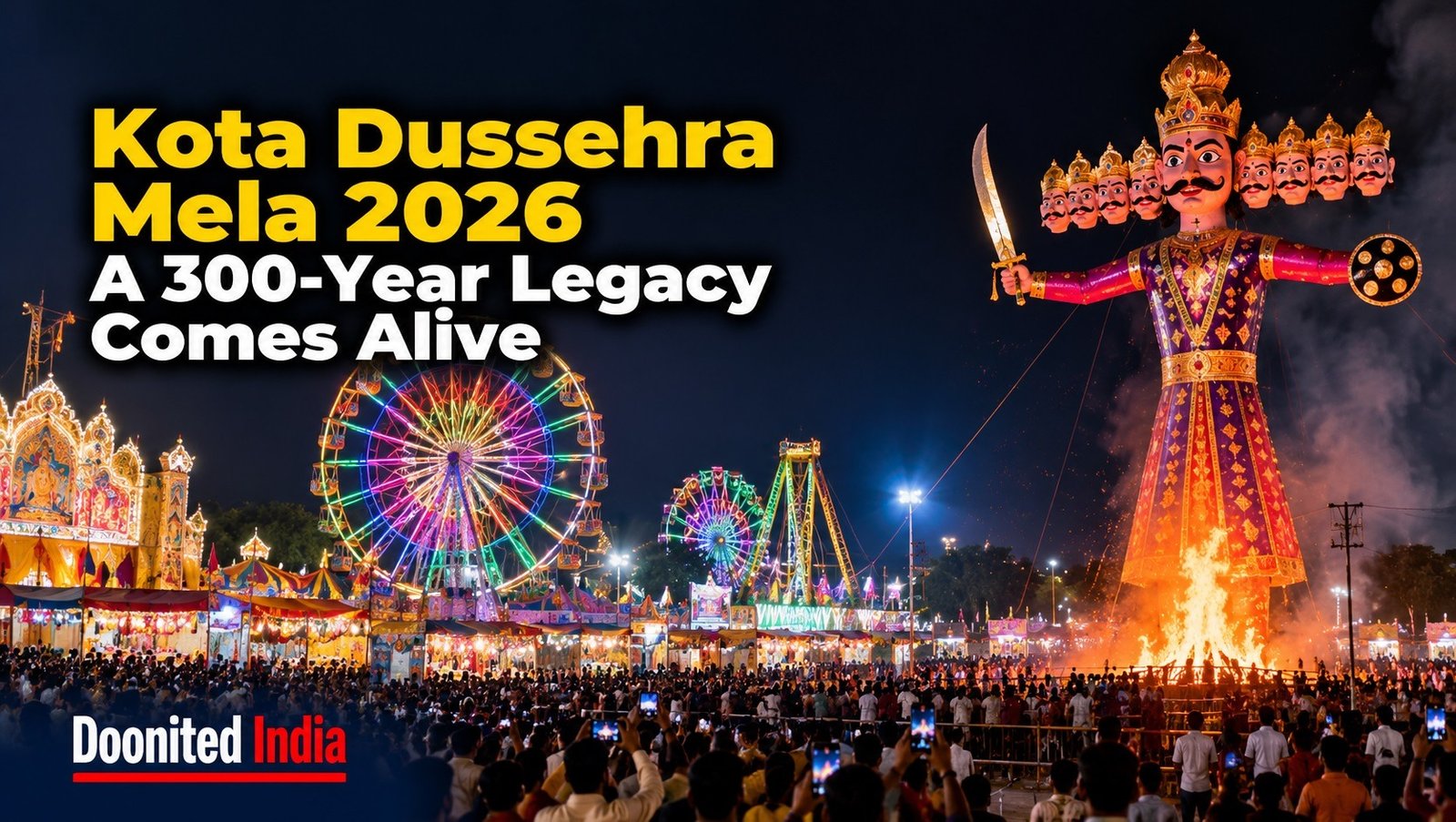
There are religious performances, Ramleela, cultural programmes, markets, food, entertainment and the spectacular burning of the Ravana, Kumbhkarana and Meghnad effigies.
The festival’s history therefore tells a larger story about India itself: how traditions survive not by remaining frozen, but by absorbing new generations, new forms of entertainment and new economic realities.
From Royal Ceremony to Public Fair
According to the Ministry of Tourism’s Utsav portal, Kota’s Dussehra tradition began during the reign of Mahrao Durjanshal Singh Hada. Early celebrations centred on religious programmes at temples, royal processions and the Darikhana, a royal gathering of local chiefs at the palace. Utsav
The scale was very different from today’s event.
The same official account records that the state-era celebration was initially only three days long and that the effigies of Ravana and his family were approximately 20–25 feet high.
Over time, the festival expanded.
The Utsav account credits Maharao Ummed Singh II, who ruled from 1889 to 1940, with helping transform the celebration into a more elaborate and colourful public event. Cultural programmes and other attractions gradually became part of the festival. Utsav
That evolution is perhaps more important than the exact height of an effigy.
It shows how a royal ritual can become a public cultural institution.
The Giant Effigies Are Only the Climax
The visual image most people associate with Kota is the burning of Ravana.
The 2026 Incredible India listing says the effigies of Ravana, Kumbhkarana and Meghnad can reach 75 feet or more, and describes their destruction as the central spectacle of the festival. Incredible India
But reducing Kota Dussehra to the effigy burning misses most of the story.
Rajasthan Tourism describes Ramleela as a major feature of the celebrations, alongside cultural programmes and performances. Rajasthan Tourism
The Ministry of Tourism’s Utsav listing describes a much broader programme, including:
- Rajasthani folk music and dance
- Bhajan Sandhya
- Kavi Sammelan
- Mushaira
- Qawwali
- Punjabi and Sindhi cultural programmes
- Bhojpuri cultural programmes
- Other performances involving artists from across India. Utsav
That range is revealing.
Kota Dussehra is not a single cultural tradition being displayed for tourists.
It is a popular cultural marketplace, where different forms of Indian performance meet the expectations of a large public audience.
A poetry evening can exist beside a fairground ride.
A religious performance can share the calendar with popular entertainment.
Traditional food can be sold alongside modern fair attractions.
That mixture may look chaotic to an outsider.
It is also precisely what makes the event culturally alive.
The Fairground Is Part of the Heritage
There is a tendency to separate “heritage” from “commerce”.
Historic buildings are considered heritage.
Crafts are considered heritage.
Traditional performances are heritage.
Markets and food stalls are sometimes dismissed as mere commercial activity.
Kota challenges that neat division.
The fair has long provided an opportunity for traders to meet rural and urban buyers. The Kota Dussehra Mela’s own historical account describes the festival as an important opportunity for traders to display goods to visitors from surrounding areas. Kota Dussehra Mela
This is an important part of understanding Indian fairs.
A mela is not necessarily a museum.
It is a place where culture is bought, sold, eaten, performed and experienced.
That commercial dimension does not automatically make heritage less authentic.
In some cases, it helps sustain it.
A local producer who can earn money during a major festival has an economic reason to return the following year.
A performer who finds an audience has a reason to keep performing.
A food vendor who earns seasonal income becomes part of the festival’s informal infrastructure.
The relationship between culture and commerce is therefore more complicated than the usual argument that tourism either “preserves” heritage or “commercialises” it.
Often, it does both.
Why the Fair Still Matters to Younger Indians
The biggest challenge facing traditional festivals is not always tourism.
It is relevance.
A three-hundred-year-old tradition can survive on paper while disappearing from everyday cultural memory.
Young people have enormous entertainment choices today. They can spend an evening watching streaming platforms, gaming, scrolling social media or attending a commercial event.
Why should a teenager still care about an old Ramleela or a centuries-old fair?
Kota’s answer is not to compete with modern entertainment by becoming solemn.
It does almost the opposite.
It makes heritage participatory.
There are performances to watch, food to eat, markets to explore, rides and attractions, music, poetry and the large communal spectacle of Ravana Dahan.
The fair creates an environment where younger visitors can encounter tradition without having to approach it like a history lesson.
That may be one reason such events continue to matter.
Heritage becomes something you do, not merely something you are told to respect.
The Economy of a Mela
Kota Dussehra also illustrates the economic importance of cultural events to cities outside India’s largest metropolitan centres.
The official sources describe the fair as attracting lakhs of visitors from across the country. Incredible India
That scale creates temporary demand for hotels, restaurants, transport, food vendors, retailers, entertainment operators and other services.
But there is a reason to be cautious about the numbers.
I could not verify a current independent 2026 economic-impact study that quantifies exactly how much additional revenue the Kota Dussehra Mela generates for local businesses.
It would therefore be misleading to attach an unsupported figure to its economic contribution.
The broader economic logic, however, is clear.
A major public festival concentrates thousands of consumers in one place over an extended period.
For local businesses, that matters.
And the 2026 preparations themselves demonstrate the scale of municipal activity surrounding the event. Rajasthan’s e-procurement system shows contracts related to cultural programmes, flower decoration and other Dussehra Mela works, including a ₹36 lakh tender for a drone light show at the Kota Dussehra Mela. Rajasthan eProcurement
The fair is therefore not simply an inherited tradition.
It is also a substantial contemporary public-production exercise.
Modern Technology Is Entering the Old Fair
The drone-light-show tender is a particularly interesting detail.
A festival whose roots reach back to the 18th century is now incorporating technology that would have been unimaginable to its founders.
That tells us something about cultural continuity.
Tradition does not necessarily mean refusing innovation.
The question is whether new technology strengthens the experience or overwhelms it.
A drone show can create a new spectacle.
Digital promotion can bring new visitors.
Modern lighting and production can make performances accessible to larger audiences.
But if every new addition is designed only to create a bigger spectacle, the festival risks becoming an entertainment fair with a historical label.
The challenge is to allow innovation without allowing the original cultural narrative to disappear beneath it.
The Environmental Question Behind Ravana Dahan
There is also a less comfortable side to the spectacle.
Large effigies, fireworks, huge crowds, temporary infrastructure and amplified entertainment all have environmental consequences.
The symbolism of Ravana Dahan is about the triumph of righteousness over evil. The physical event, however, takes place in a modern city with contemporary concerns about air quality, waste, noise and public safety.
That does not make the tradition irrelevant.
It makes responsible management more important.
A 300-year-old festival should not have to choose between tradition and modern environmental standards.
The better solution is to preserve the symbolic ritual while continuously improving materials, waste management, crowd control, fire safety and emissions management.
Heritage that survives by adapting responsibly is stronger than heritage protected by refusing every question.
Kota’s Real Heritage Is the Crowd
Perhaps the most revealing thing about Kota Dussehra is that its most important heritage asset is not the effigy.
It is the crowd.
Royal rulers established the early tradition.
Priests gave it religious meaning.
Performers expanded its cultural vocabulary.
Traders turned it into a marketplace.
Local authorities built the infrastructure.
And generations of ordinary people kept returning.
That is how a festival becomes living heritage.
The fair’s survival is not evidence that every historical practice must remain unchanged. It is evidence that a cultural tradition can continue when communities repeatedly find reasons to participate in it.
This is also why the phrase “300-year-old fair” should not be misunderstood.
Kota Dussehra is not a time capsule from 1723.
The festival has changed substantially over the centuries.
Its duration, programmes, technologies, scale and audience have evolved.
Its continuity lies in the relationship between the celebration and the city, not in keeping every detail identical to the past.
What Kota Teaches Modern India
India has thousands of festivals.
Some are globally famous.
Others are known mainly within a district or region.
The future of cultural tourism will depend partly on whether such events can communicate their significance beyond their immediate communities without becoming generic spectacles.
Kota has an advantage.
Its story is easy to understand but deep enough to explore:
good versus evil, royal history, Ramleela, folk culture, commerce, entertainment and community participation.
It also offers a lesson for other heritage cities.
A festival becomes economically and culturally valuable when visitors do not merely arrive, photograph the main event and leave.
They should encounter the city.
Eat its food.
Meet its people.
Buy its products.
Hear its music.
Understand its history.
And perhaps leave with a better understanding of why the place matters.
That is the real opportunity for Kota.
Not simply to make its Dussehra bigger.
But to make it more meaningful.
A 300-Year Tradition Still Has a Future
The Kota Dussehra Fair will run from 20 October to 6 November 2026, according to the Government of India’s Incredible India listing and Rajasthan Tourism’s 2026 festival calendar. Incredible India
For visitors, the giant Ravana will probably remain the most obvious image.
But the larger story is elsewhere.
It is in the Ramleela performer preparing backstage.
The trader arranging goods in a temporary stall.
The family arriving from a nearby village.
The poet waiting for a microphone.
The child seeing the effigy for the first time.
The municipal worker preparing the ground.
The modern drone preparing to light the sky above a festival whose roots stretch back to the 18th century.
That combination is the real Kota Dussehra story.
A tradition survives not because history tells people to preserve it, but because each generation finds a new reason to participate.
Kota’s three-century-old fair still matters for precisely that reason.
It is old enough to remember where it came from—and modern enough to keep changing.


World Beyond the News
Birds Can Navigate Using Earth’s Magnetic Field
Several bird species can sense Earth’s magnetic field, helping them navigate during long-distance migration.
Fermentation Is a Global Food Tradition
People across continents have used fermentation for centuries to preserve food and create distinctive flavours.
Modern Batteries Store Energy Chemically
Rechargeable batteries repeatedly move ions between electrodes, allowing electrical energy to be stored and released.
Why Songs Become Global Hits
Streaming platforms, short-form video, playlists and international collaborations can rapidly carry music across borders.