The Coconut Economy of the Andaman Islands: Can One Island Crop Become a Tourism Story?
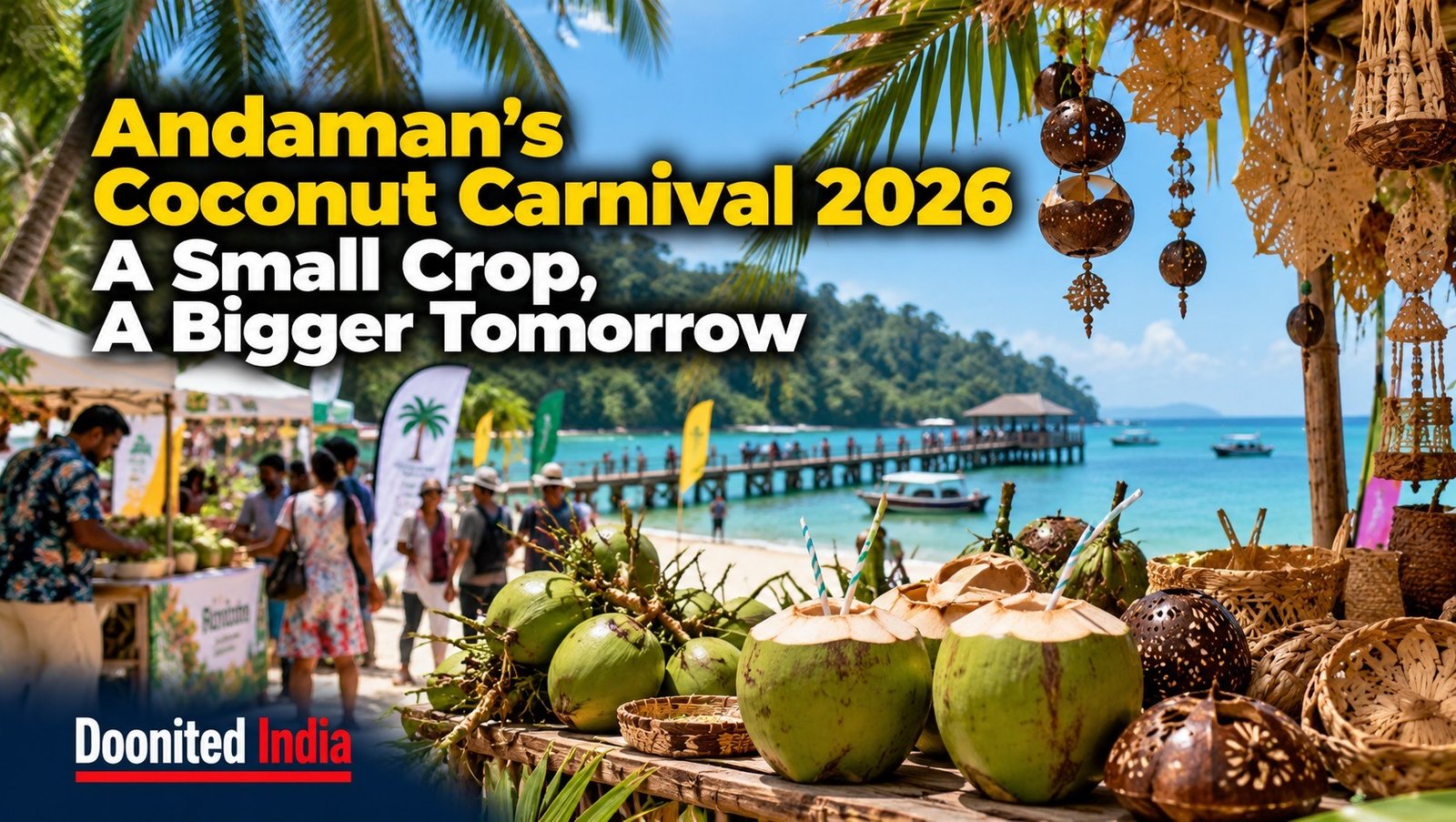
At the Islands Coconut Carnival in Sri Vijaya Puram on October 17–18, the humble coconut will appear as food, craft, product and cultural symbol. But behind the celebration lies a bigger question: can an island crop create a sustainable chain linking farmers, small businesses and tourism?
On an island, almost nothing is as ordinary — or as useful — as a coconut.
It can become a drink on a hot afternoon, an ingredient in a kitchen, oil in a bottle, fibre in a handicraft and an object that quietly carries the visual identity of the tropics.
That versatility is precisely what makes the Islands Coconut Carnival interesting.
Scheduled for October 17–18, 2026, in Sri Vijaya Puram, Andaman and Nicobar Islands, the event is designed around coconut-based food, products, cultural performances and interactive activities. The official Incredible India listing presents it as an opportunity to experience island heritage through coconut and the traditions of island communities. (incredibleindia.gov.in)
A conventional festival story would stop there.
A more useful question begins with the coconut itself:
What happens to the value of a coconut after it leaves the tree?
If the answer is simply “it is sold”, the economic story is fairly short.
If the answer includes food processing, packaging, handicrafts, tourism experiences, local retail and new products, the story becomes considerably more interesting.
From tree to tourism
Agricultural products rarely become tourism attractions simply because they are locally grown.
Something has to happen between the farm and the visitor.
A crop has to acquire a story.
A product has to become something a traveller can taste, buy, photograph or take home.
The Coconut Carnival is attempting to create that bridge.
Incredible India specifically highlights coconut-based delicacies, eco-friendly products, cultural performances and interactive activities as part of the experience. (incredibleindia.gov.in)
That combination is significant.
The coconut is not being presented only as an agricultural commodity.
It is being presented as a cultural and commercial ecosystem.
The question is whether that ecosystem can survive beyond the two-day event.
The first link: the farmer
Every coconut tourism story should begin with the grower.
That sounds obvious, but festivals often place the finished product in the spotlight while making the agricultural supply chain almost invisible.
The most important questions are therefore upstream.
Who grows the coconuts?
How large are the holdings?
How much production is sold locally?
How much is processed?
Who buys from farmers?
How much does the grower earn compared with the final retail value of a packaged product?
Those numbers would reveal whether the coconut carnival is genuinely strengthening the agricultural economy or simply creating another retail occasion.
At present, publicly available event material does not provide enough verified evidence to quantify the carnival’s impact on farmer income.
That gap should not be filled with optimistic assumptions.
It should become part of the reporting.
The second link: the kitchen
The easiest way to understand the versatility of coconut is to eat it.
Across Indian coastal and island cuisines, coconut can appear in curries, chutneys, sweets, beverages and desserts.
The Andaman and Nicobar Islands add another layer: the food culture of the islands has developed through communities with different regional backgrounds, alongside ingredients available in the tropical environment.
At the carnival, coconut-based food can therefore function as more than refreshment.
It becomes a form of cultural interpretation.
A visitor tasting a local preparation is not merely buying food.
They are being introduced to a relationship between the island, its ingredients and its people.
This is where food tourism can work particularly well.
The product has an immediate sensory quality, while the story provides the context.
The third link: the coconut that nobody eats
The economic potential of coconut does not end with the edible portion.
Coconut husk and fibre can become raw materials for products such as coir-based goods, while shells can be used in handicrafts and decorative objects.
This is where the sustainability narrative becomes particularly interesting.
A coconut economy can potentially extract value from multiple parts of the crop rather than relying entirely on the sale of fresh nuts.
But there is an important distinction.
“Can be used” is not the same as “is being commercially used at scale.”
The carnival’s presentation of eco-friendly coconut products may demonstrate possibilities, but a serious economic assessment would need to establish production volumes, business turnover, employment and actual demand.
Otherwise, sustainability risks becoming another attractive word printed on a festival banner.
The tourist changes the value of the product
A coconut sold at the farm gate is one product.
A coconut-based food experience purchased by a tourist can represent a different economic proposition.
The visitor is paying not only for the ingredient but also for preparation, presentation, location and experience.
That is the basic logic behind food tourism.
The Andaman and Nicobar Islands already possess a powerful tourism advantage: visitors arrive looking for something they cannot experience in exactly the same way at home.
The coconut can become part of that identity.
Imagine the chain:
Coconut farm → local processor → food or craft producer → tourism outlet → visitor → retail purchase → repeat demand.
Every additional step can create value.
But every additional step can also create cost.
Packaging costs money.
Transport across islands costs money.
Storage matters.
Tourist demand is seasonal.
Small producers may struggle to meet sudden large orders.
That is why the existence of a festival alone does not prove that a sustainable value chain has been created.
The real opportunity may be the souvenir
There is a useful distinction between a tourist who consumes something and a tourist who carries the experience home.
A fresh coconut is consumed on the spot.
A packaged coconut product can travel.
A shell craft can travel.
Coconut oil, food products, decorative goods or other shelf-stable products can potentially extend the economic relationship beyond the visitor’s stay.
This matters enormously for island economies.
The tourist leaves.
The product can continue travelling.
That is where branding becomes important.
If a visitor remembers the product’s name, knows where it came from and can find it online later, a two-day festival can potentially generate demand weeks or months afterwards.
Without that connection, the sale ends at the airport.
Can the carnival create small businesses rather than just stalls?
This may be the most important question for 2026.
A successful carnival can produce crowded stalls.
A successful economic programme should produce repeat businesses.
The difference is substantial.
For each participating producer, a serious follow-up should ask:
- Did sales increase during the carnival?
- How many customers bought for the first time?
- Did customers reorder later?
- Did any retailer or hotel approach the producer?
- Did online enquiries increase?
- What percentage of the product is locally sourced?
- Did production increase after the event?
- Were additional workers needed?
- What is the producer’s approximate margin after packaging and transport?
- Can the business supply tourists throughout the year?
These questions would turn a colourful festival report into original economic journalism.
Tourism can help — but it can also distort
There is another side to the story.
When a local product becomes a tourism symbol, there is pressure to make it visually attractive, easily packaged and instantly understandable to outsiders.
That can be commercially useful.
But cultural simplification can follow.
An island’s food traditions are more complicated than a coconut-themed souvenir.
The same applies to communities.
The Andaman and Nicobar Islands are not culturally uniform, and their indigenous communities must not be casually incorporated into tourism marketing without respecting their distinct identities, rights and protections.
This is especially important in an island territory where tourism development intersects with sensitive ecological and social environments.
The best coconut tourism story should therefore not be:
“Everything here is coconut.”
It should be:
“Here is how a local resource connects people, place and enterprise — and here are the limits.”
The ecological question cannot be ignored
There is an obvious irony in building a tourism economy around an agricultural crop in an environmentally sensitive island territory.
More visitors can mean more demand.
More demand can mean more production.
More production can mean more packaging, transportation and waste.
If the carnival promotes “eco-friendly” coconut products, the environmental claim should therefore be examined across the complete life cycle.
Is the product genuinely reducing waste?
Is packaging recyclable?
How far has the product travelled?
What happens after the tourist throws the packaging away?
Does the business rely on imported materials despite having a locally sourced headline ingredient?
These are not attempts to spoil the festival.
They are the questions that determine whether sustainability is real.
Why one coconut matters to the global reader
At first glance, a coconut carnival in the Andaman and Nicobar Islands may seem like a very local story.
It is not.
Across the world, rural and island economies are asking the same question:
How can a local agricultural product create more value without losing its identity or damaging the environment that produces it?
Coffee regions have built tourism around plantations.
Cheese has become a destination story in parts of Europe.
Olive oil has become both an agricultural product and a cultural experience around the Mediterranean.
Cocoa connects farms to chocolate tourism.
The Andaman coconut has the ingredients for a smaller-scale version of the same idea.
But it must be built carefully.
Tourism should not simply extract the story from the farmer.
The farmer should have a place in the value chain.
The two-day test
The Islands Coconut Carnival will last only two days.
The economic question lasts much longer.
A successful event may introduce visitors to products they had never seen.
It may give small producers a marketplace.
It may help local entrepreneurs experiment with packaging and branding.
It may connect food, craft and tourism in a single public space.
All of those are useful outcomes.
But the strongest measure will come later.
If a visitor returns home and orders the same coconut product online, the story has continued.
If a hotel begins buying from a local producer, it has continued.
If a farmer receives stronger and more predictable demand, it has continued.
If a young entrepreneur sees a future in processing a local crop instead of simply selling raw produce, it has continued.
That is the real test.
Beyond the carnival
The coconut is sometimes treated as a cliché of tropical tourism.
The Andaman Islands offer an opportunity to make it something more serious.
A coconut can be a crop.
It can be food.
It can be fibre.
It can be craft material.
It can be a souvenir.
And, potentially, it can become the starting point of a local value chain connecting agriculture with tourism.
But that possibility should not be confused with proof.
The 2026 Islands Coconut Carnival can showcase the idea.
Only farmers, entrepreneurs, consumers and tourists will determine whether the idea survives beyond the festival.
Perhaps that is the most interesting story hidden inside the coconut.
It does not need to become a global commodity to be valuable.
It needs to become more valuable to the people who grow, process, make, sell and explain it.
The carnival can provide the stage.
The island economy has to write the next chapter.


World Beyond the News
Why Elephants Stay Close to Their Herd
Elephants live in highly social family groups and use calls, touch and body movements to maintain strong bonds.
Most of the Deep Ocean Remains Difficult to Explore
Extreme pressure, darkness and distance make deep-ocean exploration one of Earth’s greatest scientific challenges.
Spacecraft Can Travel Without Traditional Roads
Spacecraft use carefully calculated trajectories and gravity assists to travel enormous distances through space.
Why Movie Trailers Are Released in Stages
Major films often use teaser trailers, full trailers and final promotional spots to build awareness over time.