From TAPAS to the Stratosphere: India’s Next Frontier in Long-Endurance Flight
DRDO’s experimental high-altitude airship reached 21 kilometres during an October 2026 trial, marking progress towards persistent surveillance and communications from the stratosphere. The achievement complements—but does not resolve—the challenges exposed by the TAPAS-BH-201 drone programme. Together, the projects show why India’s next aerospace breakthroughs will depend not only on flying higher, but on staying airborne longer, carrying useful equipment and turning successful trials into dependable operational systems.
At 21 kilometres above sea level, the atmosphere is thin, temperatures are severe and conventional aircraft face very different operating conditions from those encountered at ordinary flight altitudes. Yet this is the region in which India’s defence researchers are seeking new ways to observe, communicate and maintain a presence above the ground for extended periods.
On October 6, 2026, the Defence Research and Development Organisation (DRDO) announced a successful flight trial of an indigenous High-Altitude Platform System (HAPS). Developed by the Aerial Delivery Research and Development Establishment (ADRDE) in Agra, the lighter-than-air platform reached an altitude of 21 kilometres and remained at 20 kilometres for more than 30 minutes before being commanded to descend. It was recovered successfully, and its flight data was analysed. The trial also demonstrated the collection of real-time video and vehicle parameters at a ground control station.
Its importance lies in validating an early stage of a difficult engineering objective: developing an indigenous platform capable of operating in the stratosphere, where future systems could support surveillance, communications relay and other applications.
The trial also invites comparison with DRDO’s TAPAS-BH-201, an unmanned aircraft designed for medium-altitude, long-endurance missions. The two programmes pursue different flight regimes and use different approaches. Together, they illustrate the range of engineering challenges India must address if it wants to develop persistent aerial capabilities.
TAPAS: the lesson is endurance, not altitude alone
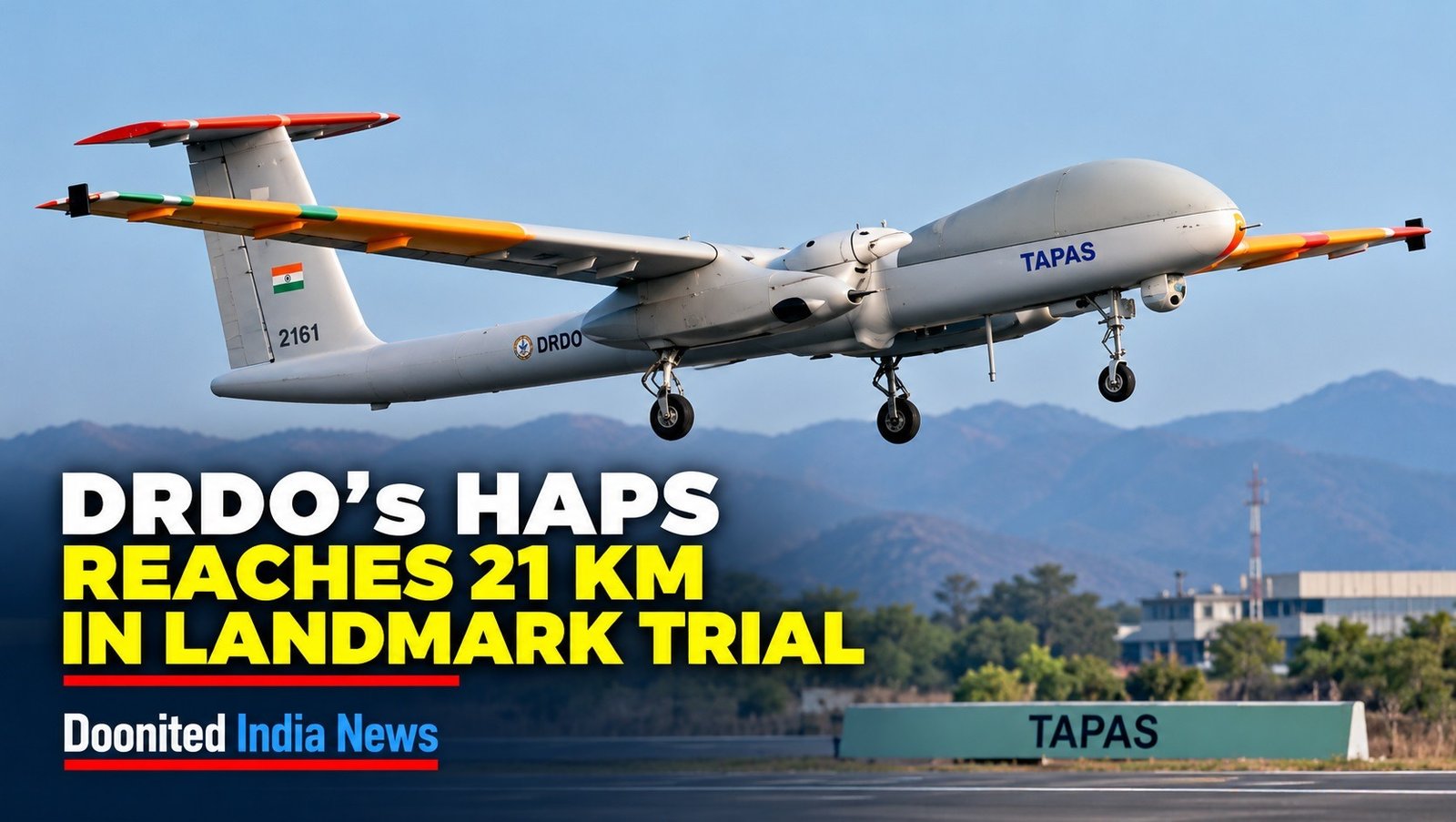
TAPAS-BH-201—originally known as Rustom-II—is a DRDO-developed medium-altitude, long-endurance unmanned aerial vehicle intended for intelligence, surveillance, target acquisition and reconnaissance missions.
DRDO has described the aircraft as capable of operating at altitudes of up to 28,000 feet and carrying payloads of up to 350 kilograms, with an intended endurance exceeding 18 hours. The programme has also demonstrated capabilities including autonomous take-off and landing and the transfer of command and control between a ground station and a naval vessel. In June 2023, a demonstration involved transferring control to INS Subhadra while the aircraft operated at 20,000 feet.
Independent defence reporting has documented performance shortfalls against some of the original requirements, including operational ceiling and endurance. That history makes TAPAS a useful reminder that an aircraft can demonstrate important technologies without automatically meeting all the requirements expected by its intended users.
Why the stratosphere offers a different kind of advantage
The new HAPS platform is not simply a higher-flying version of TAPAS. DRDO describes it as a lighter-than-air system, designed as a long-endurance stratospheric aerial surveillance platform. Its engineering challenges therefore differ from those of a conventional powered aircraft.
The stratosphere offers a potential operating zone above most weather and commercial aviation activity. A platform that can remain there reliably could provide a persistent vantage point for observing large areas or relaying communications. Unlike an orbital satellite, it could potentially be recovered, serviced and redeployed, depending on its eventual design and operating arrangements.
That does not make it a substitute for satellites or conventional aircraft. Each has different advantages. Satellites can cover vast areas and support global services, but their orbits and revisit patterns constrain some observation tasks. Conventional aircraft can respond flexibly but require fuel, maintenance and regular recovery. A high-altitude platform could fill part of the space between these systems—if it can remain on station economically and safely.
The latest trial established that the experimental system could reach the target altitude, maintain 20 kilometres for more than 30 minutes, collect data and return for recovery. It did not establish the duration of future operational missions, payload capacity, cost per hour, coverage area or readiness for deployment. Those remain important questions for subsequent testing.
The technologies that determine whether flight becomes persistence
Long-duration aerial operation depends on several engineering disciplines working together.
Propulsion and energy: Conventional aircraft need engines that can deliver adequate power in thinner air. Stratospheric platforms require an energy strategy suited to their design, including efficient propulsion or buoyancy management where applicable.
Lightweight structures: Every additional kilogram can affect endurance or useful payload. Structural strength, material durability and weight must be balanced carefully.
Thermal and environmental performance: Equipment must tolerate low temperatures, changes in solar heating and the conditions encountered during ascent, operation and descent.
Autonomy and communications: A platform must monitor its own state, maintain reliable control links and respond safely when communication is interrupted or conditions change.
Useful payloads: A successful flight is only part of the mission. Sensors, communications equipment and onboard electronics must deliver reliable data that operators can use.
India has also been developing domestic propulsion capabilities relevant to unmanned aviation. DRDO’s Vehicles Research and Development Establishment, for example, lists an indigenous 180-horsepower diesel engine for UAV applications. DRDO says the engine has undergone testing for power, thrust and fuel consumption, with high-altitude performance testing reported up to 17,664 feet at Leh and Changla.
Where the technology could be useful
If subsequent development succeeds, high-altitude platforms could support several applications:
Surveillance and disaster response: Persistent observation could assist monitoring of remote terrain, floods, forest fires or other events where ground access is difficult. Military uses would require additional operational validation and appropriate authorisation.
Communications: A platform positioned above a wide area could potentially relay communications to locations with limited terrestrial coverage. Actual capacity and coverage would depend on the payload, network design and operating altitude.
Scientific observation: High-altitude systems could carry instruments to study atmospheric conditions and collect environmental data, subject to the design and permissions of the mission.
These are potential applications rather than confirmed operational services from the experimental DRDO platform. The public information released about the October trial does not establish that it has been configured for all these roles.
From a successful test to a dependable Indian capability
India’s aerospace ambitions will be judged not only by the altitude reached during a demonstration, but by what follows. Repeated flights, longer endurance, useful payload performance, safe recovery, maintainability and credible production plans will determine whether the technology can move from research into service.
TAPAS demonstrates why this transition can be difficult: an aircraft may show meaningful capabilities while still falling short of its intended operational benchmarks. The stratospheric HAPS trial is an early milestone, not an exemption from the same discipline of testing and evaluation.
The two programmes also show why indigenous technology should be measured by capability rather than slogans. Domestic development can improve control over design, supply chains and future upgrades, but it must ultimately deliver reliable performance at an acceptable cost.
India has demonstrated a promising step towards stratospheric flight. The next challenge is persistence: proving that the platform can remain useful for longer periods, carry mission-relevant equipment and operate reliably enough to justify deployment. In aerospace engineering, reaching the destination is impressive. Building a system that can return, fly again and deliver consistent results is what makes the breakthrough matter.


World Beyond the News
Why Elephants Stay Close to Their Herd
Elephants live in highly social family groups and use calls, touch and body movements to maintain strong bonds.
Most of the Deep Ocean Remains Difficult to Explore
Extreme pressure, darkness and distance make deep-ocean exploration one of Earth’s greatest scientific challenges.
Spacecraft Can Travel Without Traditional Roads
Spacecraft use carefully calculated trajectories and gravity assists to travel enormous distances through space.
Why Movie Trailers Are Released in Stages
Major films often use teaser trailers, full trailers and final promotional spots to build awareness over time.